


Pharmaceutical marketing powerpoint presentation slides




Try Before you Buy Download Free Sample Product
 Impress Your
 Audience
 100%
100% Editable
 Save Hours
 of Time


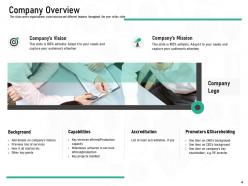
Introducing Pharmaceutical Marketing PowerPoint Presentation Slides. The presentation contains various templates describing company overview, product introduction, product launch planning, product positioning, pre-launch activities, branded/non branded message development, lifecycle management, clinical development strategy, gap analysis, pre-launch strategy, pharmaceutical marketing strategies and tactics, post-launch strategy, drug feedback survey, key performance indicators, etc. The pharmaceutical sales PPT presentation aptly discusses the vision, mission, and different features of the organization. Discuss the drug development process with the help of our readily available pharma marketing PPT slideshow. Discuss the parameters and maximum value of the salts included in the drug. Present product launch planning and product positioning with the help of this easy-to-use pharmaceutical management PPT slide deck. Also, demonstrate the pre-launch and post-launch strategies of pharmaceutical products. Also cover the gap analysis of the drug development process with objective, current situation, desired outcomes.
People who downloaded this PowerPoint presentation also viewed the following :
Content of this Powerpoint Presentation
From the conceptual idea of a molecule as a suitable fit as medicine for a particular human disease to its launch in the market, it is a long journey. In the best-case scenario, an effective drug from a major pharma company takes over ten years, usually 15. It also involves a total expenditure of over $1.5 billion over this time period, including the abandoned projects.
Pharmaceutical marketing deserves a multi-faceted look for businesses to showcase their uniqueness in a competition-ridden world. Understand it through this complete deck from SlideTeam.
Hence, pharmaceutical marketing is not for the faint-hearted. It requires knowledge of marketing, the science of drug discovery and development, and the capacity to take feedback.
Marketing plans for pharmaceutical industries are important in ensuring that pharmaceutical companies can progress and grow at a rapid pace. Find best-in-class pharmaceutical marketing company plans here.
Even as we understand it, the majority of stakeholders do not understand the basic mechanics of pharmaceutical manufacturing, especially when medicines are priced to recover all of these costs.
To ensure the business gets its point of view across is hard, but with SlideTeam, it becomes a lot easier. We provide ready-to-use PPT templates that explain and elaborate on pharmaceutical manufacturing for the lay audience and business-minded folks. The aim is to resolve the major pain point of the pharma business of communicating the effort made in drug discovery and that this can only be done with public and government support. We also showcase the steps in pharma manufacturing and the rigor involved in scientific manufacturing.
Let’s explore the PPTs now!
Template 1 Drug Development Process in Pharma Manufacturing

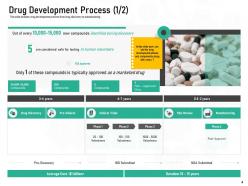
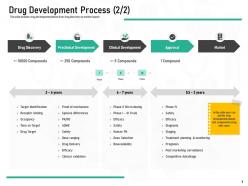
Get a hang of going from drug discovery to manufacturing. Use this slide to illustrate the five phases of drug discovery: pre-clinical and clinical trials, FDA review, and manufacturing. The PPT Template illustrates the timeline of each stage and the number of volunteers required. The numbers-oriented nature also depicts that 1 of roughly 15,000 compounds gets clearance from the FDA as an approved drug.
Template 2 Drug Components and Usage in Pharma Manufacturing

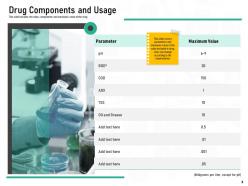
This slide includes the salts, components, parameters, and maximum value of the drug that is safe for human consumption. Users can change their dosage according to their requirements. The slide aims to educate the audience on the importance of a drug but cautions against overuse or irresponsible medicine consumption.
Template 3 Product Launch Planning for Pharma Companies

Drug launch preparations start as soon as Phase III clinical trials for the drug begin. This slide showcases drug launch plans in a 24-month timeline form. Users can change the data according to their unique requirements. The action plan has to be ready for at least six areas, such as market development, trade and distribution, regulatory preparation, and regulatory review.
Template 4 Product Positioning for Pharma Companies

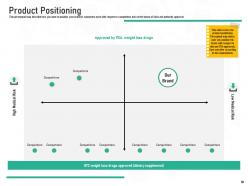
This perceptual map describes how you want to position your brand in customers' minds and hearts with respect to competitors and based on risk and authority approval. Remember that the chosen criteria can be your own, but then the competitors' and customers' perceptions of your brand will also change. For instance, price and effectiveness can be two criteria customers may want most from a medicine or drug. Remember, it is a perceptual map based on the customer's view and might or might not be true in reality.
Template 5 Pre-launch Activities for Pharma Makers

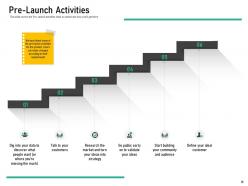
This PPT Template provides you with one of the most important activities that will set the foundation for success in the pharmaceutical industry. Define your ideal customer to the last detail is the one tip you should take to heart from this slide covering pre-launch activities. Then, the business must study data to discover what people want (or where you’re missing the mark). Talk to your customers. Research the market and turn your ideas into strategy. Going public early on to validate your ideas is another key tip.
Template 6 Gap Analysis PPT

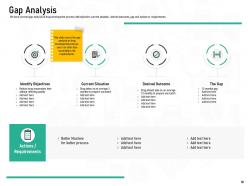
In this PPT Template, we present the complete gap analysis process of the drug development process. The idea is to give the user the real gap in the current situation that needs to be corrected, in view of the objectives the pharma business wants to accomplish. The slide also discusses the actions or requirements needed to achieve that objective.
Template 7 Clinical Development Strategy for Pharma Success

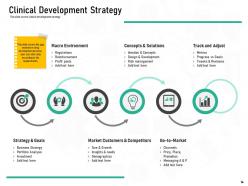
Using this slide, we inform the user of the gap analysis in the
drug development process, where the aim is to ensure data is easily moldable according to requirements. The slide also lists the five major inputs that are necessary for a clear go-to-market strategy to develop. Each of the inputs also has actionable steps attached. What are these? Please download it to find out.
Template 8 Lifecycle Management in Pharma

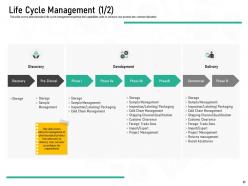
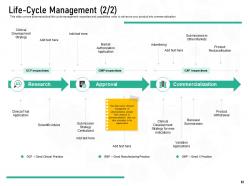
The PPT Template depicts how pharmaceutical life cycle management expertise and capabilities unite to advance your product into commercialization. The three Ds of Discovery, Development, and Delivery are also illustrated, with the complete product lifecycle displayed across 8 stages from storage to import/export.
Template 9 Pharmaceutical Marketing Strategy and Tactics

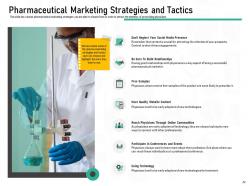
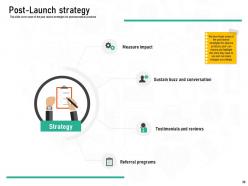
Use this PPT Template to depict pharmaceutical marketing strategies you are able to choose from to attract the attention of prescribing physicians. Some of the hugely popular ones are listed on the slide. These are free samples, social media presence, reaching physicians through online communities, and ensuring your website content is of high quality. The slide also reiterates the importance of participating in conferences and events.
Template 10 Drug Feedback Summary PPT Template

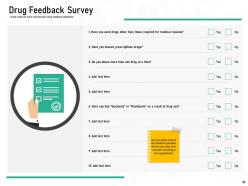
After the clinical trials, there is the requirement to ask questions related to new drug feedback. These include asking the user questions that end in Yes or NO, such as whether you have used drugs other than those required for medical reasons, and so on. The aim is to ensure no effect of the drug is left unaccounted for or ignored.
Template 11 Post-launch Gap Analysis

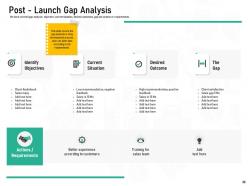
After the launch or post-launch is another important determiner of the marketing effectiveness of a pharmaceutical company. This PPT Template showcases how, at this stage, executives have to move in quickly to tabulate customer experience and provide better deals and better products to them. Training for the sales team is an important input for this post-launch gap analysis. The slide also covers
the gap analysis objective, current situation, desired outcomes, gap, and actions or requirements. Get the template now!
MARKET IS THE KING
In the pharmaceutical business, the market is indeed the king, even as the customer and the healthcare ecosystem are the key inputs. Master pharma marketing with our templates and showcase your ability to generate returns over a long time period and also withstand the tortuous wait for the first revenue to roll in.
Get a world-class flowchart template on generic drug marketing strategy to promote products and services with a click here.
Pharmaceutical marketing powerpoint presentation slides with all 40 slides:
Use our Pharmaceutical Marketing Powerpoint Presentation Slides to effectively help you save your valuable time. They are readymade to fit into any presentation structure.







FAQs for Pharmaceutical marketing
Ugh, FDA regs are the worst part honestly. Getting promotional claims approved is a nightmare, and don't even get me started on medical-legal reviews - they take forever. Digital ad rules change constantly too, which is super annoying. Off-label promotion stuff will trip you up if you're not careful. Plus fair balance requirements across every channel... it's a lot. Oh and adverse event reporting - can't forget that mess. My biggest tip? Make friends with your regulatory people ASAP. Like, buy them coffee. And always add extra weeks to your timeline because compliance reviews drag on way longer than you think.
So digital pharma marketing is way more precise than the old school stuff. You can actually target doctors based on their specialty and prescribing habits instead of just throwing ads at everyone. Real-time compliance monitoring is huge now - no more waiting around for print approvals. The coolest part? You get instant feedback on what's working. Traditional journal ads took forever to show results. Plus you can have actual conversations through webinars and social media rather than just shouting into the void. Honestly, I'd start by checking your compliance processes first - that's where most companies screw up.
Dude, patient stories are gold in pharma marketing. They turn boring clinical data into something doctors can actually connect with - way more powerful than just throwing numbers around. Conference presentations, sales decks, you name it. Just heads up though, the compliance stuff is a total nightmare compared to other industries. Tons of approval hoops to jump through. For rare diseases especially, these case studies are clutch since most docs have barely seen these conditions. My advice? Always bug your team about finding good patient stories to back up your clinical evidence. Makes everything way more compelling.
Skip the pushy sales stuff - educational content is where it's at. Disease awareness, patient stories, health tips that actually help people. LinkedIn's your best bet for doctors, Facebook and Instagram work better for patients. Oh and heads up, the FDA literally watches everything pharma posts (learned that the hard way), so legal review is non-negotiable. Honestly, being genuinely useful beats being salesy every time. Figure out where your audience hangs out online first, then create stuff they'd actually want to read. It's pretty straightforward once you get the hang of it.
Look, patient safety has to come first - no exceptions. Present the real deal: benefits AND risks, don't cherry-pick data to make your drug seem amazing. The FDA will absolutely wreck you for misleading efficacy claims or hiding serious side effects. Different audiences need different approaches too. Consumer ads vs. doctor materials? Totally different ethical rules. Honestly, I always think about whether I'd be okay with my mom seeing this kind of marketing for her meds. If it feels sketchy for family, it's probably sketchy period.
So basically, analytics lets you get way more specific with targeting than just looking at basic demographics. Instead of that old shotgun approach, you can actually figure out which doctors are most likely to prescribe what you're selling and when they're actually paying attention. Plus you can track which channels are worth your money - honestly, some of the data patterns are pretty surprising. The real magic happens when you combine prescription records with engagement stuff and behavioral data. Makes your campaigns way more targeted and actually moves prescribing habits instead of just burning budget.
Look, educating physicians is honestly your best bet for pharma marketing. Forget the pushy sales stuff - when docs actually understand your drug's mechanisms and data, they become real advocates instead of just rolling their eyes at you. I've seen companies waste tons on fancy brochures when they should've invested in solid educational content and peer-to-peer programs. The results speak for themselves: better adoption rates, smarter prescribing, and way stronger relationships. It's basically relationship building disguised as education, and it works so much better than traditional pitches.
Honestly, you've gotta be super transparent first - like share your trial data, explain how everything actually works, don't hide the messy stuff about side effects or costs. Third-party validation is huge here. Partner with legit patient groups and doctors who can back you up, because nobody trusts what pharma companies say directly anymore (and honestly, can you blame them?). Dump money into real educational content that doesn't scream "marketing." Disease awareness stuff, funding research. The whole point is showing you actually care about helping people, not just making bank. Start by figuring out where you're being sketchy in your current messaging.
Honestly? Your reputation is everything in pharma. The FDA doesn't mess around - they're watching constantly, and misleading info means huge fines and legal headaches. Doctors are way more skeptical these days too (can't blame them). Being upfront about clinical data, side effects, all the messy details? That's how you actually build trust with healthcare providers. They want to work with companies that give them straight answers. Oh, and always over-disclose rather than hiding stuff - learned that one the hard way from watching other companies get burned.
Honestly, personalized medicine is where everything's headed now. Companies are ditching those generic campaigns for stuff that's actually tailored to genetic profiles and patient data. COVID basically fast-tracked the whole digital thing too - social media partnerships, telehealth integrations, all that. AI's getting pretty good at predicting which doctors to target. There's also this big swing toward patient advocacy in campaigns, which makes sense I guess. Oh, and real-world evidence is huge now. My take? You should mess around with omnichannel stuff because that old-school rep model isn't cutting it anymore. Younger doctors especially don't respond to it the same way.
Ugh, global regs are such a pain - you basically have to start from scratch for every region. Europe's way more strict than the US with DTC ads. Different countries want totally different approval processes, and some just ban certain promo materials completely. The clinical data presentation rules? Super specific and annoying. Honestly though, don't even try adapting one campaign globally - I learned that the hard way. Build separate strategies for each market instead. Oh, and map out your priority markets' regulatory stuff first before you do anything else.
Pharma influencers are everywhere these days and honestly, they work really well. People trust patient advocates and healthcare pros sharing their actual experiences way more than boring traditional ads. It makes conditions feel less scary and more relatable, you know? Mental health campaigns especially benefit from this approach. Lifestyle influencers are getting in on it too - they're great at breaking down stigma around chronic diseases. Just heads up though, FDA disclosure rules are super strict for pharma partnerships. Your team better know those guidelines backward and forward or you'll be in trouble fast.
Honestly, market research is like having a GPS instead of just winging it with your pharma campaigns. You'll actually know which doctors have real influence over prescribing decisions and what pain points patients face. Plus you can figure out which channels they trust most - which matters more than people think. I've watched so many campaigns crash because teams made assumptions instead of just asking. The data helps you nail messaging around what docs actually care about. Like, do they prioritize efficacy stats or worry more about side effects for that specific condition? Map out your key players first, then survey them about their biggest headaches before you build anything.
So DTC ads let drug companies skip doctors and pitch straight to patients. Good news? People discover treatments they never knew existed and actually talk to their doctors about stuff. I've seen it work pretty well for awareness. But here's the thing - patients start demanding pricey brand names when the generic does the same job. Plus you get folks basically diagnosing themselves from TV commercials, which... yikes. If you're doing DTC work, just focus on education without being too pushy about it. Balance is key.
Track prescription lift and market share changes first - that's your real money data. HCP engagement rates matter too. Digital stuff like email opens and web traffic can help, but honestly half of that is just fluff if docs aren't actually changing behavior. The trick is connecting your campaign directly to what physicians do differently. Attribution tracking from day one is huge. Oh, and run some brand awareness surveys periodically - I always forget about those but they're actually useful. Just make sure you know your starting numbers before you launch anything.
-
Good research work and creative work done on every template.
-
Good research work and creative work done on every template.
-
Attractive design and informative presentation.
-
Innovative and attractive designs.
-
The Designed Graphic are very professional and classic.
-
Very well designed and informative templates.