

 0 Comment
 Customer Reviews

One of the most high-stakes events a pharmaceutical business experiences is introducing a new medicine. With about one-third of all new medications failing to fulfill their first-year sales estimates (EvaluatePharma, 2023), the need for a carefully developed launch strategy cannot be underlined. A strong launch strategy can make all the difference between a bestseller and a billion-dollar flop in the very competitive market of today, when the FDA approves more than 50 new treatments yearly.
Access our “Must-have Pharmaceutical Product Launch Plan Templates with Samples and Examples” by clicking on the link provided.
Still, developing the ideal launch plan is more of an artistic than a scientific process. From the remarkable success of Keytruda's market launch, which used strategic oncology partnerships and an aggressive real-world evidence campaign, to the cautionary tale of Exubera, Pfizer's inhalable insulin that fizzled due to inadequate market education, the pharmaceutical world is loaded with lessons about what works—and what doesn't. From creative pricing strategies to digital-first HCP involvement to patient-centric promotions to strategic alliances, the script for a successful launch has changed dramatically in recent years.
Having access to tested Drug Launch Strategy Templates—tried across therapeutic areas, geographies, and patient populations—is therefore priceless. Templates provide a disciplined yet adaptable basis for teams negotiating challenging regulatory contexts, stakeholder interactions, and fast technology developments without rethinking the wheel. Consider them as blueprints optimized over years of real-world triumphs (and mistakes), meant to hasten implementation and reduce risk by means of acceleration.
To equip your team with the resources required to produce outstanding results, we have compiled the Top 10 Drug Launch Strategy Templates in this book together with real-world examples and customizable templates. These templates are designed to handle important aspects such as market access strategy, medical affairs coordination, digital multichannel engagement, and post-launch lifeline planning whether your project is ready to introduce a biosimilar, a cutting-edge gene therapy, or a new small drug.
Let's explore the Top 10 templates to enable your next medicine release to become a market-defining success narrative.
Get your hands on our “Top 10 Launch Strategy Templates With Examples And Samples” by clicking on the link provided.
Template 1: Drug Launch Strategy PPT Template Bundles
Twenty-one ordered structured slides in this template bundle are meant to support medication launch planning and execution. It offers top-notch material emphasizing interesting buyer personas, increasing brand awareness, and giving strategic ideas. Through disciplined images and text layouts, the template helps to clearly communicate difficult ideas. To match particular branding or presentation requirements, users can change aspects including colors, typefaces, and design components. Download now!
[product_image id=716277]
Template 2: Strategy to Achieve Successful Drug Launch
Focusing on four basic areas, this slide describes techniques to reach a successful drug launch. It underlines the need of assembling a capable launch team with sales, marketing, and product development experience. It directs the development of a thorough launch strategy with budgets, milestones, and dates to track progress. It emphasizes working with powerful people by pointing out key opinion leaders to establish rapport and create leads. Supported by follow-up and customer assistance, it also addresses enhancing customer experience by making sure the pharmaceutical product answers patient issues. The slide format lets extra text be adjusted depending on certain requirements.

Template 3: Strategic Process to Launch Pharmaceutical Drugs
Emphasizing important stages, this slide shows the strategic approach for introducing a pharmaceutical medicine. It involves compiling information for a thorough plan encompassing study design, endpoints, and sample size from clinical trials. It describes doing three-phase trials under different settings to ascertain drug safety. The slide covers filing applications for FDA approval to seek permission for human trials and clarifies regulatory approval, whereby agencies evaluate drug safety by means of clinical trial data. Describing the process of marketing the approved drug to healthcare providers and patients, it ends with launch and commercialization. There is space for further tailored wording.

Template 4: New Drug Launch Strategic Framework
This slide offers a fresh medicine launch strategy structure including actions for product developers starting a new drug. It comprises internal analysis via resource and product portfolio review and external analysis via sector analysis and competition. It addresses technological viability, regulatory compliance, and industry factors analysis including product characteristics. Along with strengths and weaknesses, opportunities and hazards are found to assist launch decisions targeted on market, company, and product strategies. Tactical launch choices handle components of product, pricing, advertising, and distribution. New product performance is the measured ultimate result. One can customize space further for writing purposes.

Template 5: Challenges In Implementing Drug Launch Strategy
This slide highlights key challenges companies face while implementing a drug launch strategy, including regulatory frameworks, competition, marketing budget constraints, and the high cost of clinical trials. It outlines the impact of each challenge, such as delays in FDA approval, difficulty gaining market share, limited marketing reach, and impractical research trials. The slide also suggests solutions like collaborating with regulatory experts, promoting the unique selling propositions of the drug, utilizing digital platforms for marketing, and offering insurance support to patients. Space is provided for adding further text and customizing based on audience needs.

Template 6: Strategic roadmap for pharmaceutical drug promotion and launch
This presentation offers pharmaceutical businesses a strategic road plan for introducing a new medical medicine into the market. It lists three main phases—development, promotion, and launch—key actions across. Over 12 months, development activities include target patient identification, finance generation, drug testing, and clinical trials. Beginning one month before launch, promotion activities center on announcements, medical representative partnerships, and social media engagement. Setting up real stores, executing internet ads, and getting comments from consumers and doctors to improve the product post-launch constitute the launch phase. Editable text placeholders let one customize to meet particular tactics.

Template 7: Digital Approaches to Support Drug Launch Strategy
This presentation shows digital tools pharmaceutical companies could use to complement their medication introduction plans. Four primary topics—social media marketing, smartphone apps, virtual events, and artificial intelligence—are covered. Every strategy is briefly discussed with an eye toward increasing involvement, generating awareness, teaching medical professionals, and monitoring launch performance. Lists of recommended tools to help properly implement these ideas include Hootsuite, BuzzSummary, GoToWebinar, and IBM Watson. This structure enables businesses to use new technologies to simplify the drug launch process, therefore enhancing reach and impact throughout target markets. For particular campaign specifics and use scenarios, the slide is totally adaptable.

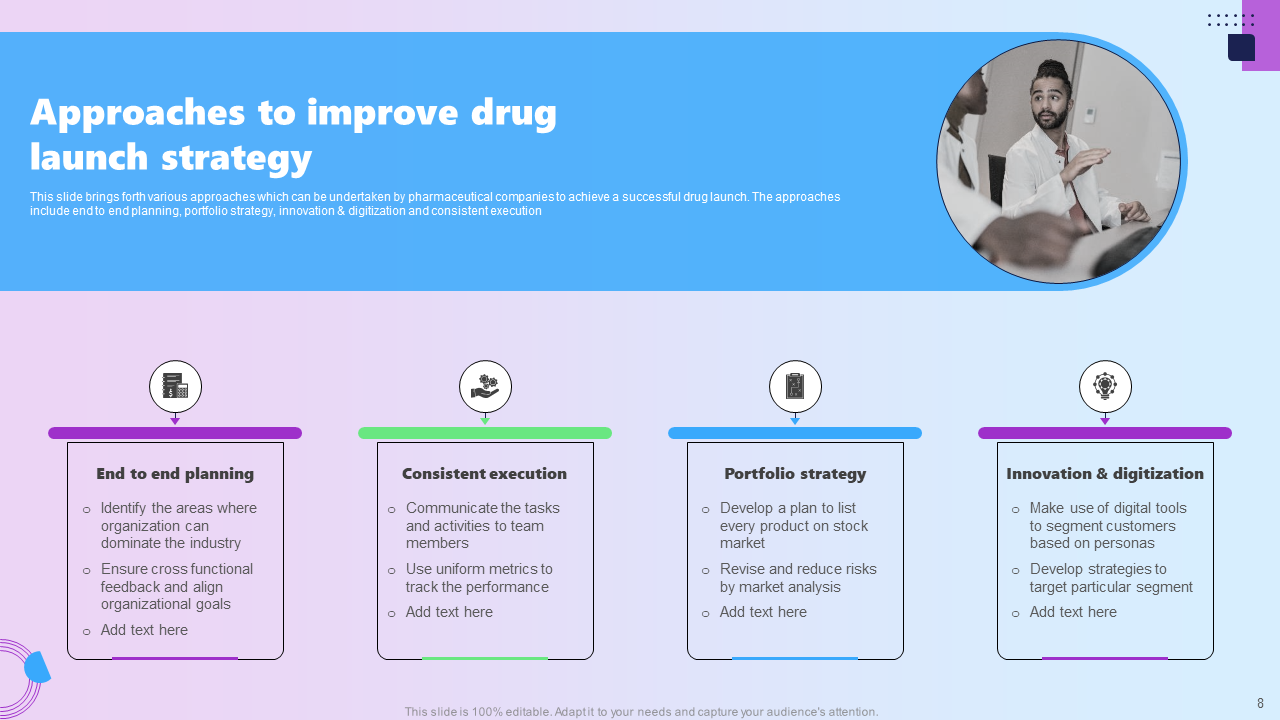
Template 8: Approaches to improve drug launch strategy
This slide presents main ideas to enhance pharmaceutical companies' medication launch plans. Four fundamental pillars—end-to--end planning, consistent execution, portfolio strategy, and innovation and digitization—are underlined. The techniques center on spotting strategic possibilities, keeping team alignment with consistent KPIs, creating strong market plans, and using digital technologies for customer segmentation. These strategies provide a coherent, data-driven launch mechanism that reduces risks and enhances market influence. For a successful and sustainable drug release, the framework exhorts businesses to match internal goals, change with the times, and inspire creativity. The material is totally flexible for certain business requirements.
Template 9: Tips to improve drug launch strategy
This presentation offers basic advice on how pharmaceutical firms may improve their medication launch plans. Understanding the target market, forging relationships with important players, employing data and analytics, leveraging digital media, and creating a thorough launch plan marks five fundamental tasks. Every action emphasizes strategic cooperation, goal-oriented execution, real-time participation, and research-based decision-making. These strategies guarantee a patient-centric, data-based strategy that maximizes market impact and promotes effective product adoption by means of support. Combining these ideas can help businesses maximize their launch strategies, increase involvement of stakeholders, and get better results in cutthroat pharmaceutical marketplaces.

Template 10: Key factors affecting drug launch strategy
Important performance indicators (KPIs) influencing a drug launch plan are compared in this slide. Six KPIs are included: leads created monthly, post-launch growth of website traffic, drug uptake rate, user retention, return on investment, and market share. The table exposes inconsistencies by contrasting industry standards with corporate performance. Negative deviations are red; positive deviations are indicated in green. While leads, adoption rate, user retention, and market share fall short, key results demonstrate website traffic and ROI above criteria. This data-driven approach helps companies to match industry standards, evaluate performance gaps, and pinpoint areas needing work.

Wrapping it Up!
Pharmaceutical teams can use this extensive reference on the Top 10 Drug Launch Strategy Templates to have organized, practical tools for handling every stage of a drug introduction. From early-stage clinical trial planning to post-launch market performance tracking, these models handle fundamental issues including market access, pricing, stakeholder interaction, digital strategy, and lifecycle management. Real-world cases show how different approaches might be modified to fit different therapeutic domains and market conditions. Clear frameworks, quantifiable KPIs, and customizable layouts in each template help teams to simplify planning, reduce risks, and match performance with industry standards for effective pharmaceutical product introductions.
Access our “Top 10 Launch Plan Templates with Examples and Samples” by clicking on the link provided.
FAQs
1. How to successfully launch a drug?
Create a thorough, fact-based launch strategy including market access, regulatory approvals, pricing, and stakeholder involvement. While always monitoring KPIs to maximize results, implement integrated promotional, digital, and medical affairs plans.
2. How to launch a new product in pharma?
Analyze markets, get licenses, and assemble a cross-functional launch team. Supported by actual data, plan omnichannel marketing, HCP education, and patient awareness efforts.
3. What factors drive drug launch success?
Important elements are market access strategy, medicine acceptance rates, involvement of stakeholders, price policies, and patient-centric projects. Tracking performance constantly against industry standards guarantees timely changes and ongoing market influence.