


Product roll out plan template good ppt example




Try Before you Buy Download Free Sample Product
 Impress Your
 Audience
 100%
100% Editable
 Save Hours
 of Time


Structure a launch campaign for your products with our product roll out plan PPT template. Thus, generate more income for your business with this product marketing plan PPT diagram. Use this timeline based product rollout roadmap PPT slide template to communicate the functions related to your product launch with in a particular timeframe. It further guides your marketing team to work in accordance to the set timeline for the new product launch. You can even define the process with this new product launch plan PPT slide design. It starts from researching about the potential product need in the market, then to stage of developing the quality products, to the stage of developing a marketing plan. Till the final stage of launching the product with the stage of evaluating its performance in the customer market. You can even describe the elements which are essential for developing a roll out plan for the new product. Such as the identifying the perfect marketing channel, and more. Thus, download it now. Convey your ideas to those in authority with our Product Roll Out Plan Template Good Ppt Example. Be able to handle the establishment.
People who downloaded this PowerPoint presentation also viewed the following :
Content of this Powerpoint Presentation
Description:
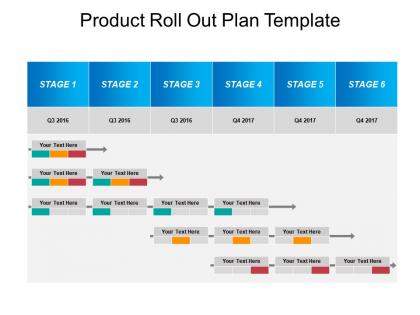
The image shows a PowerPoint slide titled "Product Roll Out Plan Template," designed to outline the stages of a product launch. The slide features a horizontal timeline broken down into six stages, each represented by a distinct column labeled from "STAGE 1" to "STAGE 6." The timeline indicates that the roll-out plan covers from Q3 2016 to Q4 2017.
Each stage has corresponding bars underneath that span across the timeline, with arrows pointing to the right, indicating the progression of tasks or milestones over time. These bars are placeholders where text can be added, providing details about what each stage involves. The text placeholders are prompts for the presenter to customize the slide with specific information about the product launch activities, such as development phases, marketing campaigns, distribution strategies, or sales goals.
Use Cases:
This product rollout plan template is a universal tool, crucial for strategic planning and execution, adaptable across various industries to streamline product launches.
1. Technology:
Use: Scheduling software release and update phases
Presenter: Product Manager
Audience: Development Team, Stakeholders
2. Pharmaceuticals:
Use: Planning clinical trials and drug release to market
Presenter: Clinical Project Lead
Audience: Research Teams, Regulatory Bodies
3. Consumer Electronics:
Use: Timing new gadget introductions and market entry
Presenter: Marketing Director
Audience: Retail Partners, Marketing Teams
4. Automotive:
Use: Staging vehicle development, testing, and launch events
Presenter: Chief Engineer
Audience: Dealerships, Press, Investors
5. Food and Beverage:
Use: Coordinating new product development, testing, and distribution
Presenter: Brand Manager
Audience: Distributors, Marketing Staff
6. Fashion and Apparel:
Use: Detailing design, production, and seasonal collection launches
Presenter: Creative Director
Audience: Retail Buyers, Fashion Show Organizers
7. Cosmetics:
Use: Outlining steps from product formulation to retail debut
Presenter: R&D Manager
Audience: Marketing Department, Retail Chains
Product roll out plan template good ppt example with all 5 slides:
Advise folks to join forces with our Product Roll Out Plan Template Good Ppt Example. Enable them to increase their influence.
FAQs for Product roll out plan template
So there are four main stages you'll want to hit. First is pre-launch - final testing, getting your team ready, all that prep work. Then soft launch where you roll out to just a small group first. Honestly this part is clutch because you'll catch bugs before they become disasters. Fix whatever comes up, gather feedback, then move to full launch with your marketing push. Last stage is monitoring how everything's performing and tracking adoption rates. Oh and definitely map out who's responsible for what at each stage - learned that one the hard way!
Look, market research basically shows you where to focus your rollout and in what order. Find the customer segments that'll jump on board first, figure out what messaging actually works, and scope out markets with the smoothest entry. Way better than just winging it, trust me. The data helps you rank regions by priority and tailor your pitch for different crowds. You'll catch potential problems before they mess up your whole timeline too. Oh, and definitely map your research to each rollout phase upfront - I've seen too many companies skip this step and end up doing expensive course corrections later.
Track user adoption first - how many people are actually signing up and using your features. Error rates and crashes are obvious must-haves. But here's what I learned the hard way: support tickets tell you way more than any fancy metric sometimes. Time-to-value is critical too since it shows when users hit that "aha moment." Customer satisfaction scores help catch weird edge cases your dashboards won't show. Daily updates work best so you can catch problems before they spiral. Oh, and don't obsess over perfect data - rough trends matter more than precise numbers initially.
Look at who gets the most value from your core features - that's your sweet spot. I'd dig into your user research and beta feedback first. Check technical readiness, business impact, and honestly? Pay attention to who's been bugging you the most about needing this. Those vocal users often make great early adopters. Don't forget implementation complexity though - you don't want to pick a segment that'll eat up all your support bandwidth. Make a simple scoring system with these factors, rank your segments, then go with whoever scores highest on value plus adoption likelihood. Just make sure you can actually support them properly once you roll out.
Dude, you absolutely need stakeholder feedback - I learned this the hard way on a project last year. Get their input early and keep asking throughout planning because they'll spot issues you totally missed. Trust me, I've watched launches completely flop when teams thought they knew what users wanted without actually asking. Their feedback helps you fix your messaging, tweak timelines, and catch problems before they blow up. Just don't ask vague stuff like "thoughts?" - be specific about what you need from them.
Skip the generic workshops - they're honestly pretty useless. Each team needs different stuff, so train your sales people on what they actually need vs what marketing needs. Make it hands-on with real scenarios they'll deal with daily. I'd pick someone from each department to be the go-to person for questions later (saves you from being bombarded). The whole thing should connect to their actual job, not just be another boring feature rundown. Oh, and definitely make it interactive - nobody retains info from sitting there listening for two hours straight.
Oh man, the classic mistakes are rushing everything and skipping tests - learned that one the hard way. Communication is huge too, like tell everyone what's happening way more than you think you need to. Set your success metrics before you start, not halfway through when things get messy. Training gets forgotten a lot, both for support people and regular users. Honestly, just build extra time into everything because stuff always takes longer. Document the process and have your backup plan ready before you launch. Buffer time is your best friend, trust me.
Dude, digital marketing is a game-changer for product launches. Start building buzz way before you actually drop the product - social media teasers, email campaigns, maybe some influencer collabs. The anticipation phase is honestly half the fun. Once you launch, SEO and content stuff keeps you visible in search results. Social listening is clutch too because you'll catch feedback instantly and can adjust if people aren't vibing with something. Oh, and definitely map out a content calendar that goes like 2-3 months past your launch date. You don't want that momentum to just die off.
Honestly, email's still your best bet - you control everything and can hit your existing customers first. Then blast it across social with different angles for each platform. LinkedIn for the professional crowd, Instagram if your product's visual, Twitter for quick buzz. Your blog's worth doing too since Google loves that stuff and it sticks around forever. Press releases? Meh, feels kinda outdated unless you're going for serious media attention. I'd probably skip that unless you've got something genuinely newsworthy. Start coordinated but don't overthink it - sometimes the scrappy approach works better than perfect timing.
Honestly, just be super upfront about timelines from the start. Tell customers exactly what the product will and won't do at launch - trust me, they'd rather know the limitations now than feel misled later. Keep them updated through emails, your site, whatever works. Share actual milestones instead of just saying "coming soon" forever. Here's the thing though - always pad your dates. Like, if you think it'll take 3 months, say 4. Delays are basically inevitable and you don't want to keep disappointing people. Way better to under-promise and actually deliver on time.
Honestly, most rollouts I've seen take about 3-6 months total. Really depends on how complex your product is though. I'd block out 4-6 weeks just for prep work, then another 2-4 weeks for the actual phased launch. Don't skip the feedback phase - that's where people always mess up. Give yourself time to actually fix what users complain about during beta. Start with your power users since they'll give you the best insights, then slowly expand from there. Oh, and always work backwards from your launch date and add like 20% extra time. Trust me on this one - something will definitely go sideways.
Honestly, just automate the boring stuff that always slows things down. I'd grab something like Monday or Asana to track everything across teams. Set up notifications so things don't get forgotten - been there, done that. Slack workflows are seriously amazing for this btw, total game changer once you get them running. Real-time analytics dashboards beat waiting around for weekly reports too. The trick is picking maybe 2-3 tools that actually work together instead of making everything more complicated. I'd start by figuring out what's eating up most of your time first.
Honestly, go with the Stage-Gate model first. It's pretty straightforward - breaks everything into phases with checkpoints where you decide whether to keep going or not. RACI matrix is clutch for figuring out who does what (trust me on this one, it prevents so many headaches). Gantt charts are perfect for tracking timing stuff. RICE framework works too if you're more into the agile thing for prioritizing features. Just don't try to use everything at once - I made that mistake before and it was a mess. Stage-Gate covers most situations you'll run into anyway.
Okay so first thing - figure out who else is hitting your markets around the same time. I always dig into their investor calls (seriously, people sleep on these but they're packed with intel). Check what they're announcing, any pricing shifts, big marketing campaigns coming up. Then think about timing. Will their stuff make yours look boring? Should you rush certain regions to beat them there? Sometimes it's smarter to wait if they're about to spam the market. Oh and whatever timeline you set, build in wiggle room. Companies say one thing and do another all the time, so you need flexibility to react to their actual moves.
First thing - get your rollback plan sorted and write down every step to revert back. Set up alerts so you catch problems fast. Communication is huge here, most teams totally bomb this part. Have talking points ready for your support folks and a plan for updating customers. Oh, and do staged rollouts where you can hit pause if the numbers look weird. Assign specific people to handle each piece beforehand. Trust me, you don't want everyone scrambling around asking "who's supposed to do what" when everything's on fire.
-
The Designed Graphic are very professional and classic.
-
Innovative and attractive designs.
-
Great experience, I would definitely use your services further.
-
Use of icon with content is very relateable, informative and appealing.