


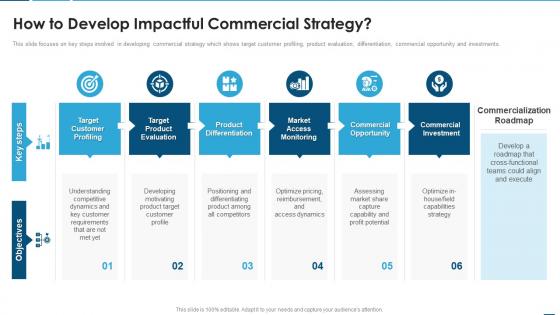
Creating product development strategy how to develop impactful commercial strategy




Try Before you Buy Download Free Sample Product
 Impress Your
 Audience
 100%
100% Editable
 Save Hours
 of Time


This slide focuses on key steps involved in developing commercial strategy which shows target customer profiling,product evaluation,differentiation,commercial opportunity and investments.
People who downloaded this PowerPoint presentation also viewed the following :
Creating product development strategy how to develop impactful commercial strategy with all 6 slides:
Use our Creating Product Development Strategy How To Develop Impactful Commercial Strategy to effectively help you save your valuable time. They are readymade to fit into any presentation structure.





FAQs for Creating product development strategy how to develop
So there's basically five stages you gotta hit: brainstorming ideas and validating them, doing your market research, design/prototyping, testing with actual users, then launch with feedback systems ready. Most teams totally rush the research part though - huge mistake IMO. You really need solid data on your market and competitors first. Actually knew a startup that skipped this and burned through 50K learning stuff they could've googled. Make sure each stage has clear goals and ways to measure success. But seriously, don't skip user testing even if you're behind schedule. Trust me, launching something half-baked will cost you way more later.
Don't wait until the end to do market research - that's a recipe for disaster. Talk to users early when you're brainstorming ideas to make sure you're actually solving a real problem. Then keep testing prototypes as you build stuff. Honestly, I've watched so many teams waste months building features that users completely ignore. It's brutal. Quick surveys and usability tests work better than those giant research projects that take forever. Set up a rhythm where you're getting feedback every couple weeks. That way you can change direction fast if something isn't working. The key is keeping it lightweight but consistent.
Dude, you absolutely need consumer feedback - like, from day one. Get people reacting to your concept early, then keep asking throughout prototyping. I've watched so many teams (myself included, honestly) get obsessed with their brilliant idea and completely ignore what users actually want. Rookie move every time. Feedback helps you figure out which features matter, fix your messaging, and sometimes realize you're solving a problem nobody has. My old coworker learned this the hard way when he spent six months building something users hated in the first five minutes. Don't be that guy.
Honestly, cross-functional teams are a game changer for product dev. Engineers catch technical issues before design gets too deep, while marketing spots user needs that slip through the cracks. Sales brings in actual customer feedback too - it's like having reality checks built in. The trick is getting people to actually work together instead of just showing up to meetings (which happens more than you'd think). Give everyone real ownership and set up regular check-ins. Oh, and figure out which departments matter most for your specific product first - don't just invite everyone.
Honestly, you need both the quick wins and long-term stuff. Track time-to-market, how much you're spending vs budget, and whether people actually use the features you build. Customer satisfaction scores matter too - plus revenue impact if you can measure it. Bug rates and team velocity are super important because they'll catch up with you later if you ignore them (learned that the hard way). The balance between short-term and strategic goals is always tough. Just pick 3-5 metrics that actually matter for your business and stick with those. Monthly reviews work well. Don't try measuring everything or you'll go crazy.
Dude, you'll love the faster feedback - no more building stuff for months only to find out users hate it. Ship small pieces regularly and pivot when needed. Daily standups actually help (I know, sounds annoying) because blockers get caught early instead of derailing everything later. We involve stakeholders constantly now instead of going radio silent for half a year. Honestly wish my old team had tried this sooner - would've saved us so much pain. Start with 2-week sprints. You'll be shocked how much clearer your priorities become once you're forced to pick what actually matters most.
Honestly, creativity and innovation need to be baked into every stage of your product development - not just tacked on at the end. During discovery, you're using creative thinking to spot real user problems. Then innovation kicks in during ideation for breakthrough solutions. Both show up again when you're prototyping and testing. Here's the thing though - you can't just hope this stuff happens naturally (it won't). Actually block out time for brainstorming sessions, deep user research, and experimentation. I learned this the hard way. Schedule creativity like you would any other meeting, otherwise it gets pushed aside.
Honestly, most people jump straight into building stuff without checking if anyone actually wants it. That's like mistake
-
Design layout is very impressive.
-
Great product with highly impressive and engaging designs.