


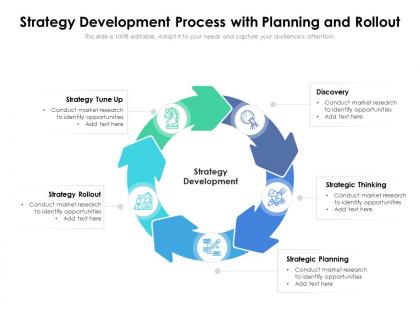
Strategy development process with planning and rollout




Try Before you Buy Download Free Sample Product
 Impress Your
 Audience
 100%
100% Editable
 Save Hours
 of Time


Our Strategy Development Process With Planning And Rollout are topically designed to provide an attractive backdrop to any subject. Use them to look like a presentation pro.
People who downloaded this PowerPoint presentation also viewed the following :
Strategy development process with planning and rollout with all 2 slides:
Use our Strategy Development Process With Planning And Rollout to effectively help you save your valuable time. They are readymade to fit into any presentation structure.
FAQs for Strategy development process with
The key stages in strategy development include environmental analysis, vision and mission formulation, strategic objective setting, strategy formulation, implementation planning, and performance monitoring. These stages work together by systematically assessing market conditions, defining organizational direction, and creating actionable frameworks, with many organizations finding that this structured approach delivers clearer decision-making, enhanced resource allocation, and ultimately sustainable competitive advantage.
Organizations ensure alignment between strategy and business goals by establishing clear objective hierarchies, implementing regular review cycles, and creating cross-functional communication channels. Through integrated planning processes, companies streamline decision-making, enhance resource allocation, and maintain strategic focus, with many finding that quarterly alignment assessments and stakeholder engagement ultimately deliver improved performance and competitive advantage.
Market analysis serves as the foundation for strategy development by identifying market opportunities, competitive threats, customer needs, industry trends, and regulatory changes. Through comprehensive market research, organizations can assess market size, customer segments, and competitor positioning, enabling data-driven strategic decisions that align resources with market realities and ultimately deliver sustainable competitive advantage.
Internal strengths and weaknesses form the foundation of strategic planning by determining competitive positioning, resource allocation, and capability gaps that need addressing. Organizations leverage core competencies while mitigating vulnerabilities through strategic partnerships, investments, or restructuring, with many companies finding that honest internal assessment enables more realistic goal-setting and sustainable competitive advantage.
Effective strategy development utilizes frameworks like SWOT analysis, Porter's Five Forces, balanced scorecards, scenario planning, and value chain analysis. These tools streamline strategic planning by identifying competitive advantages, assessing market dynamics, and aligning resources with objectives, with many organizations finding that combining multiple frameworks delivers more comprehensive insights and sustainable competitive positioning.
Stakeholder input enhances strategy development by providing diverse perspectives, identifying blind spots, uncovering market insights, and ensuring buy-in across organizational levels. Through structured feedback sessions and collaborative workshops, organizations streamline implementation while minimizing resistance, with many companies finding that inclusive strategy processes deliver higher success rates and stronger competitive positioning.
Common pitfalls include lack of stakeholder input, insufficient market research, unrealistic timelines, poor resource allocation, and inadequate performance metrics. These challenges often emerge when organizations rush through planning phases, overlook competitive landscapes, or fail to align teams effectively, with many companies finding that comprehensive preparation and cross-functional collaboration ultimately deliver more sustainable strategic outcomes.
Organizations should revisit strategic plans annually for comprehensive reviews, with quarterly assessments to monitor progress and market changes. However, dynamic industries like technology and healthcare often require more frequent evaluations, with many companies finding that agile strategic planning cycles enable faster adaptation to competitive threats, emerging opportunities, and shifting customer demands, ultimately delivering sustained competitive advantage.
Strategy success metrics include financial indicators like ROI and revenue growth, operational measures such as market share and customer satisfaction, performance benchmarks including productivity rates, and strategic milestones like competitive positioning. These comprehensive measurement frameworks enable organizations to track progress across multiple dimensions, with many companies finding that balanced scorecards combining quantitative and qualitative assessments deliver the most actionable insights for strategic optimization.
Competitive analysis influences strategic decision-making by revealing market gaps, identifying differentiation opportunities, and highlighting successful competitor tactics that can be adapted or improved upon. Through comprehensive competitor evaluation, organizations streamline resource allocation, enhance positioning strategies, and accelerate market entry decisions, with many businesses finding that systematic competitive insights ultimately deliver stronger market positioning and sustainable competitive advantage.
Scenario planning enables organizations to anticipate multiple future possibilities, assess potential risks and opportunities, and develop flexible strategies that remain effective across different market conditions. By modeling various economic, competitive, and industry scenarios, companies like financial institutions and energy firms enhance strategic resilience, minimize uncertainty impacts, and maintain competitive advantage regardless of which future unfolds.
Organizations can balance short-term objectives with long-term strategic goals by implementing integrated planning frameworks, establishing cascading metrics that connect daily operations to strategic outcomes, and creating flexible resource allocation systems. Through portfolio management approaches, companies in sectors like retail and manufacturing streamline quarterly targets while maintaining strategic investments, ultimately delivering sustainable growth and competitive advantage in an increasingly dynamic business environment.
Effective strategy communication involves cascading messaging through leadership tiers, hosting interactive town halls, creating visual dashboards, and establishing regular feedback loops. These approaches enhance understanding by translating strategic goals into departmental objectives, addressing employee concerns directly, and maintaining transparency throughout implementation, with many organizations finding that consistent, multi-channel communication significantly improves strategy adoption rates.
Cultural transformation significantly impacts strategy development by influencing decision-making processes, risk tolerance, collaboration patterns, and organizational priorities throughout the planning phase. It enhances execution by aligning employee behaviors with strategic objectives, breaking down silos, and fostering adaptability, with many organizations finding that cultural shifts ultimately accelerate implementation timelines and improve strategic outcomes.
Technology streamlines modern strategy development through data analytics, AI-powered forecasting, collaborative platforms, real-time market intelligence, and automated scenario modeling. These digital tools enable organizations to accelerate decision-making, enhance strategic accuracy, and facilitate cross-functional collaboration, with many companies finding that technology-driven approaches deliver more agile, data-informed strategies and sustainable competitive advantage.
-
Awesome presentation, really professional and easy to edit.