


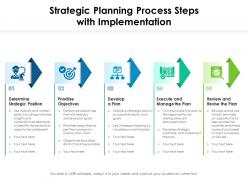
Strategic planning process steps with implementation





Try Before you Buy Download Free Sample Product
 Impress Your
 Audience
 100%
100% Editable
 Save Hours
 of Time


Our Strategic Planning Process Steps With Implementation are topically designed to provide an attractive backdrop to any subject. Use them to look like a presentation pro.
People who downloaded this PowerPoint presentation also viewed the following :
Strategic planning process steps with implementation with all 2 slides:
Use our Strategic Planning Process Steps With Implementation to effectively help you save your valuable time. They are readymade to fit into any presentation structure.
FAQs for Strategic planning process
Key components include environmental analysis, vision and mission development, goal setting, strategy formulation, resource allocation, and performance measurement systems. These elements work together by aligning organizational direction with market realities, enabling leadership teams to make informed decisions while tracking progress, with many companies finding that systematic implementation delivers improved operational efficiency and sustainable competitive advantage.
Mission statements define an organization's core purpose, current activities, and stakeholder value, while vision statements articulate long-term aspirations and future direction. These foundational elements guide strategic decisions by establishing clear organizational identity, priorities, and goals, with many companies finding that well-crafted statements enhance employee alignment, stakeholder engagement, and ultimately deliver competitive advantage through focused execution.
Effective SWOT analysis methods include stakeholder interviews, competitor benchmarking, customer surveys, internal audits, and cross-functional workshops. These approaches enhance strategic planning by gathering diverse perspectives, identifying blind spots, and creating comprehensive assessments, with many organizations finding that collaborative sessions ultimately deliver more actionable insights and stronger competitive positioning.
Organizations align strategic goals with operational capabilities by conducting thorough capability assessments, mapping current resources against strategic objectives, identifying gaps, and developing targeted improvement plans. Through strategic workforce planning and technology investments, companies in manufacturing, healthcare, and financial services streamline operations, enhance efficiency, and deliver measurable outcomes, ultimately ensuring their strategic vision translates into executable operational excellence.
Stakeholder engagement ensures strategic plans reflect diverse perspectives, secure organizational buy-in, and address potential implementation barriers through collaborative input gathering, expectation alignment, and shared accountability creation. This inclusive approach enables organizations to develop more comprehensive strategies while building the internal support necessary for successful execution, ultimately delivering stronger strategic outcomes and smoother change management across all organizational levels.
Data analytics enhances strategic planning decision-making by providing objective insights through predictive modeling, trend analysis, and performance metrics evaluation. Organizations across industries, from retail to healthcare, leverage these data-driven approaches to identify market opportunities, optimize resource allocation, and minimize risks, ultimately delivering more accurate forecasts and competitive strategic positioning.
Common strategic planning pitfalls include lack of stakeholder engagement, unrealistic goal setting, insufficient market analysis, poor resource allocation, and inadequate progress monitoring. These challenges can derail organizational objectives by creating misaligned priorities, missed opportunities, and wasted investments, with many companies finding that comprehensive preparation and regular review cycles ultimately deliver more focused execution and competitive advantage.
Organizations should revisit strategic plans quarterly for progress reviews and conduct comprehensive revisions annually, though dynamic markets may require more frequent adjustments. Many companies find that regular quarterly assessments enable timely course corrections, resource reallocation, and competitive positioning updates, while annual comprehensive reviews ensure long-term objectives remain aligned with evolving business landscapes.
Effective strategic planning tools include SWOT analysis, Porter's Five Forces, balanced scorecards, scenario planning, and OKRs (Objectives and Key Results). These frameworks streamline decision-making by identifying competitive advantages, aligning resources with priorities, and measuring progress against strategic goals, with many organizations finding that combining multiple approaches delivers clearer direction and enhanced operational efficiency.
Measuring strategic plan success involves tracking key performance indicators, financial metrics, milestone completion rates, customer satisfaction scores, and operational efficiency improvements. Organizations typically use balanced scorecards, quarterly reviews, and stakeholder feedback to assess progress, with many finding that regular measurement cycles enable faster course corrections, ultimately delivering improved accountability and sustained competitive advantage.
Successful strategic plan execution depends on clear communication, strong leadership commitment, adequate resource allocation, regular progress monitoring, and organizational alignment. These factors work together by ensuring employees understand their roles, leaders champion initiatives consistently, and teams have necessary tools, with many organizations finding that combining structured oversight with adaptive flexibility delivers measurable results and sustainable competitive advantage.
Strategic planning adapts to different industries by incorporating sector-specific regulations, market dynamics, competitive landscapes, and operational requirements into core planning frameworks. Healthcare organizations focus on patient outcomes and compliance, while manufacturing emphasizes supply chain efficiency and production optimization, with financial services prioritizing risk management and regulatory adherence, ultimately delivering tailored strategies that address unique industry challenges.
Scenario planning enables organizations to anticipate multiple future possibilities, identify potential risks and opportunities, and develop flexible strategies that remain viable across different conditions. Through systematic exploration of various scenarios, companies like Shell and financial institutions enhance decision-making resilience, minimize strategic blind spots, and maintain competitive advantage in increasingly uncertain business environments.
Cultural considerations significantly impact strategic planning in multinational organizations by influencing communication styles, decision-making processes, risk tolerance, and stakeholder expectations across different regions. Companies like Unilever and McDonald's adapt their strategic approaches by incorporating local customs, regulatory requirements, and consumer preferences, while maintaining global brand consistency, ultimately delivering enhanced market penetration and sustainable competitive advantage.
Competitive analysis shapes strategic initiatives by identifying market gaps, benchmarking performance standards, and revealing differentiation opportunities that inform positioning decisions. Through comprehensive competitor assessment, organizations can anticipate market shifts, optimize resource allocation, and develop strategic advantages, with many companies finding that regular competitive intelligence ultimately drives innovation and enhances market responsiveness.
-
Excellent work done on template design and graphics.