


Strategic project portfolio management process




Try Before you Buy Download Free Sample Product
 Impress Your
 Audience
 100%
100% Editable
 Save Hours
 of Time


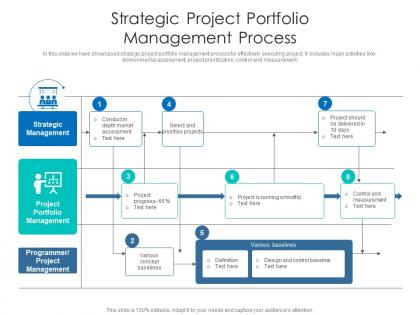
In this slide we have showcased strategic project portfolio management process for effectively executing project. It includes major activities like-environmental assessment, project prioritization, control and measurement.
People who downloaded this PowerPoint presentation also viewed the following :
Strategic project portfolio management process with all 2 slides:
Use our Strategic Project Portfolio Management Process to effectively help you save your valuable time. They are readymade to fit into any presentation structure.
FAQs for Strategic project
Start with strategic alignment - map your current projects against business goals and you'll probably find some scary gaps. Most companies totally bomb this step because defining what actually matters is hard work, but it's where the magic happens. You need solid resource allocation processes and regular portfolio reviews to stay sane. Risk assessment is key too, obviously. Someone has to make those brutal decisions about cutting projects - the governance piece can't be wishy-washy. Oh, and don't forget continuous evaluation or things will drift off course fast.
Here's what's worked for me: map every project back to your main business goals first. Can't connect them? That's your red flag right there. Do portfolio reviews quarterly - or more if your strategy changes fast. Honestly, most companies just set projects on cruise control and forget about them, which is nuts. Score everything against criteria like revenue impact and resource needs. The hardest part? Actually killing projects that don't fit anymore, even when you're already invested. But that's where the real gains come from.
So you'll definitely want the obvious financial stuff - ROI, NPV, payback period. But strategic alignment is where most people mess up. Are your projects actually supporting business goals? I'd also look at resource utilization because nobody wants their team burned out. Risk distribution is super important too - learned that one the hard way. Oh, and track whether you're actually getting the benefits you promised, not just delivering projects on time. Honestly though, start with maybe 5-7 metrics max. Too much data just makes decisions harder.
So risk management is like the foundation of your whole portfolio strategy. It helps you mix risky high-reward stuff with safer projects so you're not gambling everything on one thing. You can spot which projects might crash and burn, figure out how much risk you're actually comfortable with, and see how projects connect to each other - because sometimes when one fails, it drags others down too. I learned this the hard way once, honestly. The trick is baking risk assessment into your selection process right from the start instead of scrambling to add it later.
Honestly, I'd go with a mix of approaches here. Scoring models work really well - just rate each project on things like ROI, strategic fit, and risk level. Gets you actual numbers instead of gut feelings. Those value vs effort grids are solid too, helps you spot the easy wins versus the money pits. NPV is fine if your data's decent, but let's be real, early stage numbers are usually garbage anyway. Maybe throw in some risk-adjusted scoring? I always run 2-3 methods at once because the projects that score high across multiple approaches are usually your obvious choices.
So here's the thing - different stakeholders want different stuff, and that totally drives what projects actually get money. Executives always push for revenue projects while IT's screaming about infrastructure needs. Guess who wins? Yeah, exactly. Map out who has power and who cares about what early on. Then get the heavy hitters involved in portfolio decisions from the start. Trust me, you don't want some VP killing your project halfway through because nobody asked their opinion. Make a stakeholder matrix and do regular check-ins with the important people. Keeps everyone happy and aligned.
Dude, the worst part is everyone fighting over resources while executives constantly flip what's "priority one." Seriously feels like whack-a-mole sometimes. You'll also lose track of what teams are actually doing - so much duplicate work happens because nobody talks to each other. My advice? Map everything against your main business goals first. Shows you real quick where you're wasting time and money. Then set up some kind of regular check-ins so the chaos doesn't spiral. Oh, and get your governance sorted early - sounds boring but it'll save your sanity later when things get messy.
Honestly, these tools just handle all the boring stuff you're probably doing by hand right now - budget tracking, timelines, who's working on what. Real-time dashboards are a game changer because you'll actually see what's happening instead of bugging everyone for updates. They're also pretty good at spotting resource conflicts before things get messy. The reporting features make those stakeholder meetings way less awful too. Oh, and capacity planning becomes actually manageable. I'd definitely try it on just a few projects first though - see what your team actually uses before going all in.
Look, resource allocation is honestly what makes or breaks your whole portfolio. You're deciding who gets what money, people, and time - and if you mess this up, your team ends up stretched across a bunch of mediocre projects instead of crushing the ones that actually matter. Been there, seen that disaster too many times! The trick is ranking everything against your real strategic goals first. Then give your top performers the resources they need. Yeah, you'll have to make some brutal calls about what doesn't get funded, but that's the job.
Honestly, quarterly reviews are a game-changer - that's when you pause and actually kill the projects that aren't working. Don't fall into the sunk cost trap like everyone else does. Keep some budget on the sidelines for when random opportunities pop up (trust me on this one). Stage-gate milestones work way better than committing everything upfront. Your portfolio isn't some sacred document you follow religiously. It's more like... I dunno, a garden? Sounds cheesy but you've gotta keep pruning and replanting based on what's actually growing.
Pick 3-5 metrics that your execs actually care about first - budget variance, schedule stuff, strategic alignment. Don't go overboard initially. Automated dashboards are a lifesaver here since chasing people for updates gets annoying real quick. I'd create standard templates that capture both the numbers and those messy qualitative insights from your PMs. Oh, and schedule regular portfolio reviews with stakeholders - sounds boring but you need those conversations about performance trends and moving resources around. Build from your core metrics once you get the rhythm down.
Try splitting your budget 70/20/10 - most for day-to-day stuff, some for medium-term goals, and a slice for big future bets. I know it's tempting to throw everything at whatever's screaming loudest, but don't. Treat those long-term projects like rent payments - you just pay them, no negotiating. Figure out which strategic stuff absolutely can't wait (there's usually 2-3 things max), then fit your short-term projects around those. Regular check-ins help too - just make sure you're looking at both quick wins and where you want to be in a few years. Otherwise you'll end up constantly chasing fires.
Your portfolio management is only as good as your company culture, honestly. When people actually collaborate and share info openly, you'll get real project updates instead of sugar-coated BS. Political environments? Good luck getting anyone to admit problems early. I've watched teams cling to dead projects for months just because nobody wanted to rock the boat. Change-friendly cultures pivot fast when priorities shift. The stubborn ones... well, they're still probably working on that "critical" initiative from 2019. My advice? Figure out what kind of culture you're dealing with first, then build your processes around that reality.
Honestly, scenario planning saved my butt last year. Pick 3-4 big uncertainties that could wreck your plans - budget cuts, market changes, whatever keeps you up at night. Then build "what-if" models for each one. Test how your current projects would actually survive in each scenario. Some will be bulletproof, others... not so much. The whole thing gets pretty messy but you'll spot which projects are worth keeping versus the ones that only work if everything goes perfectly. I'd rebalance toward the resilient stuff and have backup plans ready for the risky bets.
Honestly, most portfolio failures boil down to throwing random projects together without any real strategy. When your projects don't actually support your main goals, you end up spreading resources thin and getting nowhere fast. Communication breakdowns between teams are brutal too - suddenly everyone's working in silos and fighting each other instead of collaborating. Risk assessment is another big one that bites people later if you skip it upfront. Oh, and here's something I learned the hard way: don't be scared to axe projects that aren't delivering. Set up solid governance early and keep checking how your projects connect to each other.
-
Innovative and attractive designs.
-
Excellent products for quick understanding.