

Product lifecycle management powerpoint presentation slides




Try Before you Buy Download Free Sample Product
 Impress Your
 Audience
 100%
100% Editable
 Save Hours
 of Time


Integrate your business systems in an extended enterprise using Product Lifecycle Management PowerPoint Presentation Slides. With the help of this lifecycle management PPT template, you can create a system architecture across all functions. You can increase the revenue by developing a new product strategy using systems engineering PowerPoint presentation complete deck. If you want to optimize your work by improving efficiency, then use the management of change PPT slides. There are various stages involved in production such as price, distribution, advertising, sales promotion which you can explain using our professionally designed product architecture PowerPoint presentation visuals. The product data management PowerPoint presentation comprises of a total of twenty-four slides. This product data excellence PowerPoint presentation complete deck helps you to generate a current and final KPI dashboard that improves cost margin. Therefore, download this ready-to-use enterprise resource planning PPT slides and maintain open communication between internal and external stakeholders.
People who downloaded this PowerPoint presentation also viewed the following :
Content of this Powerpoint Presentation
Slide 1: This slide introduces Product Lifecycle Management. State Your Company Name and begin.
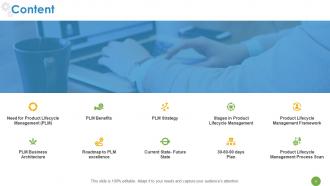
Slide 2: This slide shows Content of the presentation.
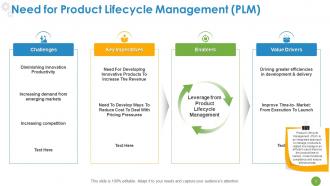
Slide 3: This slide presents Need for Product Lifecycle Management (PLM) with Challenges, Enablers, Key Imperatives and Value Drivers.
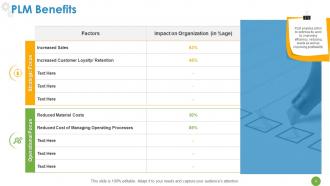
Slide 4: This slide represents PLM Benefits to optimize work by improving efficiency, reducing waste as well as improving profitability.
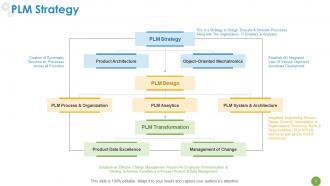
Slide 5: This slide displays PLM Strategy with related flow chart.
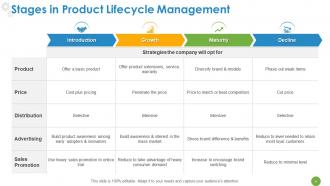
Slide 6: This slide showcases Stages in Product Lifecycle Management as Introduction, Growth, Maturity, Decline.
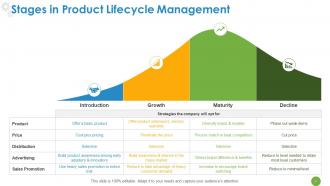
Slide 7: This is an optional slide for Stages in Product Lifecycle Management.
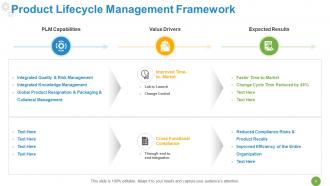
Slide 8: This slide shows Product Lifecycle Management Framework with- PLM Capabilities, Value Drivers and Expected Results.
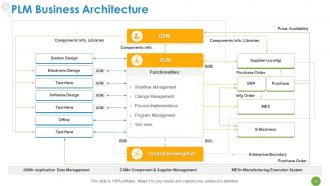
Slide 9: This slide presents PLM Business Architecture with related diagram.
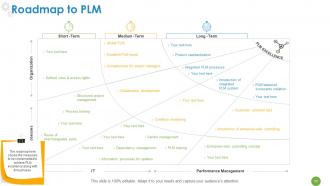
Slide 10: This slide displays Roadmap to PLM describing the measures to be implemented to achieve PLM excellence along with time phases.
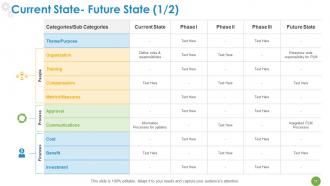
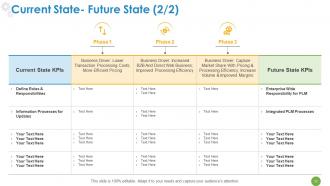
Slide 11: This slide represents Current State- Future State in tabular form.
Slide 12: This is an optional slide for Current State- Future State.
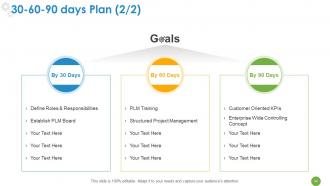
Slide 13: This slide showcases 30-60-90 Days Plan.
Slide 14: This is an optional slide showing 30-60-90 days Plan.
Slide 15: This slide shows Product Lifecycle Management Process Scan.
Slide 16: This slide displays icons for Product Lifecycle Management Icons.
Slide 17: This slide is titled as Additional Slides for moving forward.
Slide 18: This is About our Company slide to show company specifications etc.
Slide 19: This is Our Mission slide with related imagery and text.
Slide 20: This is Our Team slide with names and designation.
Slide 21: This is Our Goal slide. Show your firm's goals here.
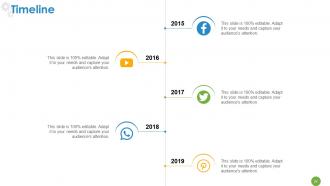
Slide 22: This is a Timeline slide to show information related with time period.
Slide 23: This is a Bulb or Idea slide to state a new idea or highlight information, specifications etc.
Slide 24: This is a Thank You slide with address, contact numbers and email address.
Product lifecycle management powerpoint presentation slides with all 24 slides:
Counsel the deprived with our Product Lifecycle Management Powerpoint Presentation Slides. Empower them to fight for their due.








FAQs for Product lifecycle management
So there's four main stages: introduction, growth, maturity, and decline. But real talk - it's way messier than any business class makes it sound. Introduction is all about getting people to even know you exist. Growth means your sales are finally taking off and you're scrambling to keep up. Maturity hits when everyone's already in the market, so you're just trying to hold onto what you've got. Decline is when things start dying and you gotta decide if it's worth saving. Here's what they don't tell you though - products don't always follow this neat little path. You might jump around between stages or even skip one entirely. Keep tracking your numbers so you'll know when to switch up your approach.
PLM cuts your development costs and gets products out faster - that's money back in your pocket. Teams collaborate way better when everyone's on the same page. You'll spot the money-makers vs the products just bleeding cash (honestly, this part is kind of eye-opening). Design revisions? Way fewer of those expensive headaches. The biggest benefit though is seeing your whole product lineup clearly so you can decide what's worth investing in and what needs to die. Quick tip - just map out your current processes first. You'll probably find some obvious fixes right off the bat.
Honestly, the biggest game-changer is probably cloud-based PLM - your team can actually work together no matter where they are. AI stuff is getting crazy good at catching product problems before they blow up. Those IoT sensors? They're telling you how people really use your products in the wild, which is wild. Digital twins cut way down on physical prototypes (saves a ton of money). Automation takes care of the boring approval workflows and documentation updates. My advice? Figure out what's your biggest headache right now and tackle that first with whatever tech fits.
Think of market research as your GPS for product decisions. Before launch, you're validating ideas and figuring out what people actually want. After launch, you see how things are really going (versus your wishful thinking). Later on, research tells you when to update features or maybe kill something off entirely. Don't just do it once and call it good - keep that conversation with customers going. Honestly, the companies that phone it in with research usually build stuff nobody ends up using. It's way better to stay plugged into what your market's thinking throughout the whole journey.
Honestly, PLM is a game-changer for getting products out faster. You know how teams usually work in silos and everyone's dealing with different versions of everything? PLM fixes that mess by putting all your product data in one place. Teams can actually work at the same time instead of waiting around for handoffs. Design problems get caught way earlier when everyone can see what's happening. The approval stuff gets automated too, which saves tons of time. Oh, and you stop rebuilding things from scratch - just reuse what already works. I'd start by looking at where your teams currently pass work back and forth. That's where you'll find the worst bottlenecks.
Honestly, data migration is going to be your biggest headache - everyone's info is scattered and messy. Your teams will hate the change too since it totally flips their daily routine. Don't believe what vendors say about integration being smooth, seriously. Budget way more time than they quote you. Getting departments to standardize their data? Good luck with that. Oh, and change management isn't optional - best system in the world is useless if nobody wants to touch it. I'd start small with just one department first. Work out all the problems there before you go company-wide.
So PLM basically tracks your environmental stuff from start to finish - raw materials all the way to when someone tosses it. Carbon footprints, material choices, energy use, it's all there in one spot. Teams can actually work together on green design decisions instead of the usual chaos. You'll spot chances to cut waste or swap in recycled materials way easier. Oh and you can see if your suppliers are being sketchy about sustainability too. Honestly, just start with setting up some environmental metrics on your dashboard - that's where most people see results fast.
Time-to-market is your main one - shows whether PLM actually speeds things up. Quality stuff matters too like defect rates and customer happiness scores. Development costs are huge because otherwise why bother, right? If you're in a regulated space, compliance pass rates will save your butt. User adoption tells you if people actually use the tools or if they're just sitting there looking pretty. Those five cover the basics, then you can get fancy with industry-specific metrics later. Oh, and track these monthly at minimum - quarterly is too slow to catch problems.
Honestly, you gotta get everyone talking from the start - none of this "figure it out later" nonsense. Set up regular cross-team check-ins and shared dashboards so nobody's working in the dark. I've watched so many launches crash because marketing and engineering didn't speak until the last minute (nightmare fuel, seriously). Map out where teams need to hand stuff off to each other. Everyone should know how their work affects the next person down the line. Oh, and create dedicated Slack channels for each product - keeps things organized. Start your next project by actually planning these touchpoints instead of hoping it'll work itself out.
Honestly, the biggest thing is having solid checkpoints between each stage - like actual criteria, not just "feels ready" vibes. Get your whole team together (product, engineering, marketing, finance) for regular reviews where you're looking at real numbers: sales momentum, what customers are saying, resource needs. Documentation saves your butt later, even though nobody wants to do it. Map out where things currently break down first - that's usually where products either get stuck forever or someone panics and rushes them through. Oh, and don't let anything drift between stages without an actual decision being made.
Look, customer feedback is everything for your product lifecycle. It shows you when to pivot, double down, or just kill something entirely. During development, you'll spot feature gaps. After launch, performance problems become obvious. When people's needs shift, that's your cue for updates or retirement. Flying blind without customer voices? Recipe for disaster. Use surveys, support tickets, analytics - whatever gets you real data. Then actually do something with it! This stuff should guide your concept validation, feature priorities, launch timing, even end-of-life calls. I've seen too many teams collect feedback then ignore it completely.
So PLM keeps all your audit trails and documentation locked down - super important when regulators show up asking questions. It tracks who approved what and when, which honestly saves your butt later. The cool thing is it catches compliance issues early in development instead of during those nightmare market reviews. All regulatory requirements get centralized so teams don't accidentally miss stuff. Oh, and definitely set up those automated checkpoints in your workflows. Nothing worse than finding out you missed something critical right before launch.
So for PLM systems, Siemens Teamcenter, PTC Windchill, and Dassault's ENOVIA are the big names everyone talks about. Autodesk Vault is decent if you're already using their CAD stuff - way easier to implement than those enterprise monsters. Arena PLM and Propel are pretty good cloud options that won't cost a fortune, especially for smaller teams. Honestly depends on your company size and how messy your product data is. Oh, and what CAD tools you're stuck with already. I'd definitely demo 2-3 of them first - you'll know pretty quick which interface doesn't make you want to throw your laptop.
So PLM basically gives you this bird's eye view of your whole product development mess - and trust me, it's usually a mess. You'll catch problems and opportunities way faster when everything's in one place. Real-time collaboration becomes actually possible instead of playing endless email tag. The analytics are honestly the best part though - you can see patterns in what worked before and copy that approach for new stuff. Reusing components speeds things up too. I'd start by just mapping out how your team currently does things, then figure out where PLM could cut out those ridiculous handoff delays.
Honestly, you can't ignore AI automation anymore - it's handling predictive analytics and boring PLM tasks way better than humans. Sustainability isn't optional either; companies are making it a core requirement now. Digital twins have gotten insane though, they're mapping entire product ecosystems instead of just single parts. Real-time collaboration through cloud platforms is a game changer for global teams. Oh, and IoT integration means you can monitor products constantly throughout their whole lifecycle, which is pretty cool. I'd mess around with these concepts sooner rather than later - don't wait until everyone else figures it out first.
No Reviews