

 0 Comment
 Customer Reviews

Do you need to work through inefficient processes that bog down your team and generate endless manual work? Failure or progress depends much on these bottlenecks. Here's to help you overcome these challenges: the "Top 10 Process Architecture Templates with Samples and Examples" collection. These templates are designed to enhance the workflow processes of a business analyst, project manager, or process architect by providing a structured approach, helping to align the workflows in unison with your business objective. Automating critical tasks, reducing manual tasks, avoiding errors, and ultimately increasing operational efficiency provide the tools. Integrating automation into your entire organization will help you make decisions faster, scale faster, and better manage resources. With this collection, you and your team will be able to adopt best practices in process architecture and design to build automated solutions for continuous improvement and innovation.
Template 1: Idea Development Process Strategies and Architecture
What if you could turn a common meeting into a think tank for inventiveness? A place of collaboration and developing bright ideas with an explosive effect on solutions? This allows you to not only share ideas but also help your team feel encouraged to contribute to the next big breakthrough. The set provides you with frameworks for brainstorming to advanced problem-solving techniques to help elevate discussions by including structure together with out of the box thinking. This extensive toolkit contains each of the slides to tap into group genius using approaches that have been proven to work, such as mind mapping, star bursting, and role-storming, all in order to empower leaders and innovators alike. Using these tools, you’ll open up new lenses, facilitate productive dialogue, and, most importantly, establish a culture that consistently breeds and speeds up idea development.
[product_image id=73437]
Template 2: Data Preparation Architecture and Stages Involved in Data Preparation Process
It's the perfect world in which raw data is your sharpest decision-making tool. This isn't just a guide but a blueprint to take unstructured data and turn it into usable and actionable insights that drive business value. As more and more companies put their fate in the hands of data, it's becoming absolutely crucial for companies to understand how to prepare their data so they can use it for reliable, efficient analysis. Every slide takes you through the best practices, pitfalls, and the leading tool to help you organize, cleanse, and enrich your data to be ready to get quickly analyzed. This comprehensive data analytics and visualization deck will equip your team to leverage data better, create a data-oriented culture, and make better, more informed decisions with precision and clarity.
[product_image id=542386]
Template 3: Process Architecture PPT Template
For a strategic powerhouse that brings clarity and precision to complicated processes, this is the Process Architecture PowerPoint template bundle. With these slides by your side, you're able to optimize market services or refine organizational structure in order to produce streamlined processes. Diving into the details of these frameworks ultimately increases operational efficiency, moves teams in the same direction, and leaves no stone unturned regarding how all components of the process fit into the overall business mission. Designed for business leaders, project managers, and architects aiming to increase their organizations' efficiency in mastering the more than 200 projects required in parallel, this template bundle outlines a scalable, replicable process that serves as the basis for future growth and adaptability.
[product_image id=451334]
Template 4: Real-Time Data Processing Architecture for Management Systems
This real-time data processing architecture is a game changer for energy management systems because of the power of instant insights. It effortlessly links the layers of data acquisition, processing, and presentation to form a flow that captures raw data, integrates it, and evaluates it on the spot. This architecture slide uses streamlined data stream applications and integration processes to ensure that key information is always readily available, all with a clear and immediate view of system performance. Data collection isn't the only thing—It's how we take advantage of a responsive, agile framework to ensure all decisions and actions are made with real-time precision.

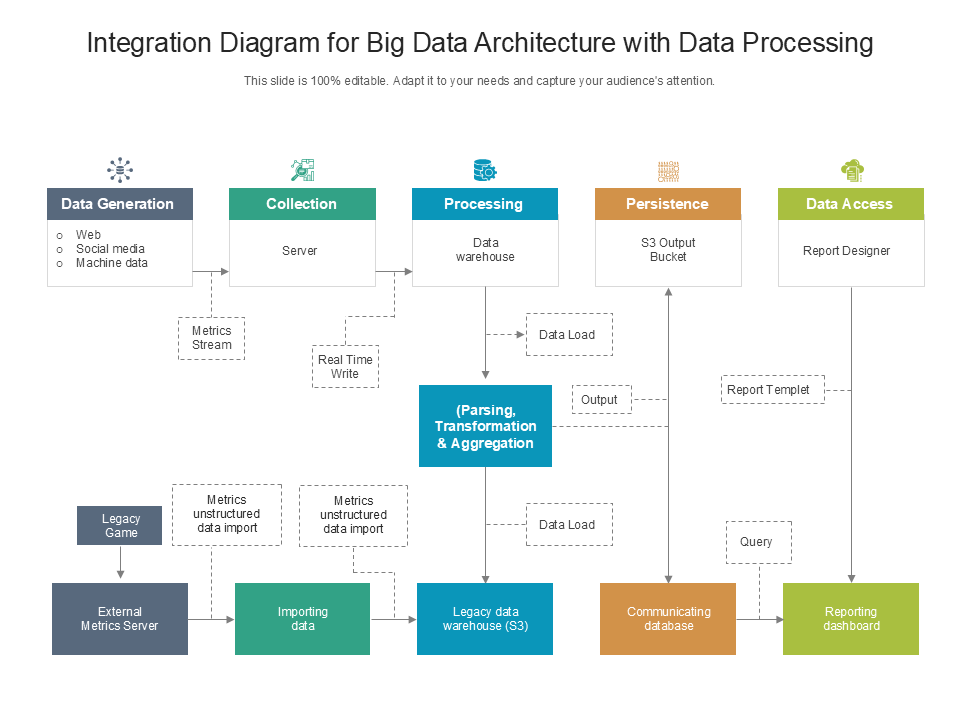
Template 5: Integration Diagram for Big Data Architecture with Data Processing
What if data just flowed from raw information to useful insights without disruption? This provides a structured architecture to traverse complex data ecosystems, as shown in the big data integration diagram. Beginning with data generation, the journey then proceeds through processing stages, which reduce and arrange data at great scales. Raising this refined data into a communication database guarantees smooth interactions and accessibility. Processed data arrives crisp, with concise metrics in the command center and the reporting dashboard. Finally, we have the component for importing the data so that it can be updated ongoingly, making sure that the architecture is open to new inputs. It is not just aligned with this flowchart; it's about defining a coherent pathway that supports real-time data-driven strategies within the entire organization.
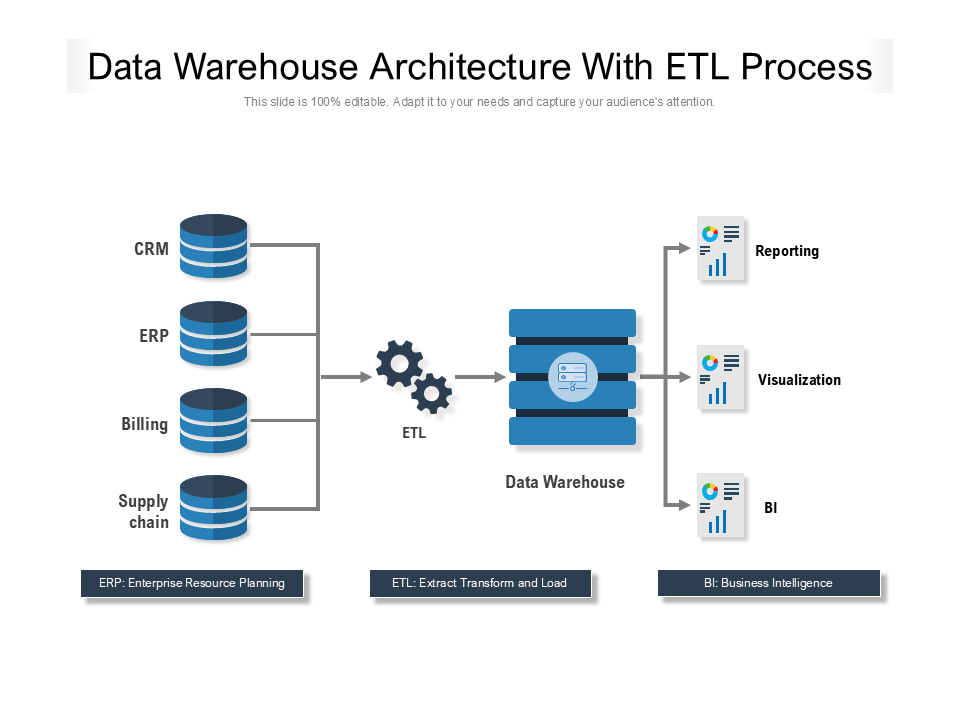
Template 6: Data Warehouse Architecture with ETL Process
The data warehouse architecture, whereby the raw data is converted into strategic intelligence through the ETL process and backed by a centralized hub, makes it possible to make insightful decisions. The purity, organization, and ready Analysis of data that pass through the Extraction, Transformation, and Loading (ETL) fit easily into an Enterprise Resource Planning (ERP) system. With every step, more data gains structure and becomes relevant for providing powerful Business Intelligence (BI) capabilities. Stored data on this architecture gets the users to tap into exciting insights, leading to a workplace that embraces the power of making data-driven decisions to drive the company's direction. But storage is not just about storing; it's the base for making smarter, more strategic decisions.
Template 7: Business Process Automation Architecture
In a world wherein repetitive tasks are done with speed and precision, this is the kind of business process automation architecture that will help make workflows from start to finish. RPA forms the core of this architecture, with intelligent document validation, document processing, and information extraction being done along every processing path – ensuring process path competency. This automation blueprint picks the best path for each task, with the focus of reducing manual workload and shortening response times, apart from decreasing human errors and letting teams focus on strategic high-value work.

Template 8: Flowchart for Architecture Board Review Process
This is your architecture board review process flowchart, your roadmap to confirm that every design decision is in line with strategic goals and technical feasibility. It is a clear, one-stage process, first with Architecture Guidance to set down the foundational direction and then Technology Assessments to turn the tools and platforms the organization is using into a means for getting work done. A solution review follows to make sure the proposed solution meets business and technical expectations, and a requirements analysis is conducted to determine what exactly needs to be delivered. Finally, the Design phase takes this approach and turns these concepts into an action blueprint.

Template 9: Robotic Process Automation RPA Architecture Analysis
This Robotic Process Automation (RPA) architecture analysis slide provides an overview of all key requirements needed for a successful RPA project. It goes through each step in seven stages that encompass big key points in an automated process. From usability and seamless integration to robust security and streamlined deployment features, each stage is geared to optimize the efficiency and reliability of automated workflows. Addressing these factors enables the architecture to ensure that RPA systems are effective not only in the present but also in the future when these systems will scale, be secure, and change business needs. This slide represents the importance of thinking through your plan in detail and evaluating every technical requirement so that the end user can have a seamless experience.

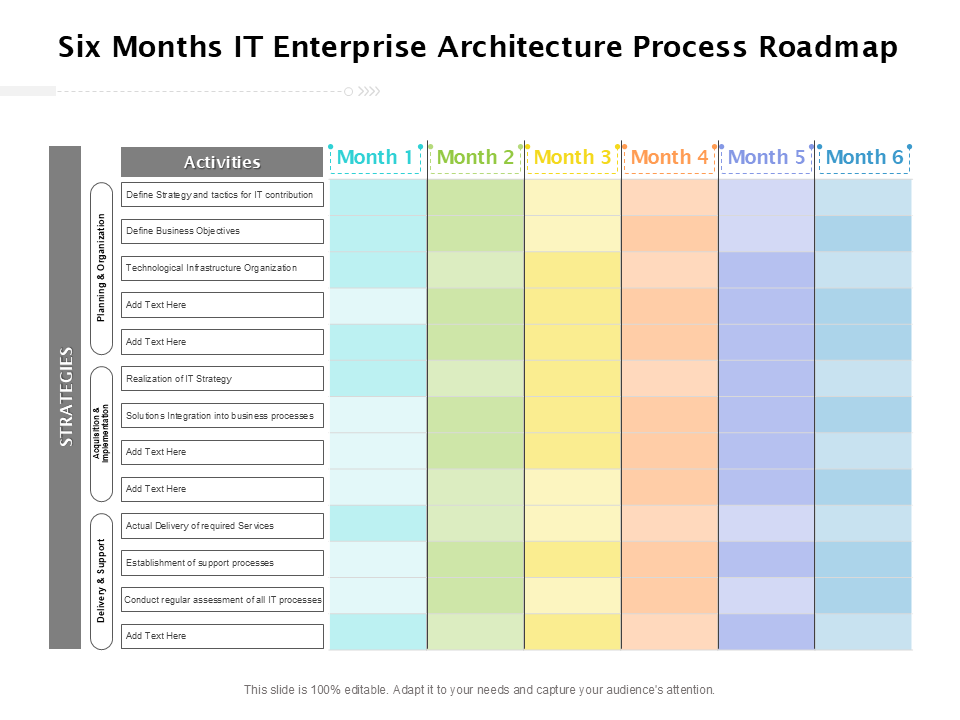
Template 10: Six Months IT Enterprise Architecture Process Roadmap
This 6 month long IT enterprise architecture process roadmap is a guide to taking a strategic approach to the confusing swamp of IT planning and implementation. The left side of this roadmap includes activities, while the right side demonstrates how timeframes are laid out, which gives a clear, actionable path for each stage of the process. The layout of the work is based on whether it is system integration, technology assessment, or strategic alignment in order to make sure that each task is done in time and under the scope. The architecture has the flexibility to adapt to changing business needs while keeping the stakeholders on track, allowing it to adapt to technology as well. It's not simply a timeline but a road map to success, converting long-term goals into desirable milestones.
Template 11: Layer Architecture of Cloud Computing with Data Processing
The layered architecture of cloud computing with data processing forms a well-structured framework for the interfacing of different cloud service models, which, in turn, each offers some advantages to the user. However, the four layers of cloud computing—BPaaS, SaaS, PaaS, and IaaS—function together to produce a complete cloud ecosystem. BPaaS (Business Process as a Service) provides ready-to-use business solutions, SaaS (Software as a Service) delivers software applications based on demand, PaaS (platform as a service) provides an environment to develop applications, and IaaS (Infrastructure as a Service) delivers on fundamental computing resources. Each layer has an important role to play in not only smooth data processing but also scalability and in making cloud environments efficient. With this architecture, businesses are able to select the right tools and have consistent, non-interrupted data flow and integration across all levels.

Template 12: Symmetrical Multi-Processor SMP Architecture Parallel Processing Architecture
Have you ever wanted your computer to do a little thinking faster, more of the brain for operation? In essence, that's what symmetrical multiprocessing (SMP) does: it lets a bunch of identical processors work together and share a single memory pool to accelerate computing tasks. There, with a team of experts fighting these issues, you're on the same page. All these are essential, such as the main memory, bus, cache, and input/output systems through which data flows freely between processors, making it easy to minimize slowdowns and improve efficiency. Equally important, they're telling scaling performance when you're adding more processors and if you want high-performance demand that needs speed but is still reliable. And that's less time and more intelligence.

Final Word
For more advancement on your process design and automation capabilities, we recommend also taking a look at Program Architecture Templates with Samples and Examples, Architecture Diagram Samples with Templates and Examples, and Architecture Framework Templates with Samples and Examples. These collections offer an in-depth look into various approaches to architecture, with practical templates and real-world examples that you can easily modify to your own needs. Utilizing these resources means you will be at the forefront when it comes to optimizing processes, reducing efficiency, and ultimately ensuring that the automation project at your organization ends in the most successful manner possible. These powerful tools don't give you a chance to miss the opportunity to refine your architecture strategy.