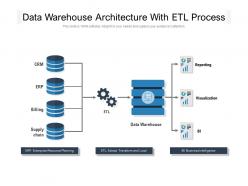
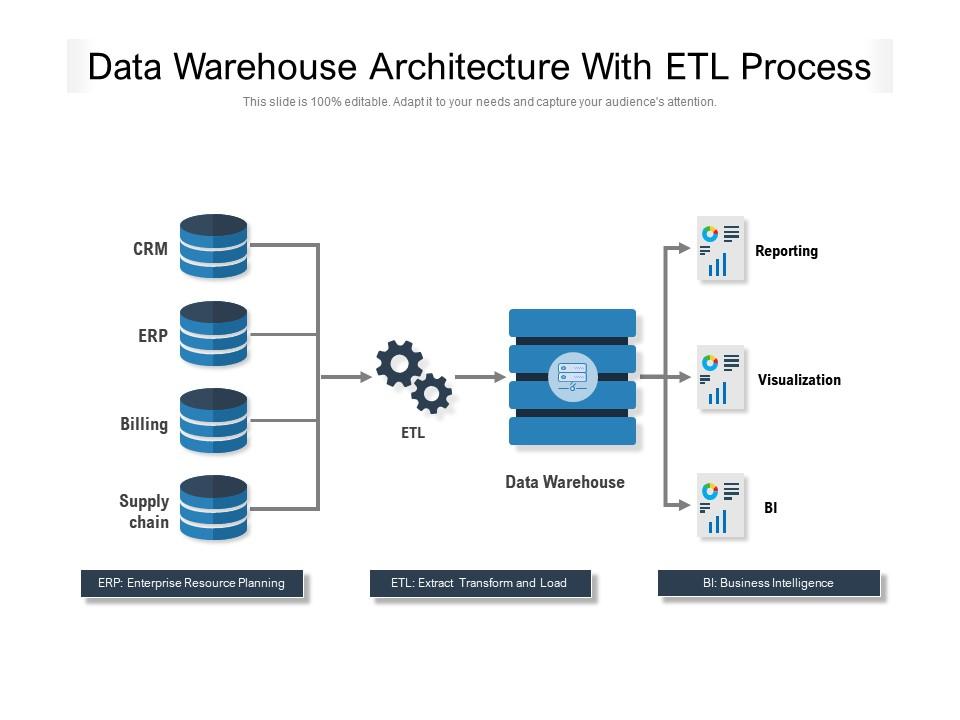
Data warehouse architecture with etl process
Try Before you Buy Download Free Sample Product
Audience
Editable
of Time
Our Data Warehouse Architecture With ETL Process are explicit and effective. They combine clarity and concise expression.
People who downloaded this PowerPoint presentation also viewed the following :
Data warehouse architecture with etl process with all 2 slides:
Give your audience a fulfilling experience. They will find our Data Warehouse Architecture With ETL Process elevating.
FAQs for Data warehouse architecture
So you've got a few key pieces to think about. Your raw data sits in various sources first. ETL processes grab that data and clean it up for the warehouse - that's your main storage hub. Data marts branch off from there, basically customized views for different teams. There's also a metadata repository tracking everything (honestly kind of boring but super necessary). Users hit the presentation layer for their reports and dashboards. The flow goes: sources → ETL → warehouse → marts → people actually using it. I'd start by just mapping what data sources you currently have. Gets messy fast if you don't know what you're dealing with upfront.
So basically star schema keeps dimension tables flat - like one huge Customer table with everything. Snowflake breaks that up into smaller normalized tables, so Customer links to separate City, State, Country tables and whatnot. Star's way easier to query and usually faster, which is honestly why most people go with it. Yeah, snowflake saves storage space but you end up with messier joins that can slow things down. I mean, unless you're really hurting for storage or dealing with absolutely massive dimensions, I'd just stick with star schema. Way less headache to maintain too.
So ETL is your data pipeline - it grabs stuff from different sources, cleans it up, then dumps it into your warehouse tables. The transform step is where you'll live honestly, because raw data is always a disaster. It handles validation, formatting, removing duplicates, all that fun stuff. Without decent ETL you're stuck with junk data that makes your reports useless. Oh and definitely map out your sources and what transformations you need first - I learned that the hard way. Saves you from wanting to throw your laptop later.
Honestly, you can't stick with batch processing if you want real-time stuff. Streaming pipelines are where it's at - Kafka or Kinesis will handle the continuous data flow. Then you need something like Spark for instant analysis. Lambda architecture works pretty well since it does both streaming and batch at once. Oh, and definitely set up columnar storage with pre-aggregated data marts for those super fast queries. Your ETL needs to handle micro-batches or full streaming mode. But here's the thing - figure out what actually needs to be real-time first. Most stuff can wait until morning.
Dude, cloud data warehouses are honestly a game-changer. No more buying expensive servers that just sit there doing nothing most of the time. You literally pay for what you use, which is amazing for budgets. Need extra power for those crazy month-end reports? Boom, scaled up in minutes instead of waiting weeks for IT procurement (ugh, the worst). Your team can work from anywhere too. Oh, and no more babysitting hardware or worrying about backups - that's all handled automatically. You'll actually spend time analyzing data instead of fixing servers. Try a small pilot first!
Data governance basically cuts across your entire data warehouse setup - it touches everything from source systems to end users. Most people implement it through metadata management tools, quality checks during data ingestion, and access controls in their ETL pipelines. Honestly, it sounds super dry but it'll save you major headaches down the road. The framework handles data lineage tracking and sets quality standards. Oh, and compliance policies get built into your architecture instead of slapped on later (trust me on this one). Start by mapping your current data flows, then figure out where you need those governance touchpoints.
Oh man, data quality will absolutely wreck you - inconsistent formats, missing stuff, duplicates everywhere. Way messier than anyone tells you upfront. Integration gets gnarly fast too, plus stakeholders always want to expand scope halfway through (classic). Performance tuning is its own nightmare, and honestly? Getting people to actually USE the thing after you build it is harder than the technical parts sometimes. Start with something small first - like a pilot that won't kill you if it goes sideways. Get users involved early or they'll just complain later. And do data profiling right away, even though it's boring. Saves so much headache down the road.
Honestly, partitioning your tables by date or region is gonna be your biggest lifesaver - that alone will fix most performance headaches. I'd also switch to columnar formats like Parquet for way better compression and analytics speed. For processing, Spark or Snowflake's auto-scaling are solid choices. Oh, and definitely separate your raw ingestion from your analytics layer. Different workloads need different optimizations, you know? If you're working with time-series stuff, start with partitioning first. That's usually where you'll see the most immediate improvement without too much hassle.
Honestly, go with the cloud stuff - Snowflake, AWS Redshift, or Google BigQuery. Way easier than dealing with your own servers and all that mess. Most teams I know are using Apache Spark for the heavy processing, then dbt handles transformations pretty well. Oh and for getting data in, Fivetran's solid but kinda pricey if you're just starting out. Stitch works too. The whole cloud-native thing just makes sense now - scales without you having to think about it. Tableau's still king for dashboards, though Power BI's getting better. Start with one of the big cloud warehouses and you'll avoid most headaches.
Think of data modeling as your warehouse blueprint. Dimensional modeling sets you up for star/snowflake schemas, which totally changes your ETL and query performance. It's like picking your foundation before building - relational models push you toward normalized stuff, while dimensional goes for denormalized fact tables. Your choice affects storage, processing power, even which tools play nice together. I learned this the hard way on a project last year. Start with your business questions first, then pick your approach. Trust me, you'll dodge so many headaches down the road.
Honestly, start with automated checks at every data entry point - catch nulls, weird formats, duplicates before they mess things up. We once had terrible data in production for *weeks* because nobody was watching. Set up alerts so you know right away when stuff breaks. Document where your data comes from and make specific people responsible for different datasets. Oh, and build the quality checks into your actual pipelines from the start. Don't just slap them on later - that never works as well. Monitor everything continuously.
So data marts are like mini versions of your main data warehouse, but they're built for specific teams - sales, marketing, finance, whatever. Way faster than making everyone dig through the massive central warehouse every time they need something. You can either pull data from your main warehouse (dependent marts) or go straight from the source systems (independent ones). Honestly, I'd go with dependent marts first - less headache to manage and your data stays consistent. My old company tried the independent route initially and it was a mess trying to keep everything synced up.
Honestly, think of a data warehouse as your single source of truth - it pulls all your messy data from different systems into one clean spot. Your analysts won't waste time hunting around or second-guessing numbers anymore. Everyone's working with the same definitions, which is huge for avoiding those awkward meetings where nobody agrees on basic metrics. You can build automated reports and let business users grab their own data without bugging IT constantly. Trust me, spend the time getting your warehouse structure right upfront. Your BI tools will actually work like they're supposed to instead of giving you garbage insights.
Honestly, big data has totally flipped data warehouse design on its head. Those old monolithic systems? They're dying fast. Volume and speed of data now means your traditional ETL and relational databases can't handle it anymore - they just choke. Most companies are moving to cloud-native setups, data lakes, hybrid models. Real-time processing is huge now too. Schema-on-read, microservices, all that stuff. I'd seriously look into cloud solutions if you haven't yet. The old warehouse-only approach becomes a massive bottleneck pretty quick with today's data loads.
Start modular from day one so you can scale horizontally later. Cloud stuff like Snowflake or BigQuery will save your butt - they auto-scale way better than anything on-premise. Honestly, predicting future needs is basically impossible, so just focus on flexibility. Partition your data and maybe go with a lakehouse setup where storage and compute are separate. Your ETL processes need to handle 10x the volume without completely dying. I learned this the hard way at my last job - don't make architectural choices that'll box you in later. Always think "what if we suddenly get massive?"
No Reviews