Data Warehouse Reference Architecture Diagram

Rating:
80%
Data Warehouse Reference Architecture Diagram
Slide 1 of 6
Favourites Favourites

Try Before you Buy Download Free Sample Product

Audience Impress Your
Audience
Editable 100%
Editable
Time Save Hours
of Time
The Biggest Sale is ending soon in
0
0
:
0
0
:
0
0
Rating:
80%
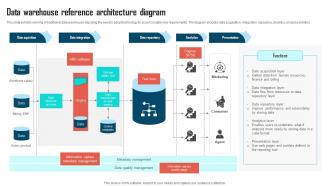
This slide exhibits working of traditional data warehouse depicting the need to adopt technology to accommodate new requirements. The diagram includes data acquisition, integration, repository, analytics and presentation. Introducing our Data Warehouse Reference Architecture Diagram set of slides. The topics discussed in these slides are Metadata Management, Data Quality Management, Information Sphere. This is an immediately available PowerPoint presentation that can be conveniently customized. Download it and convince your audience.

FAQs for Data Warehouse

So basically, regular databases handle your everyday stuff - processing orders, updating records, that kind of thing. Data warehouses are totally different though. They're built for analyzing huge amounts of historical data from tons of sources. It's like comparing your daily planner to a massive filing system, you know? Regular databases are fast for transactions, but warehouses use special structures (star schemas and stuff) that make complex analytics way faster. Honestly, if you're doing any serious trend analysis or building dashboards, you'll definitely want the warehouse over a regular database. Way better for that kind of work.

So ETL is how you actually get your data warehouse working. You pull data from databases, APIs, whatever messy sources you have, then clean it up and standardize everything. The transform part is honestly where you'll spend most of your time - that's where you apply business rules and make the data actually make sense. Then you dump it into your warehouse so people can use it. Without this process you're just stuck with a bunch of random, inconsistent data that's pretty much useless. I'd start by figuring out what sources you have and what cleanup you need to do.

Honestly, you've got three main options here. Star schema is what most people go with - fact table in the middle, dimensions around it. Fast queries, easy to grasp. Snowflake schema takes that same idea but normalizes everything (which I find pretty annoying tbh). Then there's data vault with its hubs and satellites thing - more scalable but way more complex. I'd just stick with star schema unless you have a really good reason not to. Your business folks will actually understand it, and performance is solid. Save yourself the headache.

Build validation rules right into your ETL pipeline - catch data type issues, nulls, dupes, and business rule violations at each step. Trust me, I've wasted way too many hours tracking down garbage data in reports! Data lineage tracking is clutch for tracing problems back to source systems. Short sentences work. Profile your data regularly to spot weird patterns early. Honestly, data quality is one of those things that seems boring until it bites you. Start with your most critical tables and expand from there. You'll thank yourself later.

Honestly, cloud data warehouses are pretty sweet. No more dealing with physical servers or worrying about capacity planning - just scale up when things get busy and dial it back when they don't. The cost savings alone make it worth considering since you're not paying for hardware that just sits there doing nothing most of the time. Security updates happen automatically too, which is nice. Setup takes days instead of those painful months-long projects we used to deal with. The whole pay-per-use thing works really well for most teams I've seen. Maybe try it on a smaller project first though, just to get a feel for how it meshes with your current setup.

Honestly, your data warehouse is perfect for this stuff. Get all your business data centralized and cleaned up first - then you can actually run those complex queries and build predictive models without pulling your hair out. No more jumping between five different systems (ugh, the worst). BI tools plug right into the warehouse, so you'll get real-time insights and can spot trends you'd totally miss otherwise. Oh, and design your schema around the specific business questions you're trying to answer. Makes everything way smoother.

Go with a star schema - seriously, it'll save your sanity later. Separate storage from compute so you can scale each piece when needed. Columnar formats like Parquet are clutch for performance. Oh, and partition everything from the start (learned this the hard way). Your ETL jobs should handle failures gracefully and be repeatable. Data lineage tracking sounds boring but you'll thank yourself later when something breaks. Keep it simple at first though - I've seen too many projects die from over-engineering right out the gate.

So data warehouses and big data tools aren't enemies - they're actually best friends. Use Spark or Hadoop to wrestle with your massive, chaotic datasets first. Then push that cleaned stuff into your warehouse for the structured analytics work. It's like a assembly line, honestly. Big data handles the messy transformation part (and trust me, some datasets are absolutely bonkers), then your warehouse becomes where business folks can actually run queries without crying. Just gotta match the right tool to each step.

Okay so metadata is like your data warehouse's GPS - shows you what data exists, where it came from, and what it actually means. You'll be lost without it, trust me. Can't figure out table structures, trace data lineage, or understand business rules. It's basically documentation that (fingers crossed) stays current. Helps with query performance, compliance stuff, getting new people up to speed. I learned this the hard way - spend time on good metadata practices now or you'll waste hours later digging through random tables trying to make sense of everything.

Yeah so traditional warehouses are super batch-heavy, which sucks for real-time stuff. But there's workarounds! Kafka's probably your best bet for streaming data straight in. Snowflake and BigQuery have gotten way better at near real-time ingestion lately too - honestly surprised me how much they've improved. You could also do lambda architecture where you're running both batch and streaming in parallel. Really depends on what you mean by "real-time" though. Like, are we talking seconds or can you live with a few minutes? Figure that out first and it'll make picking tools way easier.

Oh man, you're gonna hit so many snags. Data quality will make you want to scream - duplicates everywhere, missing stuff, formats that make zero sense. Integration is a nightmare since nothing talks to each other properly. Performance issues hit hard if your schema sucks from day one. People hate change too, even when it helps them. And honestly? Everyone's gonna crawl out of the woodwork wanting their random reports added once you get started. Scope creep is real. Just start tiny with one pilot project first. Prove it works, then grow from there.

So basically, data warehousing puts all your messy company data in one clean place where everyone can actually use it. No more waiting around for IT to run reports or making decisions based on hunches. You'll be able to spot trends and back up your ideas with real numbers - which honestly feels pretty powerful once you get the hang of it. Teams stop being reactive and start planning ahead because they can see the full picture from historical data. Oh, and figure out your biggest business questions first, then see how much faster you can answer them. Makes a huge difference.

So the main ones everyone talks about are Amazon Redshift, Google BigQuery, and Snowflake. Snowflake's been blowing up recently - super easy to use. If you're already using Microsoft stuff, Azure Synapse works well too. There's open-source options like Apache Hive and ClickHouse if you want to go that route. Oracle and Teradata are still decent but they'll cost you a fortune honestly. I'd probably start with BigQuery or Snowflake since they both have free tiers. That way you can mess around with your actual data first instead of just guessing what'll work.

Okay so basically - warehouses are super organized and structured, like everything's already cleaned up and ready for reports. Data lakes? Total opposite. They're messy and hold raw stuff in whatever format it came in. Warehouses are great when you need reliable insights fast. But honestly, I'd go with a data lake if you want flexibility to experiment later. It's like the difference between a filing cabinet vs just throwing everything in a box (which isn't always bad btw). What's your project actually trying to do? That'll help you decide.

Visualization tools are honestly what make data warehouses actually useful instead of just expensive storage. Nobody wants to dig through spreadsheets all day – dashboards and charts let you spot trends right away. Your team can finally make decisions without learning SQL (which half of them will never do anyway). The best part? Connect everything directly to your warehouse so everyone's looking at the same numbers. I'd start with whatever reports people bug you about most. Makes adoption way easier when stakeholders can actually see what's happening at a glance.

Ratings and Reviews

80% of 100
Review Form
Write a review
Most Relevant Reviews
  1. 80%

    by Cyrus Ellis

    The information is visually stunning and easy to understand, making it perfect for any business person. So I would highly recommend you purchase this PPT design now!
  2. 80%

    by Danny Kennedy

    I joined SlideTeam last month and there’s no doubt that I tend to find our bond only strengthening over time. Best place to find world-class themes, templates, and icons.

2 Item(s)

per page: