

Cloud Computing Reference Model Architecture




Try Before you Buy Download Free Sample Product
 Impress Your
 Audience
 100%
100% Editable
 Save Hours
 of Time


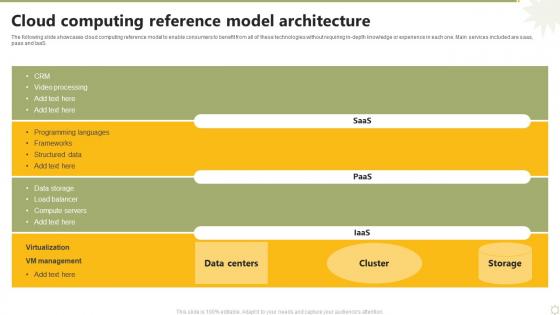
The following slide showcases cloud computing reference model to enable consumers to benefit from all of these technologies without requiring in depth knowledge or experience in each one. Main services included are saas, paas and Iaas.
People who downloaded this PowerPoint presentation also viewed the following :
Cloud Computing Reference Model Architecture with all 6 slides:
Use our Cloud Computing Reference Model Architecture to effectively help you save your valuable time. They are readymade to fit into any presentation structure.





FAQs for Cloud Computing
Cloud computing architecture comprises virtualization layers, storage systems, networking infrastructure, security frameworks, and management platforms. These components work together by enabling scalable resource allocation, automated service delivery, and seamless data integration, with many organizations finding that this strategic combination ultimately delivers enhanced operational efficiency and reduced infrastructure costs.
Public cloud deployment utilizes shared infrastructure managed by providers like AWS or Azure, private cloud operates on dedicated resources within organization boundaries, and hybrid combines both approaches strategically. These models differ in resource allocation, security controls, and scalability options, with many enterprises finding that hybrid deployments deliver operational flexibility while maintaining regulatory compliance and cost optimization.
Microservices enable cloud architecture by breaking applications into independent, loosely-coupled services that can be developed, deployed, and scaled individually. This approach enhances scalability through dynamic resource allocation, fault isolation, and technology flexibility, with companies like Netflix and Amazon leveraging microservices to handle millions of concurrent users while maintaining system resilience and operational efficiency.
A multi-cloud strategy significantly influences architecture design by requiring standardized APIs, cross-platform compatibility, and distributed workload management across multiple cloud providers. This approach enables organizations to avoid vendor lock-in, optimize costs through competitive pricing, and enhance resilience through redundancy, with many enterprises finding that strategic multi-cloud implementations deliver improved flexibility and operational efficiency.
Essential security measures include multi-factor authentication, encryption at rest and in transit, network segmentation, identity access management, and continuous monitoring systems. These approaches work together by creating layered defense protocols, automated threat detection, and zero-trust frameworks, with many financial institutions and healthcare organizations finding that comprehensive security architectures ultimately deliver enhanced compliance and reduced breach risks.
Docker and Kubernetes revolutionize cloud architecture by enabling microservices deployment, automated scaling, resource optimization, and seamless application portability across environments. These containerization technologies streamline development workflows, reduce infrastructure costs, and enhance system reliability, with many enterprises finding that Kubernetes orchestration delivers faster deployment cycles and improved operational efficiency in increasingly complex cloud ecosystems.
Serverless computing transforms traditional cloud architecture by eliminating infrastructure management, enabling automatic scaling, and shifting costs to usage-based models. This approach streamlines deployment processes, reduces operational overhead, and accelerates development cycles, with many organizations finding that serverless architectures deliver enhanced agility and cost efficiency while maintaining robust performance.
Data storage management in cloud computing architecture operates through distributed file systems, automated backup protocols, and scalable storage tiers that dynamically allocate resources based on demand. Through virtualization and redundancy mechanisms, organizations streamline data accessibility, minimize storage costs, and enhance disaster recovery capabilities, with many enterprises finding that cloud-native storage delivers improved scalability and operational efficiency.
**INPUT**: What are the best practices for network configuration in cloud architecture? **OUTPUT**: Best practices for network configuration in cloud architecture include implementing proper subnet segmentation, configuring robust security groups, establishing VPN connections, optimizing load balancing, and setting up redundant network paths. These configurations enhance performance by minimizing latency, strengthening security protocols, and ensuring high availability, with many enterprises finding that strategic network design ultimately delivers improved scalability and reduced operational costs. *[Word count: 60 words]*
Organizations ensure high availability and disaster recovery through multi-region deployments, automated failover systems, data replication strategies, redundant infrastructure components, and comprehensive backup solutions. These approaches streamline business continuity by minimizing downtime, accelerating recovery processes, and maintaining service reliability, with many enterprises finding that strategic cloud architectures ultimately deliver enhanced operational resilience and competitive advantage.
Cloud architecture performance should track metrics including response time, throughput, availability uptime, resource utilization, cost per transaction, and error rates. These KPIs enable organizations to optimize operational efficiency, identify bottlenecks, and ensure scalability, with many enterprises finding that comprehensive monitoring ultimately delivers enhanced user experiences and competitive advantage.
APIs serve as essential communication bridges in cloud architecture, enabling seamless data exchange, service orchestration, and resource management across distributed components. Through standardized protocols, organizations streamline application connectivity, automate workflows, and enhance scalability, with many financial services and retail companies finding that robust API strategies ultimately deliver faster deployment cycles and improved operational efficiency.
Cloud architecture facilitates DevOps practices by providing automated deployment pipelines, scalable infrastructure provisioning, containerization support, and integrated monitoring tools. These capabilities streamline development workflows, enable faster release cycles, and enhance collaboration between development and operations teams, with many organizations finding that cloud-native architectures ultimately deliver reduced deployment times and improved operational efficiency.
Cloud architecture compliance considerations include data residency requirements, encryption standards, access controls, audit trails, and industry-specific regulations like GDPR, HIPAA, or SOX. These frameworks enable organizations to maintain regulatory alignment while leveraging cloud scalability, with many financial services and healthcare institutions finding that strategic compliance integration ultimately delivers operational efficiency and reduced risk exposure.
Edge computing integrates with traditional cloud architecture by creating distributed processing layers that handle data closer to users, reducing latency while maintaining centralized cloud resources for complex analytics and storage. This hybrid approach enables organizations in manufacturing, healthcare, and retail to process real-time data locally while leveraging cloud scalability, ultimately delivering faster response times and enhanced operational efficiency.
-
Attractive design and informative presentation.
-
My search for complete decks ended with SlideTeam. Such a surplus collection of HD PowerPoints. Moreover, their standard and widescreen formats have helped me in delivering bullseye presentations.