


Cloud Computing Security Architecture Of Cloud Security Cont




Try Before you Buy Download Free Sample Product
 Impress Your
 Audience
 100%
100% Editable
 Save Hours
 of Time


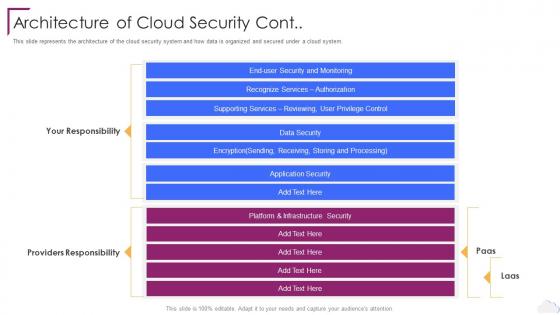
This slide represents the architecture of the cloud security system and how data is organized and secured under a cloud system.
People who downloaded this PowerPoint presentation also viewed the following :
Cloud Computing Security Architecture Of Cloud Security Cont with all 7 slides:
Use our Cloud Computing Security Architecture Of Cloud Security Cont to effectively help you save your valuable time. They are readymade to fit into any presentation structure.





FAQs for Cloud Computing Security Architecture Of
Cloud security architecture principles include defense in depth, zero trust verification, data encryption at rest and in transit, identity and access management, and continuous monitoring. These frameworks enhance organizational resilience by implementing multi-layered protections, automated threat detection, and granular access controls, with many enterprises finding that strategic security architecture ultimately delivers reduced vulnerabilities and improved compliance outcomes.
Organizations assess their specific cloud security requirements by conducting comprehensive risk assessments, evaluating data sensitivity levels, identifying compliance obligations, and analyzing threat landscapes specific to their industry. Through systematic auditing and stakeholder consultation, companies across sectors like healthcare and financial services can map their unique vulnerabilities, ultimately delivering tailored security frameworks that enhance operational efficiency while maintaining regulatory compliance.
Identity and access management (IAM) serves as the foundational control layer in cloud security architecture, managing user authentication, authorization, role-based permissions, multi-factor authentication, and access policies across cloud resources. Through centralized identity governance, organizations streamline security operations, reduce unauthorized access risks, and ensure regulatory compliance, while enabling seamless user experiences and scalable access control for distributed cloud environments.
Encryption safeguards cloud data through end-to-end protection, robust key management, multi-layered security protocols, and access controls that secure information both in transit and at rest. Financial institutions and healthcare organizations increasingly leverage advanced encryption algorithms, secure key vaults, and zero-trust architectures, ultimately delivering enhanced data protection, regulatory compliance, and customer confidence while maintaining operational efficiency.
Multi-cloud security architecture best practices include unified identity management, consistent policy enforcement, centralized monitoring, data encryption across environments, and comprehensive compliance frameworks. These approaches streamline security operations by eliminating silos, standardizing controls, and enabling real-time threat detection, with many organizations finding that strategic multi-cloud designs ultimately deliver enhanced resilience and operational efficiency.
**INPUT**: How does a shared responsibility model impact cloud security strategies? **OUTPUT**: A shared responsibility model fundamentally reshapes cloud security strategies by clearly dividing security obligations between cloud providers and customers, with providers securing infrastructure while customers protect their data, applications, and access controls. This strategic division enables organizations to focus resources on application-level security, identity management, and compliance requirements rather than underlying infrastructure, ultimately delivering more specialized protection and streamlined security operations across increasingly complex cloud environments. **Word count: 60 words**
Identity and access management, data encryption, network segmentation, vulnerability management, and compliance monitoring should be prioritized during cloud migration. These controls work together by securing user authentication, protecting data in transit and at rest, isolating workloads, and maintaining regulatory compliance, with many organizations finding that this layered approach significantly reduces security risks while enabling scalable operations.
Organizations ensure regulatory compliance in cloud security architecture by implementing data encryption, access controls, audit trails, automated monitoring, and regular compliance assessments. Through strategic frameworks like GDPR, HIPAA, and SOX alignment, companies streamline regulatory adherence while maintaining operational efficiency, with many financial services and healthcare institutions finding that proactive compliance measures ultimately deliver competitive advantage and customer trust.
Common cloud vulnerabilities include data breaches, misconfigurations, insufficient access controls, insecure APIs, and account hijacking. These risks can be mitigated through multi-factor authentication, encryption, regular security audits, and automated compliance monitoring, with many financial institutions and healthcare organizations finding that comprehensive security frameworks ultimately deliver enhanced data protection and regulatory compliance.
Network security in cloud infrastructure can be effectively managed through multi-layered approaches including virtual firewalls, network segmentation, zero-trust architectures, encrypted traffic monitoring, and automated threat detection systems. These technologies streamline security by providing real-time visibility, isolating workloads, and enabling rapid incident response, with many financial services and healthcare organizations finding that integrated cloud security delivers enhanced protection while reducing operational complexity.
Essential cloud security monitoring tools include SIEM platforms, CASB solutions, CWPP systems, cloud access security brokers, and automated compliance scanners. These technologies enhance visibility by detecting threats in real-time, monitoring user access patterns, and ensuring regulatory compliance, with many financial services and healthcare organizations finding that integrated security platforms deliver faster incident response and significantly reduced operational risks.
Cloud incident response requires coordinating with cloud service providers, managing shared responsibility models, and leveraging cloud-native security tools for faster detection and containment. While on-premises environments offer complete control, cloud environments enable automated response capabilities, distributed logging across multiple regions, and scalable forensic analysis, with many organizations finding that cloud-based incident response delivers faster recovery times and enhanced visibility.
Securing serverless and containerized applications requires implementing identity and access management, runtime protection, vulnerability scanning, network segmentation, and secrets management. These security measures enhance operational efficiency by automating threat detection, minimizing attack surfaces, and ensuring compliance across deployments, with many financial services and healthcare organizations finding that integrated security frameworks ultimately deliver faster incident response and reduced operational costs.
Organizations balance security and cloud agility through strategic frameworks like Zero Trust architecture, automated compliance monitoring, identity access management, and continuous security integration within DevOps pipelines. These approaches enable enterprises, from financial services to healthcare providers, to maintain robust protection while accelerating deployment cycles, ultimately delivering enhanced operational efficiency and competitive advantage in increasingly dynamic markets.
Automation enhances cloud security architecture by enabling real-time threat detection, automated incident response, continuous compliance monitoring, and dynamic resource provisioning. Through AI-driven security orchestration, organizations streamline vulnerability management, accelerate threat remediation, and maintain consistent security policies across multi-cloud environments, ultimately delivering reduced response times and enhanced operational efficiency.
-
Presentation Design is very nice, good work with the content as well.
-
One-stop solution for all presentation needs. Great products with easy customization.