


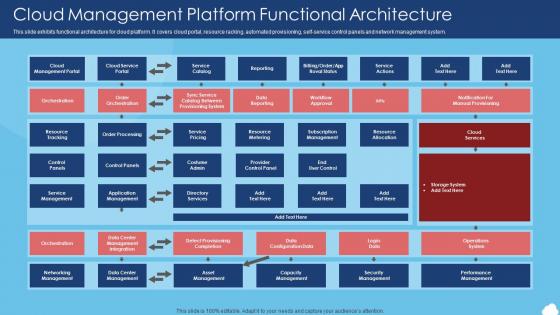
Cloud Management Platform Functional Architecture




Try Before you Buy Download Free Sample Product
 Impress Your
 Audience
 100%
100% Editable
 Save Hours
 of Time


This slide exhibits functional architecture for cloud platform. It covers cloud portal, resource racking, automated provisioning, self-service control panels and network management system.
People who downloaded this PowerPoint presentation also viewed the following :
Cloud Management Platform Functional Architecture with all 6 slides:
Use our Cloud Management Platform Functional Architecture to effectively help you save your valuable time. They are readymade to fit into any presentation structure.





FAQs for Cloud Management
So you're gonna want automated provisioning and scaling - that's the bread and butter stuff. Real-time monitoring with good analytics is clutch too. Policy-based governance lets you control who can spin up what (trust me, you need this). Multi-cloud support is basically required now unless you love vendor lock-in. Cost optimization tools are great for catching waste you didn't even know about. Oh, and workload placement that automatically picks the best cloud or region based on performance and cost. Honestly the whole point is getting visibility without having to babysit everything manually.
So basically a CMP shows you exactly where all your cloud money's disappearing to - across every service and account. Budget alerts are clutch, set those up first or you'll get hit with some brutal surprise bills. The optimization stuff is pretty sweet too, finds idle resources and suggests rightsizing you'd never catch yourself. Cost forecasting helps you plan ahead instead of just reacting. Oh and the reporting breaks everything down by team or project which is super helpful for accountability. Honestly just having that real-time visibility changes everything - no more mystery charges eating your budget.
Honestly, automation is what makes cloud platforms actually worth using. Without it you're stuck doing everything manually which sucks. It handles the boring stuff - scaling up when you get traffic spikes, spinning up new environments, patching systems. Cost optimization too since it'll kill unused instances (saves you money). Security policies stay consistent across everything which is huge. The best part? Your team can work on interesting projects instead of babysitting servers all day. I'd start with whatever manual task is eating up most of your time right now.
So your CMP turns into this central hub where you can see everything happening across your cloud stuff. Pretty handy actually. Set up those automated compliance checks and keep your security policies consistent everywhere. Most platforms come with templates for the big frameworks - SOC 2, GDPR, all that - which saves you tons of time honestly. They'll catch sketchy configurations before they blow up on you. Plus access controls become way easier to manage. I'd start by figuring out what compliance stuff actually matters for your company first, then build out those monitoring rules. Don't try to do everything at once though.
Oh man, integration issues will definitely bite you first - nothing wants to connect properly. Plus the costs always end up way higher than anyone expects, which is super annoying. Training takes forever too, like way longer than you'd think. Your current tools won't cooperate at all. Finance team needs to be on board from day one or you're screwed. Honestly, just do a small pilot first instead of going all-in. Budget extra time for everything. Getting different cloud environments to actually work together is such a headache.
So basically a CMP is like having one control center for all your cloud stuff - AWS, Azure, Google Cloud, whatever you've got running on-premises. No more bouncing between different dashboards (seriously, who has time for that?). Everything's in one spot: spinning up resources, keeping an eye on performance, managing costs. It smooths out all the API differences automatically. You can set the same policies everywhere and actually see where your money's going. Oh, and moving workloads between clouds becomes way less of a headache. I'd start by listing what clouds you're using now and figure out what's driving you crazy about managing them separately.
Track resource utilization first - compute, storage, network stuff. Shows if you're actually saving money or just moving it around. Response times matter too because waiting 3 hours for a VM is brutal. I'd also watch cost savings (the whole point, right?) and any compliance mess-ups. Platform uptime is huge - hard to manage anything when your tools are broken. Honestly, throw these on a dashboard and check weekly. Security incidents should be on there too, obviously. Catches problems before they become disasters.
Think of a CMP like a shared dashboard where your IT folks and devs can finally see what's going on with cloud stuff. No more endless back-and-forth about deployments or who's using what resources. Developers get to self-serve some things through automated workflows, but IT still keeps the important controls in place. Honestly, it's pretty satisfying when teams stop working in their own bubbles and start using the same data. The visibility into costs and performance alone makes conversations way more productive. I'd say figure out what's driving everyone crazy right now - that's your starting point for which features matter most.
So AI in your CMP is honestly a game changer for automation. Predictive analytics help forecast what resources you'll need, plus it automatically shuts down stuff you're not using to save money. Security-wise, it catches threats way before they blow up into actual problems. The ML algorithms get smarter about your usage patterns over time - which is kinda wild when you think about it. Your ops team will definitely appreciate the anomaly detection flagging issues early. Oh, and automated fixes for common problems without bugging anyone. I'd start with cost optimization first since you'll see results immediately and it builds trust in the whole AI thing.
So CMPs basically give you automated backups and real-time replication across different cloud regions. When stuff breaks (and it will), you get instant failover that actually works. The recovery workflows are pretty slick - they'll automatically spin up resources in other zones if your main setup dies. Plus the dashboards are solid for tracking your recovery times and testing disasters without breaking production. Honestly feels like having insurance that pays out lol. I'd start by mapping out your critical stuff first, then set up cross-region replication for your most important data.
Oh man, vendor lock-in is such a trap! Basically you get hooked on one platform's specific tools and APIs. Your team gets used to their workflow, you build integrations around it, and your data ends up in their format. Switching later? Brutal and expensive. The real kicker is losing bargaining power - they can jack up prices or change features and you're stuck. I learned this the hard way at my last job, honestly. Before picking anything, just check they've got standard APIs and you can actually export your data if needed.
So a CMP is basically your DevOps control room. It handles all the infrastructure setup automatically and lets your dev teams grab cloud resources whenever they need them - no more waiting around. The cool part? It connects CI/CD pipelines that scale up or down based on what's happening. Honestly, the biggest win is getting dev and ops to actually work together instead of constantly fighting. Both sides can see costs, performance, all that stuff in one place. Developers get their test environments instantly while ops keeps everything from going completely off the rails budget-wise. I'd start with whatever's slowing you down most - usually it's spinning up new environments.
Honestly, your CMP is toast without proper user training. People will just go back to doing things manually if they don't get it. Start with comprehensive onboarding covering both tech features and workflow changes. Resistance is inevitable - nobody likes change, right? But once they see how much time it saves on provisioning and monitoring stuff, they'll come around. Don't just do one training session and call it done though. Set up ongoing support channels. Oh, and find your power users first - they'll become your biggest advocates internally.
So basically a CMP lets you see all your compliance stuff in one place across different clouds. Pretty clutch when you're juggling GDPR, SOX, HIPAA - whatever applies to you. It'll automatically enforce things like data residency and encryption based on where your workloads live. Audit trails get tracked automatically too, which honestly saved my team's ass last review cycle. The cool part? Policies adjust themselves depending on jurisdiction requirements. I'd start by figuring out what regulations actually hit your cloud setup first, then build your CMP policies around that.
Honestly, the automation stuff is getting wild - platforms can predict what resources you need and scale up without anyone touching anything. Most companies are dealing with AWS, Azure, and GCP all at once now, so multi-cloud orchestration is becoming essential. Edge computing's blowing up with all the IoT devices everywhere. The security features are actually pretty impressive too, they're catching threats in real time. Oh, and sustainability tracking is trendy since everyone wants to measure their carbon impact. I'd start looking at platforms with these features now. You might not need them today, but trust me, you will.
-
Content of slide is easy to understand and edit.
-
“I required a slide for a board meeting and was so satisfied with the final result !! So much went into designing the slide and the communication was amazing! Can’t wait to have my next slide!”