


Agile Business Architecture Framework Diagram




Try Before you Buy Download Free Sample Product
 Impress Your
 Audience
 100%
100% Editable
 Save Hours
 of Time


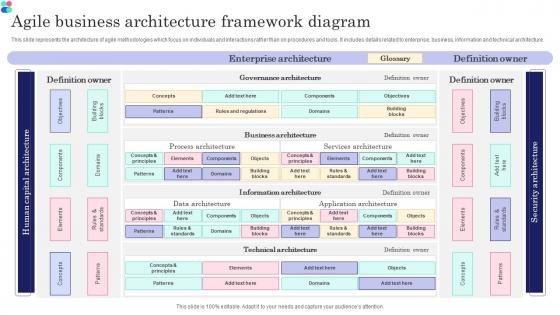
This slide represents the architecture of agile methodologies which focus on individuals and interactions rather than on procedures and tools. It includes details related to enterprise, business, information and technical architecture.
People who downloaded this PowerPoint presentation also viewed the following :
Agile Business Architecture Framework Diagram with all 6 slides:
Use our Agile Business Architecture Framework Diagram to effectively help you save your valuable time. They are readymade to fit into any presentation structure.





FAQs for Agile Business
So basically, work in short cycles and get feedback constantly - don't vanish for months building some giant framework nobody wants. Collaborate with stakeholders early and keep things flexible. Business needs change, so your architecture should too. I learned this the hard way at my last job, honestly. Focus on delivering real value instead of perfect documentation. Start small and stay lightweight. When priorities shift (and they will), be ready to pivot quickly. The whole point is being adaptive rather than rigid.
So basically, Agile Business Architecture is all about building as you go instead of planning everything upfront. TOGAF and those traditional frameworks? They want you to document every tiny detail before touching any code - honestly, half that stuff ends up useless anyway. With agile, you just architect what you need for your current sprint, then adjust when you learn something new. You're always checking with real users instead of guessing what they want. Way more practical. Your architecture actually stays current this way. Oh, and start with your most important business capabilities first - don't try to boil the ocean.
Look, you can't do Agile Business Architecture without getting everyone involved from the start. Business users, IT folks, leadership - they all need to be giving you feedback constantly, not just signing off at the end. I mean, it's like having a cooking buddy taste-testing as you go (which honestly saves you from disasters). Regular check-ins help you spot problems early before they blow up. The whole thing falls apart if stakeholders aren't bought in. My advice? Map out who matters most and set up those touchpoints right away. Don't wait.
Track cycle times for architecture decisions and stakeholder satisfaction - those are your bread and butter metrics. But here's the thing: if business people aren't actually using your models and frameworks day-to-day, you've got a problem. That's honestly more important than delivery speed or defect rates. Engagement is everything. Set up quarterly reviews to see if your architecture evolution matches business strategy. Oh, and measure stakeholder engagement first - it'll tell you way more than the other stuff. It's like your early warning system.
Honestly, I'd start with ArchiMate for architecture modeling and maybe TOGAF but with way shorter cycles. Lean Canvas works great for business model stuff. For collaboration, Miro or Lucidchart are solid - seriously, getting everyone staring at the same diagrams solves like half your problems right there. Value stream mapping keeps you focused on what customers actually care about instead of just internal mess. Mix some Design Thinking workshops with regular architecture reviews. Oh, and don't try to architect everything upfront - that's a recipe for disaster. Pick one business capability and build from there.
So basically, agile business architecture helps you ditch those rigid enterprise plans that take months to change. You break everything into smaller, modular pieces that can actually pivot when stuff happens. The cool part? You're getting constant feedback instead of building based on guesses. Teams collaborate way better since everyone's working from the same flexible blueprint - no more silos everywhere. Markets shift fast these days, so having something that adapts quickly is pretty crucial. I'd honestly start small though. Pick your most unpredictable business areas and run some lightweight experiments there first. Way less risky than overhauling everything at once.
So Agile Business Architecture is basically your GPS for digital transformation. You break down big scary overhauls into bite-sized pieces that actually deliver results fast. Map out where you currently are first though - can't plan a route without knowing your starting point, right? The whole thing keeps you focused on real business wins instead of just shiny new tech for tech's sake. Honestly, most companies jump straight into massive changes and wonder why everything crashes and burns. This approach lets you move in chunks that make sense and don't break the bank.
Honestly, the biggest pain is getting people to actually change - everyone's so used to waterfall that agile feels weird. Business teams especially hate the iterative thing since they want to plan everything once and be done. Multiple departments moving at totally different speeds? Nightmare. Plus you're constantly juggling documentation needs with trying to stay flexible, which is basically impossible. Resource allocation gets super messy too when priorities keep shifting. My advice? Start with like one small pilot project first. Prove it works before you try rolling it out everywhere - trust me on this one.
So basically, Agile Business Architecture lets you actually listen to what customers want instead of just doing whatever's easiest internally. You're constantly testing ideas with real people and pivoting when stuff doesn't work - way better than those old waterfall methods that take forever. The whole point is building processes that serve customers, not just make your life easier (though honestly, it usually does both). Start by mapping out how customers currently interact with you and find the biggest headaches to fix first. It's pretty much the only approach that makes sense anymore.
Track your delivery speed first - how fast you're shipping changes and getting feedback. Business impact matters more though. Look at stuff like process efficiency gains, less technical debt, better customer satisfaction. Time-to-market improvements are gold (executives eat that up). Are people actually using what you build? That's huge. Don't go crazy with tons of metrics - pick 3-4 that connect to your company's big goals. Review them in retrospectives. Honestly, I'd probably start with delivery speed and one business metric, then add more later.
So with agile business architecture, you get these feedback loops that catch problems way faster than waiting around for yearly reviews. Instead of guessing, you're actually measuring how your business capabilities match up with real results. When something's off, you can change direction quickly. Honestly, it's kind of like having a control panel for your whole company - which sounds intense but it's actually super helpful. The whole thing works because you're always testing stuff, learning from it, then tweaking your approach. I'd start with regular team check-ins to spot gaps and figure out what's worth fixing first.
Dude, iterative development is a game-changer for agile architecture. Instead of planning everything upfront (which never works anyway), you build in small pieces and adjust as you go. Test your assumptions early, grab feedback from people, and don't be afraid to change direction. Trust me, pivoting happens way more than anyone wants to admit! You'll dodge that awful trap where you spend forever designing something "perfect" that totally flops in real life. Each round teaches you something new about what the business actually needs. Oh, and always start with your most critical stuff first - everything else can wait.
So cross-functional teams are basically just mixing people from different departments instead of keeping everyone in their little bubbles. You grab folks from IT, business analysts, operations, maybe finance - whoever actually matters for what you're building. The whole point is they work together on problems instead of that awful game of telephone where everyone passes stuff along and nothing gets done right. These teams can actually make decisions without having to ask their boss's boss every time, which is honestly refreshing. Just make sure everyone gets both the tech stuff and the business side. Oh, and don't go crazy - only include the departments you actually need for your specific project.
Honestly, you need tools that actually speed things up instead of creating more bureaucracy. Cloud platforms and modeling tools are game-changers - they let teams prototype and test ideas fast without waiting weeks for approvals. Collaborative stuff like Miro beats shuffling PowerPoint decks around (we've all been there). APIs help too since they connect everything smoothly. The real win is getting business and IT talking faster. I'd start by looking at where you're doing manual handoffs - that's usually where things get stuck. Pick tools that give everyone visibility into what's happening.
Don't try to overhaul everything at once - that's a recipe for disaster. Pick a pilot project and layer in some Agile BA stuff like iterative capability mapping. Honestly, most EA teams I know are buried under documentation nobody reads anyway, so lighter docs usually make everyone happier. Set up regular planning sessions between your business architects and solution teams - those collaboration rhythms are what make it work. Business architecture artifacts need to flex with changing requirements. Start with one domain, show it works, then spread it around. Way less risky than a big bang approach.
-
I never had to worry about creating a business presentation from scratch. SlideTeam offered me professional, ready-made, and editable presentations that would have taken ages to design.
-
I faced no difficulty while searching for the slide I wanted. Honestly, the website’s interface is easy to use and can be navigated easily!