


Generic Data And Analytics Architecture Framework




Try Before you Buy Download Free Sample Product
 Impress Your
 Audience
 100%
100% Editable
 Save Hours
 of Time


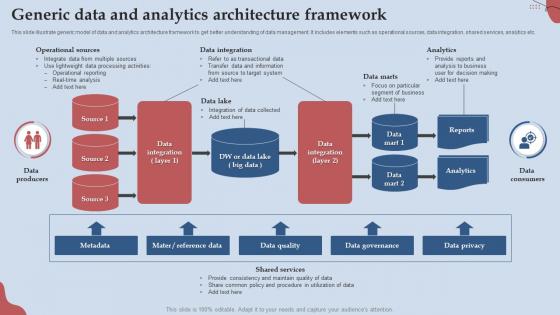
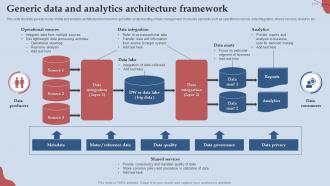
This slide illustrate generic model of data and analytics architecture framework to get better understanding of data management. It includes elements such as operational sources, data integration, shared services, analytics etc.
People who downloaded this PowerPoint presentation also viewed the following :
Generic Data And Analytics Architecture Framework with all 6 slides:
Use our Generic Data And Analytics Architecture Framework to effectively help you save your valuable time. They are readymade to fit into any presentation structure.





FAQs for Generic Data And
Core components include data sources, ingestion layers, storage systems, processing engines, and presentation interfaces, along with governance frameworks and security protocols. These components work together by capturing data from multiple sources, transforming it through automated pipelines, and delivering actionable insights to stakeholders, with many organizations finding that this integrated approach streamlines decision-making and enhances operational efficiency.
A generic data architecture supports diverse data sources and formats through standardized APIs, flexible data ingestion pipelines, schema-on-read capabilities, and universal data transformation layers. These components enable organizations to seamlessly integrate structured databases, unstructured files, and real-time streams, ultimately delivering unified analytics and faster decision-making across retail, healthcare, and financial services sectors.
Data governance establishes the policies, standards, and procedures that ensure data quality, security, and compliance across all architectural layers. It enables organizations to maintain consistent data definitions, access controls, and regulatory adherence, while streamlining data stewardship processes, ultimately delivering trusted analytics and operational efficiency.
Scalability and flexibility in generic data architecture enable organizations to adapt storage capacity, processing power, and analytical capabilities as business needs evolve, supporting growth without complete system overhauls. These capabilities streamline resource allocation, reduce infrastructure costs, and accelerate decision-making processes, with many enterprises finding that adaptable architectures deliver competitive advantages in rapidly changing markets.
Best practices for integrating legacy systems include API-based connectivity, data virtualization layers, ETL pipeline modernization, incremental migration strategies, and standardized data formats. These approaches streamline integration by preserving existing investments, minimizing operational disruption, and enabling real-time data flow, with many organizations finding that phased modernization delivers enhanced efficiency while maintaining business continuity.
A generic data architecture enhances security and compliance by establishing standardized access controls, encryption protocols, audit trails, and governance frameworks across all data touchpoints. This systematic approach enables organizations like financial institutions and healthcare providers to maintain consistent regulatory compliance, automate threat detection, and streamline data protection measures, ultimately reducing security vulnerabilities while ensuring adherence to industry standards.
Cloud technologies integrate into generic data architectures through scalable storage solutions, distributed computing platforms, managed database services, real-time analytics tools, and automated data pipeline orchestration. These cloud-native capabilities enable organizations to streamline data processing, enhance accessibility, and reduce infrastructure costs, with many enterprises finding that hybrid cloud approaches deliver both operational flexibility and strategic competitive advantage.
A generic data architecture facilitates analytics and business intelligence by establishing standardized data pipelines, centralized storage systems, and unified access protocols that streamline information flow across organizations. This framework enables faster query processing, automated reporting, and real-time dashboards, with many enterprises finding that standardized architectures reduce analytics deployment time by 40-60% while enhancing decision-making capabilities.
Common challenges include data integration complexity, ensuring scalability across diverse systems, maintaining data quality and consistency, managing security protocols, and balancing standardization with flexibility requirements. These obstacles often stem from legacy system incompatibilities, varying data formats, and organizational resistance to change, with many enterprises finding that phased implementation approaches and cross-functional collaboration ultimately streamline adoption while delivering improved operational efficiency.
Stakeholders ensure data quality through automated validation rules, comprehensive monitoring systems, standardized cleansing protocols, regular auditing processes, and clear governance frameworks. These mechanisms streamline data accuracy by detecting inconsistencies early, establishing consistent formats, and maintaining reliability standards, with many organizations finding that proactive quality measures ultimately enhance decision-making capabilities and operational efficiency.
Key metrics include data quality scores, processing latency, storage efficiency, system availability, and user adoption rates across different business functions. These measurements enable organizations to assess performance bottlenecks, optimize resource allocation, and ensure scalability, with many enterprises finding that comprehensive monitoring ultimately delivers improved decision-making speed and operational efficiency.
Different industries adapt generic data architecture by customizing storage systems, processing workflows, and security protocols to address sector-specific requirements, compliance standards, and operational demands. Financial services implement real-time fraud detection layers, healthcare organizations integrate patient privacy safeguards and clinical data formats, while retail companies optimize for inventory management and customer analytics, ultimately delivering industry-tailored efficiency and competitive advantage.
A generic data architecture significantly enhances data lifecycle management by standardizing collection, storage, processing, and governance across organizational systems. This standardized approach enables seamless data flow from creation to archival, automated compliance monitoring, and consistent quality controls, with many enterprises finding that it reduces management complexity while accelerating analytics and decision-making processes.
Organizations leverage machine learning within generic data architectures by integrating automated data pipelines, scalable computing resources, and real-time analytics platforms that streamline model development and deployment. Through cloud-based infrastructures, companies in retail, healthcare, and financial services enhance predictive capabilities, automate decision-making processes, and optimize customer experiences, ultimately delivering competitive advantages and operational efficiency.
Emerging trends influencing generic data architecture evolution include cloud-native designs, real-time streaming capabilities, AI-driven automation, edge computing integration, and zero-trust security frameworks. These advancements enable organizations to streamline data processing, enhance scalability across distributed environments, and deliver faster analytics, with many enterprises finding that modern architectures significantly reduce operational complexity while improving competitive advantage.
-
I am extremely pleased with these PPT slides that we used for our event. They were easy to modify and came out great in all aspects!
-
You know what? I'm so glad I opted for this PPT design. It has been a total game-changer for me and my presentations. Thank you!