


Logical Data Mart And Real Time Data Warehouse Architecture




Try Before you Buy Download Free Sample Product
 Impress Your
 Audience
 100%
100% Editable
 Save Hours
 of Time


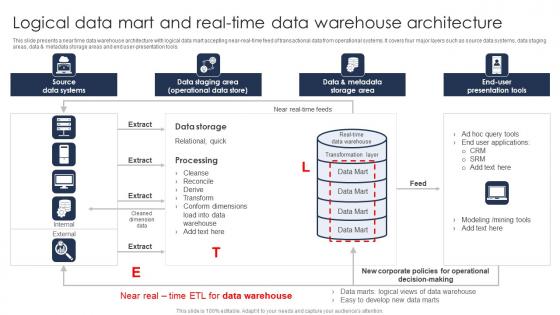
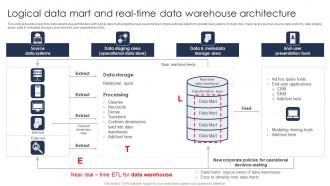
This slide presents a near time data warehouse architecture with logical data mart accepting near-real-time feed of transactional data from operational systems. It covers four major layers such as source data systems, data staging areas, data and metadata storage areas and end user-presentation tools.
People who downloaded this PowerPoint presentation also viewed the following :
Logical Data Mart And Real Time Data Warehouse Architecture with all 6 slides:
Use our Logical Data Mart And Real Time Data Warehouse Architecture to effectively help you save your valuable time. They are readymade to fit into any presentation structure.





FAQs for Logical Data Mart And Real Time
Honestly, you're looking at four core pieces: getting data in, storing it somewhere, processing/transforming it, and governance stuff to keep everything clean. APIs and integration layers are huge too - they're basically what connects everything so your components can actually talk. I'd bake security into each piece from the start rather than adding it later (learned that one the hard way). The real challenge is making sure all these parts work together without creating a mess. Start by mapping your current data flows first, then figure out what's missing or slowing things down.
Honestly, data governance is like the foundation that dictates how you build everything else. Compliance stuff, quality standards, access controls - you've gotta build these in from day one. Retrofitting later? Total pain in the ass, learned that the hard way. Your whole setup needs to track where data comes from, handle retention rules, and sort data into proper categories. It's basically the guardrails that decide data flow, storage locations, and permissions. Oh, and definitely get your governance people involved early when you're planning new systems - they'll save you headaches down the road.
Honestly, cloud tech changes everything about how you handle data. You're not stuck buying crazy expensive servers upfront anymore - just spin up what you need and pay as you go. The whole storage/compute separation thing is brilliant, and disaster recovery gets so much easier when your data's spread across regions. Plus you get all these managed services for data lakes and analytics without having to build everything yourself (which, let's be real, is a pain). I'd say start by figuring out where you're hitting walls with your current setup - that's your best entry point for migration.
So data modeling is like your blueprint for how all your data fits together - where it flows, how it connects, the whole structure. Kind of like designing a house layout but way messier with more people having opinions. You really need this figured out early or you'll hate yourself later when nothing talks to each other properly. It prevents duplicate data and helps teams actually find stuff when they need it. Honestly, most integration headaches come from skipping this step. Start with what the business actually needs, then work backwards to the tech side. Trust me on this one.
Honestly, start thinking about scaling from the beginning or you'll hate yourself later. Cloud services with auto-scaling are a lifesaver - managed databases, serverless functions, that whole thing. Microservices work great but can turn into a nightmare if you don't stay organized (learned that one the hard way). Set up your data pipelines so they won't crash when traffic spikes. Kafka's solid for streaming if you need it. Oh, and partition your data properly from the start. First step though? Figure out where your current system chokes up, then build the next version to fix those exact problems.
Honestly, data contracts are your best friend here - treat them like APIs for data flows. Event-driven stuff beats batch jobs every time (trust me on this one). You're gonna want lineage tracking so debugging doesn't make you want to cry later. Pick your formats early too - JSON's easy, Avro's solid, Parquet if you're doing analytics heavy stuff. Oh and don't try to boil the ocean right away. Grab one important data pipeline, get the patterns right, then copy that approach everywhere else. Way less painful than trying to architect everything perfectly from day one.
So basically, data warehouses make you organize everything upfront - tables, relationships, the whole ETL thing. Kind of like Marie Kondo-ing your data before storing it. Data lakes are the opposite - just dump everything in there and sort it out when you actually need it. JSON files, videos, random logs, whatever. Lakes are way cheaper and flexible, but warehouses give you faster queries since everything's already structured. Honestly depends on your timeline - need answers now or can you wait to clean things up later? I'd probably go warehouse if you're doing regular reporting stuff.
Oh man, data consistency is gonna be your worst enemy - when stuff's scattered across services, keeping it all synced is brutal. Plus you're suddenly monitoring like 15 databases instead of one, which honestly makes debugging a total pain. Network calls between services slow everything down too. Schema changes? Good luck coordinating those across different teams. The ops work just explodes. Seriously though, don't jump into the deep end right away. Try splitting into maybe 2-3 services first so you can feel the pain gradually instead of all at once.
Think of metadata management like having a really good filing system for all your data stuff. It shows you what data exists, where it lives, and how everything connects. No more digging around forever trying to figure out what some random table is supposed to be (honestly the worst part of any project). When things break, you can trace the lineage and see what else got messed up downstream. Makes compliance way less painful too since you actually know where your data flows. Oh, and don't go crazy trying to catalog everything at once - just start with your most important datasets first.
Start with encryption - both at rest and in transit, that's your baseline. Role-based access is huge too, keeps people from seeing stuff they shouldn't. For the really sensitive data like PII, you'll want masking and tokenization. Network segmentation helps a ton, especially with mixed data types. Audit logging is boring but honestly a lifesaver when someone inevitably asks who touched what. The trick is baking this into your design from the start instead of scrambling to add it later. Build your threat model first, then work backwards - saves you so much headache down the road.
Dude, you can't just pump up your old SQL databases and expect them to handle big data - learned that the hard way. The whole architecture needs to change. You're looking at distributed systems now, stuff that can actually deal with tons of data coming from everywhere at once. Cloud setups, data lakes, real-time processing with Spark or Kafka - it's honestly pretty cool once you get into it. Decoupling storage from compute is huge so you can scale each separately. First step? Figure out how much data you're actually dealing with and where it's headed. That'll show you what to fix first.
So you're basically flipping everything upside down - no more batch processing, hello streaming data. Your ETL pipelines become continuous flows instead. Hot data needs instant access while cold storage sits in the background. Kafka is honestly a game changer for event-driven stuff (trust me on this one). Data quality checks get complicated since you can't do long validations anymore. Here's the thing though - figure out what actually needs real-time first. Most data doesn't, and you'll save yourself major headaches and costs by being picky about it.
Honestly, you're probably way over-provisioning right now – most companies do that at first. Set up auto-scaling so you're not paying for stuff you don't actually need. For storage, put your hot data on fast drives and dump the old archives onto cheaper cold storage. Cloud pay-as-you-go beats buying a ton of hardware upfront, trust me on that one. Oh, and don't optimize based on your worst-case scenarios. Run it for a couple months, see what you're actually using, then adjust. Way better than guessing.
For orchestration, grab Apache Airflow or Prefect - both are solid choices. Cloud storage is pretty much a must, so go with S3 or Azure Data Lake for your raw stuff. Processing-wise, Spark works great, but honestly? Everyone's obsessed with dbt right now for transformations, and I kinda get why. Your warehouse should be something modern like Snowflake or BigQuery. Oh, and definitely get monitoring set up - Monte Carlo or Great Expectations will save your sanity when data goes wonky. Just pick one tool per category first though. Don't overcomplicate it from the start.
So basically, good data architecture makes agile way smoother by keeping things modular and flexible. Your data components should be loosely coupled - kinda like microservices but for data. That way when requirements change (and they always do), you're not breaking everything downstream. APIs help abstract the messy stuff, and your schemas need to handle those constant iterations without falling apart. Honestly, rigid data dependencies are sprint killers. Teams get blocked constantly. I'd start by mapping out your current data flows first. Find where the biggest bottlenecks are slowing you down - that's usually where you'll get the most bang for your buck.
-
It saves your time and decrease your efforts in half.
-
“As you have innovative ideas and they are all customizable, this saves a huge chunk of your time to prepare well-read presentations.”