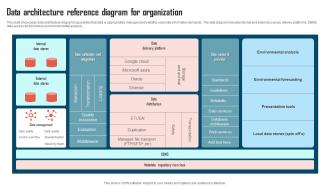
Data Architecture Reference Diagram For Organization
Try Before you Buy Download Free Sample Product
Audience
Editable
of Time
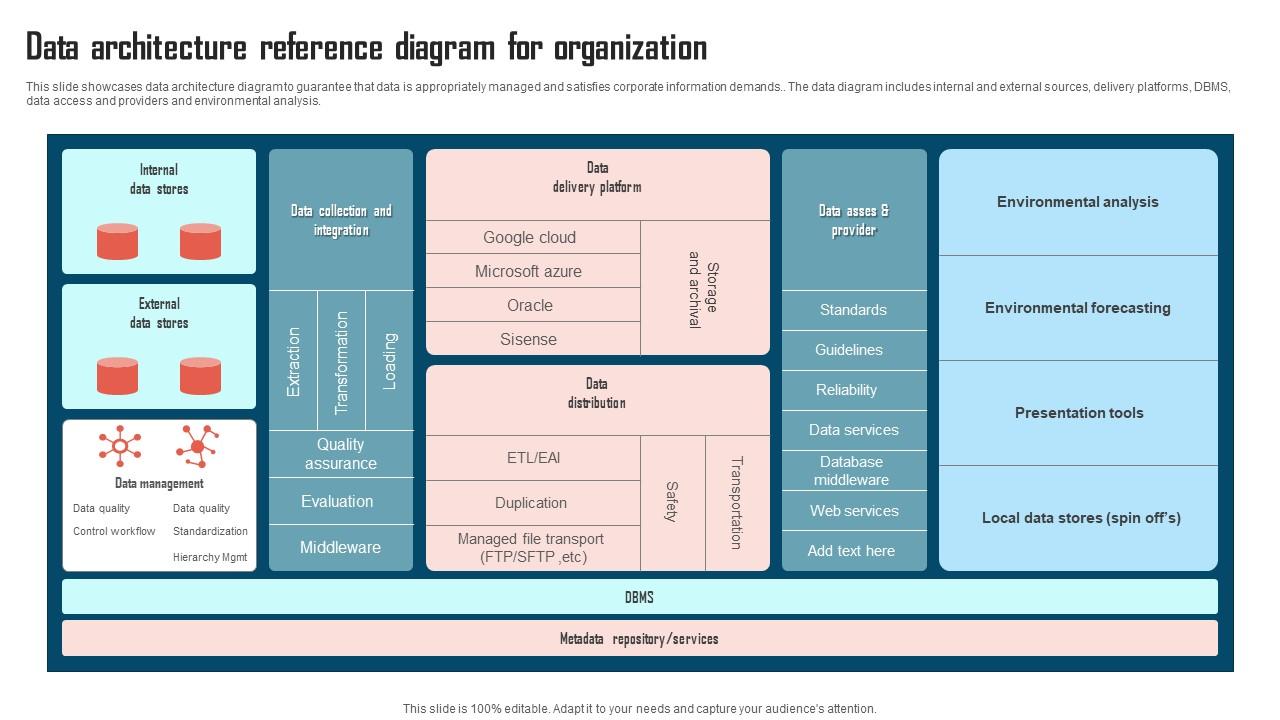
This slide showcases data architecture diagram to guarantee that data is appropriately managed and satisfies corporate information demands. The data diagram includes internal and external sources, delivery platforms, DBMS, data access and providers and environmental analysis.
People who downloaded this PowerPoint presentation also viewed the following :
Data Architecture Reference Diagram For Organization with all 6 slides:
Use our Data Architecture Reference Diagram For Organization to effectively help you save your valuable time. They are readymade to fit into any presentation structure.
FAQs for Data Architecture Reference
So you'll need the basic stuff first - ways to get data in, somewhere to store it (data lakes or warehouses), and processing engines for transformations. APIs handle access. Then there's orchestration tools for workflows, monitoring, and governance layers for security compliance crap. The "modern" label just means cloud-native and scalable these days. Here's what I'd do though - map your current data flows first. Shows you what you actually need vs. all the shiny vendor demo features. Way better to solve real problems than build some fancy stack that looks impressive but doesn't work.
Look, data governance literally makes or breaks everything. Without it, you get messy data definitions and nobody knows who's responsible for what - total nightmare. I learned this the hard way at my last job, honestly. You need clear ownership rules and quality standards upfront, or your systems won't talk to each other properly. Good governance means setting up data stewardship roles first. Then add some basic quality metrics. Trust me, it's like having building codes for your data house. Skip this step and you'll hate yourself later when everything's chaos.
Cloud computing completely flipped data architecture on its head. Instead of those clunky on-premise setups, you get flexible systems that actually scale. Spin up data lakes or warehouses in minutes now - used to take forever. The best part? You're not stuck with bad early decisions (we've ALL made those). Storage and compute can scale separately, which is honestly brilliant. Try new tools without dropping serious cash upfront. Plus integration that would've required custom dev work before is basically plug-and-play now. My advice? Pick one cloud data service and just start playing around with it.
Dude, build quality checks right into your system from the start - don't try to patch them in later, it's a nightmare. Automated validation at ingestion points is clutch. Data profiling catches weird stuff early too. The governance part? That's honestly where everyone screws up. People won't just magically follow standards without structure. Make sure there's clear ownership for each data area and create feedback loops so issues get fixed at the source, not when it's too late downstream. Oh, and focus on your most critical datasets first - get those rock solid before moving on.
First thing - figure out what data you actually need instead of just grabbing everything. APIs or middleware will save your sanity vs direct database connections (trust me on this). Don't try lifting everything at once, I've watched that disaster play out too many times. Pick your battles based on business value and how clean the data is. Migration should happen in chunks with validation after each step. You'll want monitoring set up early to catch problems before they snowball. Oh, and test in staging that actually matches production - can't stress that enough.
Think of data architecture like the foundation of your house - mess that up and everything else falls apart. Clean pipelines and organized schemas? Your team pulls insights super fast. Scattered data across random systems with wonky formats? You're basically debugging instead of analyzing. Honestly, I've watched entire teams burn through months just hunting for usable data (so frustrating). Short version: build it right from the start. Your dashboards and reporting will thank you later, and you won't hate your job.
Honestly, data silos are going to be your worst enemy. Different teams all want their stuff handled their way, which gets messy fast. Scalability bites you later when you didn't plan for growth. Security and compliance? Total pain, especially in regulated industries - learned that one the hard way. Legacy system integration is always worse than expected. Quality control becomes impossible when you're pulling from everywhere. Oh, and stakeholder buy-in takes forever. Start with a pilot project though. Get everyone aligned upfront and plan for way more data than you think you'll need.
Honestly, AI totally flips data architecture on its head. You're not just storing stuff anymore - you're feeding these super demanding algorithms that want clean, massive datasets. Real-time streaming becomes crucial. Model training pipelines too. And wow, these models are ridiculously picky about data quality, way more than I expected when I first started working with them. Feature stores and model versioning should be planned early, trust me. Experiment tracking is huge too. Figure out your actual use cases first, then design backwards from there to build what you really need.
Don't make the mistake of adding security after you build everything - bake it in from day one. Encrypt your data when it's stored and when it moves around. Set up proper access controls where people only get what they actually need to do their job. Oh and seriously, segment your network properly. I see way too many places where everything can talk to everything because someone got lazy with the config. Map out which data is most sensitive first, then work backwards from there. Also figure out your data classification early so you're not protecting cat photos like they're social security numbers.
Honestly, good data architecture is a game changer - you'll actually trust your numbers instead of second-guessing everything. No more wasting time digging through spreadsheets or wondering if your data's even accurate. It kills those stupid silos where marketing can't see what sales is doing (so annoying). You catch problems early. Decisions happen faster because you're working with real info, not just your best guess. Oh, and definitely set up governance rules early - learned that one the hard way. Your whole team ends up seeing the complete picture for once.
Think of data modeling as your blueprint for how info moves around your system. I've watched teams skip this step and regret it later - total nightmare to fix. It maps out relationships between different data pieces and sets up integrity rules so nothing breaks. Your architecture won't scale properly without it, plus you'll end up with those annoying data silos that make everyone's job harder. Performance suffers too. Start by looking at your main business processes, then work outward from there. Way easier than trying to retrofit everything later.
Yeah so with microservices, each service gets its own database which sounds cool until you realize you can't just JOIN tables anymore like the good old days. Data consistency becomes this whole thing with events and APIs instead of normal ACID transactions. Honestly feels messy at first but your teams won't be blocked by each other constantly, which is nice. Plus each service can use whatever database actually makes sense for it. Oh and seriously - map out your data boundaries before you start chopping things up. I learned that the hard way.
So basically, centralized means everything goes through one main system - like a data warehouse that controls all your info. Decentralized is the opposite: teams handle their own data across different systems. Centralized gives you way better control and keeps things consistent, but changes take forever. With decentralized, teams move fast and stay flexible. Problem is, it can get messy real quick - I've seen companies where nobody knows what data to trust anymore. Honestly depends on your company size. Small teams? Go decentralized. Big org that needs tight control? You'll probably want centralized.
Yeah, so basically you want both - they work great together. Raw messy stuff like logs, social media posts, IoT data? Dump that in your data lake. Perfect for ML projects and exploring weird patterns. Your clean business data though - that belongs in the warehouse for reports and dashboards. Honestly, most companies I've seen do this hybrid thing now. The lake's good for "maybe we'll need this someday" data, while the warehouse handles your daily operations. Just figure out what needs to be structured right away vs what can sit there looking ugly until someone has time to analyze it.
Honestly, cloud-native is just gonna be everywhere - no getting around it. Real-time streaming too. And yeah, AI/ML is finally getting built right into the platforms instead of being this awkward afterthought. The whole "modern data stack" thing is kinda played out as a term, but the idea's still good. You want tools that actually work together through APIs. Data mesh is picking up steam where teams own their own data instead of bottlenecking through one group. Makes sense if you think about it. Oh, and privacy stuff will keep driving how we build things from the ground up. Start messing around with event-driven architectures now and learn containers. Those'll be basics soon enough.
-
Based on my personal experience, I would recommend other people to subscribe to SlideTeam. No one can be disappointed here!
-
Qualitative and comprehensive slides.