


Enterprise application architecture with business and data




Try Before you Buy Download Free Sample Product
 Impress Your
 Audience
 100%
100% Editable
 Save Hours
 of Time


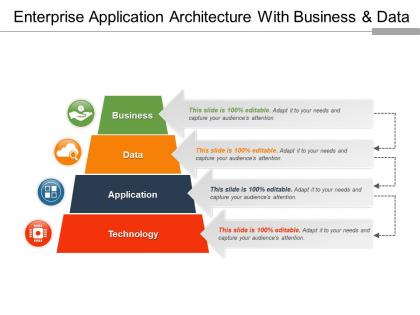
Utilize this Enterprise Application Architecture With Business And Data PowerPoint presentation to increase the overall efficiency of the firm. The long-term evolution of IT systems can be highlighted using this enterprise information technology PPT layout. The vital significance of enterprise software architecture implementation in determining an organization's success can be highlighted using our business software PowerPoint theme. Taking the assistance of this internal organization PPT theme, you can discuss the features of the business software architecture. Also, the merits of implementing company application to your institution such as flexibility, maintainability, reusability, and simplicity can be highlighted using this company software PowerPoint layout. The four-tier structure of the firm application namely the business, data, application, and technology can be showcased by incorporating this IT PPT theme. The organized growth and development of an organization’s information can be demonstrated by employing this institution software PowerPoint template. Download this technology advancement PowerPoint theme to minimize system complexity, thereby increasing overall efficiency.
People who downloaded this PowerPoint presentation also viewed the following :
Enterprise application architecture with business and data with all 5 slides:
Give them the confidence that they can be fit again with our Enterprise Application Architecture With Business And Data. It helps aid the infirm.
FAQs for Enterprise application architecture with
Key components of an effective enterprise architecture framework include business architecture, application architecture, data architecture, technology infrastructure, and governance structures. These elements work together by aligning strategic objectives with technical capabilities, standardizing processes across departments, and enabling scalable digital transformation, with many organizations finding that integrated frameworks reduce operational complexity while accelerating innovation initiatives.
Enterprise architecture aligns business strategy with IT infrastructure by creating comprehensive frameworks that map strategic objectives to technology capabilities, establishing governance processes, and ensuring systematic integration across all organizational layers. Through detailed blueprints and roadmaps, organizations streamline operations, optimize resource allocation, and accelerate digital transformation initiatives, ultimately delivering enhanced agility and competitive advantage in increasingly complex business environments.
Enterprise architecture serves as the strategic blueprint for digital transformation, aligning technology investments with business objectives, standardizing processes, and ensuring seamless integration across systems. Through comprehensive frameworks, organizations streamline operations, reduce redundancy, and accelerate innovation deployment, with many financial services and healthcare institutions finding that structured EA approaches deliver faster transformation outcomes and sustainable competitive advantage.
Organizations can measure enterprise architecture effectiveness through key performance indicators like system integration speed, cost reduction percentages, compliance adherence rates, and business process efficiency metrics. These measurements enable companies to track how architecture decisions streamline operations, reduce redundancies, and accelerate digital transformation initiatives, with many enterprises finding that systematic EA assessment ultimately delivers measurable competitive advantages.
Common implementation challenges include resistance to change, siloed departmental structures, legacy system integration complexities, insufficient executive sponsorship, and resource allocation conflicts. Large organizations often struggle with coordinating across multiple business units while managing technical debt, with many finding that phased approaches and strong governance frameworks help minimize disruption and deliver measurable transformation outcomes.
Enterprise architecture facilitates better decision-making by providing standardized frameworks, centralized data governance, and cross-functional visibility into business processes and technology dependencies. Through integrated dashboards and unified information systems, departments can access consistent data, understand interdependencies, and align initiatives with organizational strategy, ultimately reducing silos and enabling more informed, coordinated decisions across the enterprise.
Essential enterprise architecture tools include modeling platforms like TOGAF and ArchiMate, repository management systems, visualization software such as Lucidchart and Visio, integration platforms, and governance frameworks. These technologies streamline architectural planning, enhance cross-departmental collaboration, and automate documentation processes, with many organizations finding that strategic tool combinations deliver faster decision-making and improved operational alignment.
Enterprise architecture supports regulatory compliance and risk management by establishing standardized governance frameworks, implementing consistent data management protocols, and creating transparent audit trails across all systems. Through systematic risk assessment processes and automated compliance monitoring, organizations streamline regulatory reporting, minimize operational vulnerabilities, and ensure consistent policy enforcement, ultimately delivering enhanced regulatory transparency and reduced compliance costs.
Enterprise architecture addresses interoperability by establishing standardized protocols, common data formats, unified APIs, and integration frameworks that enable seamless communication across diverse systems. Through strategic middleware solutions and service-oriented architectures, organizations streamline data exchange, reduce operational silos, and enhance workflow efficiency, ultimately delivering faster decision-making and improved customer experiences.
**INPUT**: What are the best practices for documenting and communicating enterprise architecture? **OUTPUT**: Best practices include creating standardized visual models, maintaining centralized repositories, establishing clear governance frameworks, using stakeholder-specific views, and implementing regular review cycles. These approaches streamline communication by delivering consistent documentation, enabling cross-functional collaboration, and providing accessible roadmaps, with many organizations finding that structured visualization ultimately enhances strategic alignment and accelerates decision-making processes. **Word count: 55 words**
Organizations ensure stakeholder buy-in for enterprise architecture initiatives by demonstrating clear business value through cost savings projections, operational efficiency gains, and competitive advantage outcomes. Strategic communication that connects EA benefits to specific departmental goals, combined with phased implementation showcasing quick wins, helps executives and operational teams recognize tangible value, ultimately building sustained organizational support.
Enterprise architecture evolves through continuous assessment frameworks, agile design principles, cloud-first strategies, API-driven integrations, and real-time monitoring capabilities. Organizations increasingly adopt modular architectures that enable rapid technology adoption, with financial services and healthcare institutions finding that flexible, scalable frameworks deliver faster innovation cycles and enhanced competitive positioning.
Enterprise architecture and agile methodologies present both challenges and opportunities, requiring strategic balance between long-term structural planning and iterative development cycles. While traditional EA emphasizes comprehensive upfront design, agile EA frameworks enable adaptive architecture through incremental planning, continuous stakeholder feedback, and flexible governance models, with many organizations finding that this hybrid approach delivers faster innovation while maintaining architectural coherence and strategic alignment.
Enterprise architecture enhances customer experience by creating integrated systems that enable seamless interactions across channels, personalized services, and faster response times. Through unified data platforms and streamlined processes, organizations can deliver consistent experiences while reducing friction points, with many retail and financial services companies finding that strategic architecture alignment significantly improves customer satisfaction and retention.
Future trends shaping enterprise architecture include cloud-first strategies, API-driven integration, microservices adoption, AI-powered automation, and hybrid infrastructure models. These approaches streamline organizational agility by enabling faster deployment, reducing operational complexity, and enhancing scalability, with many enterprises finding that strategic architecture evolution delivers competitive advantage and improved customer experiences.
-
Colors used are bright and distinctive.
-
The content is very helpful from business point of view.