Business Architecture Service Reference Model
Try Before you Buy Download Free Sample Product
Audience
Editable
of Time
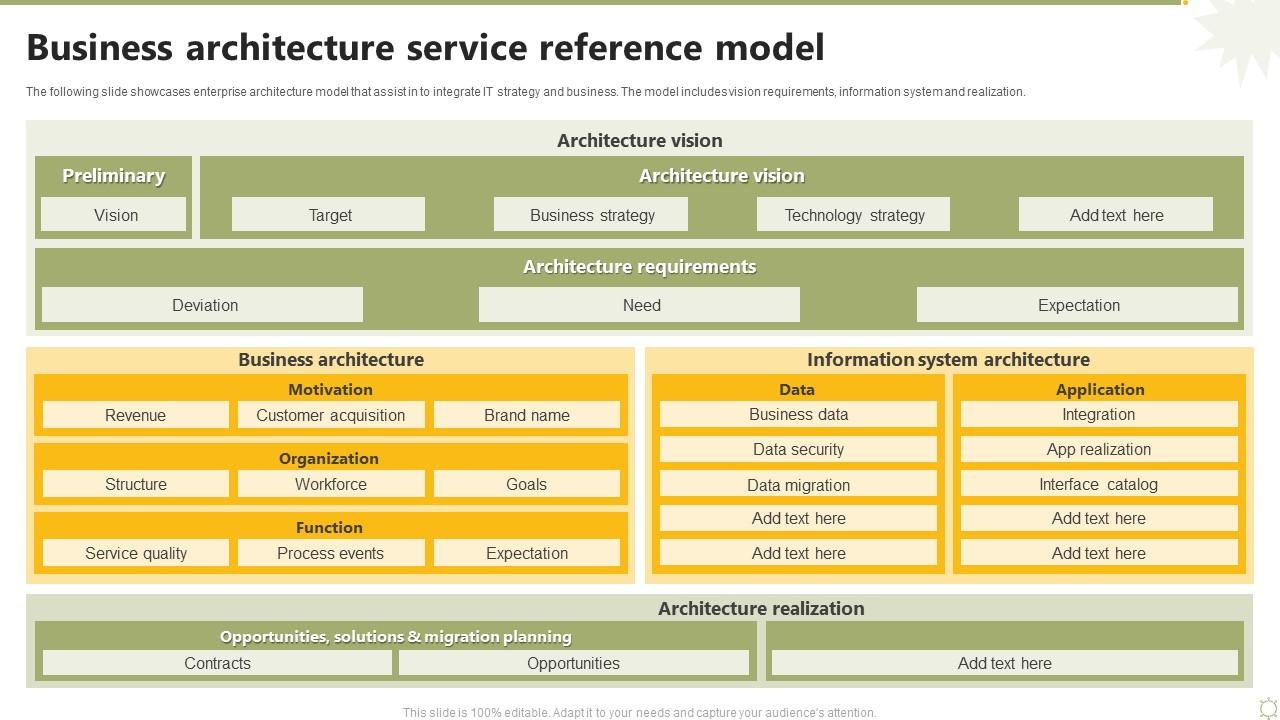
The following slide showcases enterprise architecture model that assist in to integrate IT strategy and business. The model includes vision requirements, information system and realization.
People who downloaded this PowerPoint presentation also viewed the following :
Business Architecture Service Reference Model with all 6 slides:
Use our Business Architecture Service Reference Model to effectively help you save your valuable time. They are readymade to fit into any presentation structure.
FAQs for Business Architecture
You need four main things: strategy mapping, capability models, value streams, and org design. Strategy mapping shows your direction. Capability models define what you can actually do. Value streams track how you deliver to customers. Org design covers roles and governance - honestly this gets messy but you can't skip it. Don't forget tech and data architecture too. I'd start with capability mapping though. It's the easiest way in and you'll see quick wins that help build buy-in from leadership. That momentum really matters when you're trying to get this stuff off the ground.
So business architecture is basically connecting what your company can do right now to where you want to go strategically. Map out your current processes, people, and tech first. Then figure out what needs to change to hit your goals. Honestly, it's like having a roadmap that shows you the detours before you waste time going the wrong way. The trick is getting your strategy folks talking to operations people early - otherwise you'll have teams working toward completely different things. Document where you are now, then design what you need to look like later.
Think of business architecture as your GPS for going digital. Map out how your processes, data, and systems actually talk to each other first - trust me on this one. Otherwise you'll just be randomly throwing money at shiny new tech (we've all been there). It shows you which projects will actually move the needle and stops you from accidentally nuking something critical. The dependencies part is huge - everything's connected in ways you don't expect. Honestly, skip the current state mapping and you're basically flying blind into whatever digital transformation thing comes next.
Honestly, business architecture is a game-changer because it shows you how everything actually fits together - your processes, data, all of it. You'll spot so much waste you didn't even know existed. Redundant work, bottlenecks, the whole mess. Think of it like getting GPS instead of driving around blind. Once you see the big picture, you can cut out duplicate efforts and make your tech actually work for you instead of against you. My advice? Pick one major process and map it out completely. Trust me, you'll find inefficiencies everywhere.
Honestly, leadership buy-in is your biggest nightmare - they want results yesterday but don't want to fund it properly. Data's a mess too since every department does their own thing. Breaking down silos? Good luck with that one. Most companies think this stuff takes 6 months when you're really looking at 18-24 months minimum. Oh, and people hate change, especially when they can't see what's in it for them right away. Start with small pilot projects to get some wins on the board first. That actually works. Change management isn't optional either - you'll need it from day one or you're toast.
Think of business architecture as that friend who translates when your different groups of coworkers can't understand each other. Those visual maps you create? They're gold for getting everyone on the same page. Executives, IT people, operations - they all speak different languages basically. But when you throw up a capability map in a meeting, suddenly everyone sees how their stuff connects. The conversations get way less messy. I've seen teams argue for hours until someone drew it out. Try making a simple map for your next big meeting. You'll be surprised how fast people start actually agreeing on things.
TOGAF or Zachman Framework are solid starting points - they give you structure but won't box you in completely. ArchiMate's pretty good for visual modeling too. Honestly though, don't blow your budget on fancy tools right away. Sparx Enterprise Architect and BiZZdesign are nice, but Visio or even Miro work fine when you're figuring things out. I'd actually start there. Get your capability maps and value streams mapped out first - that's the real meat of it anyway. Once you know what you're actually dealing with, then you can decide if you need the expensive stuff.
Honestly, just map your business stuff directly to your tech systems first - you'll spot gaps and redundancies fast. Those cross-team meetings everyone hates? They're actually worth it here. Get enterprise architecture tools that connect capability maps to your app portfolios. Both sides need to speak the same language, so establish common terms and governance that makes sense to everyone. Oh, and don't wait for big projects to review this alignment - quarterly check-ins save you from major headaches later. The whole thing falls apart without regular communication between teams.
You need to track both numbers and gut feelings to see if your business architecture actually works. Cycle times, cost cuts, how fast you roll out new stuff - that's the quantitative side. But honestly? The qualitative stuff tells you more. Employee surveys will roast you if your architecture sucks. Stakeholder feedback sessions are gold - people won't sugarcoat whether it makes sense. Oh, and don't track everything under the sun. Pick 3-4 metrics that connect to what you originally wanted to achieve and stick with those over time. Otherwise you'll drown in data.
So think of business architecture like having a really good map of how your company actually runs - all the processes, who talks to who, how data moves around, that stuff. When you're planning changes, you can see exactly what'll get hit before you start. Way better than just winging it, honestly. It's kinda like having house blueprints before you renovate - you'll spot the dependencies and figure out what order to do things. Plus stakeholders actually get it when you can show them visually what's changing and why.
So business architecture is just the business stuff - your processes, capabilities, how value actually flows to customers. Enterprise architecture? That's the whole shebang including all the tech, data, applications on top of the business layer. Here's how I think about it: business architecture asks "what does the business do and how?" EA asks that PLUS "with what technology?" Which honestly gets complicated fast. If you're mapping capabilities or trying to understand how departments work together, start with business architecture first. You'll need that foundation anyway before you dive into the technical mess.
Honestly, visual stuff is a game-changer for business architecture. Flowcharts and diagrams let you spot connections and problems instantly - way better than slogging through endless documents. Who has time for that? You'll see how your processes and systems actually link up without getting lost in jargon. I swear, a good diagram saves hours of confusion. Stakeholders get it right away instead of glazing over during meetings. Oh, and definitely map out what you've got now before jumping into any fancy new framework. Trust me on this one.
So business architecture basically shows you how your whole company actually delivers value to customers - it connects your strategy to your day-to-day processes. What's cool is you can follow customer journeys from start to finish and spot exactly where things get messy or fall apart. Honestly, seeing it mapped out visually is kind of a wake-up call. You'll figure out which parts of your business need work and where processes are totally broken. My advice? Pick one important customer journey and map it out first. You'll see pretty quickly where your setup is creating headaches for people.
So business architecture is getting flipped upside down right now. Digital-first is basically non-negotiable - companies are redesigning everything around digital capabilities. Cloud-native stuff has taken over completely. Honestly, I can't remember the last client who even considered on-premise solutions (feels like ancient history). Ecosystem thinking is huge too - you've gotta plan for partnerships and API integrations from the start, not bolt them on later. Oh, and sustainability metrics are actually driving architectural choices now, which is wild. Map out how this hits your roadmap soon.
Grab a whiteboard and sketch out how your main processes actually work - you'll be shocked at what you discover. There's always this weird gap between what we think we do and reality, so document the real stuff first. Don't overthink the tools part. Your current systems are probably fine for mapping things out and figuring out who does what. Pick one important function to start with (maybe your biggest headache?) then build from there. Honestly, this approach saves you from that nightmare scenario where everything's growing but nothing makes sense anymore.
-
The templates are easy to get, and the chat customer support is excellent.Â
-
SlideTeam’s readymade presentations have landed my unique images with my bosses in the past and it continues to reward me.