

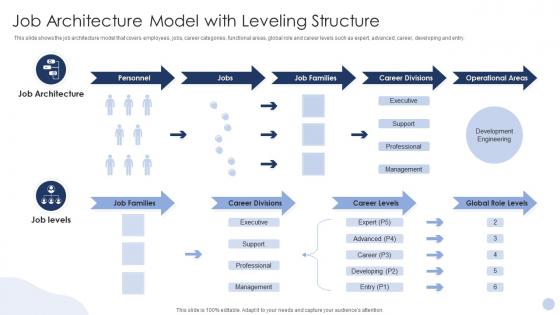
Job Architecture Model With Leveling Structure




Try Before you Buy Download Free Sample Product
 Impress Your
 Audience
 100%
100% Editable
 Save Hours
 of Time


This slide shows the job architecture model that covers employees, jobs, career categories, functional areas, global role and career levels such as expert, advanced, career, developing and entry.
People who downloaded this PowerPoint presentation also viewed the following :
Job Architecture Model With Leveling Structure with all 6 slides:
Use our Job Architecture Model With Leveling Structure to effectively help you save your valuable time. They are readymade to fit into any presentation structure.





FAQs for Job Architecture Model
So job architecture is basically mapping out how all your company roles connect - like who reports to who, what the different levels are, career paths, all that stuff. Without it, you get those awkward situations where people don't understand why certain promotions happen. Plus it helps with fair pay across similar jobs. Honestly, most companies wing it way too long before getting this sorted out. You'll want to start by just writing down what roles you currently have, then figure out what's missing or doesn't make sense. Makes hiring way less of a headache too.
Look, when people can see where they're headed career-wise, they don't bail as much. Fair pay structures help too - nobody wants to find out their coworker makes way more for the same work (been there, it sucks). Map out some realistic paths for advancement so your team actually knows what's next. The transparency alone will boost morale. You'll cut down on those weird salary conversations that make everyone uncomfortable. Short version: give people a roadmap and they'll stick around longer. Start with the roles you have now and work backwards from where people want to be.
So there's basically four main pieces you need to get right. Start with job families - group similar roles together like all your engineering people, marketing folks, whatever. Career levels come next so people can actually see where they're headed. Honestly, the competency piece is huge because that's what separates good performers from mediocre ones (and saves you from those awkward "why didn't I get promoted" conversations). Then tie compensation bands to each level. Oh, and don't overcomplicate it - your managers need to actually use this thing for hiring and developing people, not just let it collect dust.
So job architecture is basically your company's way of mapping out career paths - it shows you exactly what roles exist, what levels there are, and what skills you need to move up. No more wondering why Sarah got promoted and you didn't! It also shows sideways moves if you want to try something different. Honestly, some companies do this better than others, but when it works well, your manager can actually give you concrete feedback on what to focus on. My advice? Find yours (if it exists) and bring it up in your next one-on-one to talk about where you want to go.
So job architecture is basically setting up clear frameworks that kill bias in hiring and promotions. With standardized levels and pay bands, everyone gets judged by the same rules - way harder for unconscious bias to sneak in. Career paths become transparent too, which is huge. Underrepresented employees can actually see what they need to do instead of playing some weird guessing game about unwritten rules. You can spot pay gaps across different groups with the data. Honestly, I'd start by auditing what you've got now to see where things are broken.
Honestly, you gotta think modular from day one - like building blocks instead of these super rigid job descriptions. I'd focus on broader job families that can actually flex when things change. Companies get totally screwed when they have these weirdly specific roles that make no sense after a pivot or whatever. Do regular check-ins - quarterly works well - to see if your structure still matches where you're headed. Oh, and definitely loop in your actual employees on this stuff. They'll catch problems way before leadership does since they're in the trenches doing the work. Makes a huge difference.
Honestly, you can't build job architecture without decent tech anymore. Specialized software handles role mapping, tracks career paths, and keeps compensation data straight across departments. I've seen teams try to wing it with spreadsheets - total nightmare. The software also helps you spot skills gaps and benchmark against market rates, which is huge. Those complex job family structures? Yeah, you'd lose your mind trying to track all that manually. Quick tip though - check what your current HR systems can do first before you go buying separate tools. Might save you some cash.
Job architecture is a game changer for recruiting - basically you create standard profiles for each role so you're not reinventing the wheel every time. No more scrambling to figure out what skills you actually need or having those awkward "wait, what are we even hiring for?" conversations mid-interview. Your hiring managers can focus on whether someone's a good fit instead of sorting out basic requirements. Candidates love it too since they can see clear career paths and pay ranges. Honestly, once you get it set up, everything just flows better. Start with whatever roles you hire for most often.
Track your internal equity stuff and market comp metrics to see if this thing's actually working. Pay range utilization is key, plus promotion rates across levels. Are you hitting market benchmarks consistently? Employee satisfaction scores around fairness matter way more than people think - sometimes they'll tell you what's broken before the numbers do. Monitor turnover by job level too, and how long roles take to fill at different grades. Oh and definitely audit whether managers are actually using the framework for comp and promotion decisions. That's where it either works or falls apart honestly.
So job architecture is basically your roadmap for paying people fairly. It creates clear career levels that connect directly to salary bands - super helpful for budget planning too since you'll know what promotions cost. Honestly, it's one of those things that sounds boring but saves you so much drama later. Different roles get grouped into families, and everyone can see what they need to hit the next level. Makes bonus decisions way less subjective. I'd start by using it to check if you're paying similar roles consistently - that's usually where companies find the biggest gaps.
Oh man, the politics alone will drive you nuts - people get SO weird about their job titles and pay. I've literally watched grown adults have meltdowns over grade levels. Getting clean data is another nightmare since everyone describes their role differently. Tech roles especially are moving targets, so good luck keeping anything current. Plus the whole competency mapping thing is way more complex than it looks on paper. Honestly? Pick one small department first and get your executives on board early. You'll need like 3x more change management than you think - trust me on that one.
So job architecture is basically like creating a roadmap for who does what in your company. No more of those awkward moments where everyone's like "wait, is that my responsibility?" You map out clear boundaries and expectations for each role upfront. Think of it as your org chart but actually useful - you define the skills needed, who reports to whom, all that stuff. Honestly, the overlap and confusion it eliminates is huge. I'd start by writing down what everyone currently does, then spot the gaps or where people are stepping on each other's toes. That's where you'll see the biggest improvements.
Start talking about it way sooner than feels comfortable. People will make up their own stories if you don't give them the real one first. Lead with why you're making changes, not just what's changing. The rumor mill is honestly brutal and moves insanely fast, so beat it to the punch. Do town halls for the big stuff, smaller team meetings for details, and one-on-ones for personal worries. Your managers need talking points before anything goes public - they'll get hit with questions immediately. Oh, and actually listen when people have concerns. You might not change direction, but it matters.
Honestly, having clear job architecture is a game changer for cross-functional teams. You know those awkward moments where everyone's staring at each other like "who's supposed to handle this?" Yeah, that disappears when roles are mapped out properly. People actually understand how their skills connect with everyone else's, which makes working together way less painful. Plus you'll spot skill gaps faster - like whether you need someone more senior or if a junior person could handle it. I've seen teams waste so much time just figuring out who does what. Map it out early and you're golden.
So job architecture is basically what makes performance reviews not suck. You need clear job levels and career paths set up first, otherwise your reviews turn into those awkward conversations where nobody knows what they're talking about. I've seen this mess up so many teams. When roles are well-defined though, you can actually give feedback that means something - stuff tied to real career growth and skills. Short version: audit if your job descriptions match how you're evaluating people. It's like building the foundation before the house, you know?
-
SlideTeam provides PPTs on every single topic. Their templates suit my job very well. I am very grateful!
-
Thank you SlideTeam for such an excellent service.