

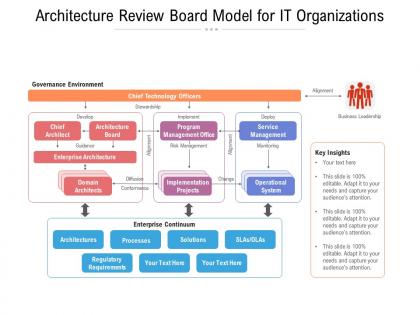
Architecture review board model for it organizations




Try Before you Buy Download Free Sample Product
 Impress Your
 Audience
 100%
100% Editable
 Save Hours
 of Time


Our Architecture Review Board Model For It Organizations are topically designed to provide an attractive backdrop to any subject. Use them to look like a presentation pro.
People who downloaded this PowerPoint presentation also viewed the following :
Architecture review board model for it organizations with all 2 slides:
Use our Architecture Review Board Model For It Organizations to effectively help you save your valuable time. They are readymade to fit into any presentation structure.
FAQs for Architecture review board model
So basically an ARB is like a checkpoint for tech decisions - they make sure whatever you're building actually makes sense for the business and follows their standards. Yeah, it can slow things down sometimes (honestly feels like bureaucracy), but they catch dumb mistakes early. They're looking for stuff like whether you're duplicating work someone else already did or creating a mess future developers will hate you for. Pretty much any big system changes or new projects need their thumbs up first. Think of it as annoying but necessary quality control.
So ARBs are basically your reality check team - they sit between business strategy and all the technical stuff. Every major architecture proposal goes through them to make sure it actually helps hit business goals, not just because it's some shiny new tech the devs are excited about. They'll look at cost, scalability, whether it fits with what the company's doing overall. Honestly, the trick is getting business people in these conversations from the start. Don't wait until you've already designed everything - loop them in early when you're still figuring things out.
Get your senior architects and tech leads obviously, but don't forget ops, security, and product folks. Engineering management needs a seat too - they're the ones who'll tell you if your brilliant design is actually buildable with the team you have. Oh and grab someone from the business side, they're surprisingly good at calling out when you're overengineering something users don't even want. Keep it tight though, maybe 6 people tops. I've been in those 12-person architecture reviews and honestly, half the time gets wasted just trying to find a meeting slot that works for everyone.
Every two weeks works best, honestly. Weekly's too much unless you're scaling like crazy, and monthly just creates this awful bottleneck situation. Shoot for 90 minutes but block out 2 hours just in case. Teams get enough prep time without feeling rushed, plus you keep things moving. I've sat through those brutal 3-hour sessions before - nobody's making good decisions after hour two anyway. If you're always running over time, you're cramming too much into each meeting. Maybe start tracking how long each proposal actually takes? That way you won't overstuff your agenda next time.
Look at four main things when reviewing proposals: does it actually solve your problem and work with your current tech? Can it scale without you rebuilding everything later (seriously, avoid that nightmare). Technical feasibility matters too - your team needs to actually build and maintain this thing. Security can't be optional, obviously. Performance and cost implications will bite you if ignored. I'd make a quick scoring rubric first so you're not all over the place with decisions. Oh, and double-check it aligns with business goals - sounds basic but you'd be surprised how often that gets overlooked.
Build compliance checks right into your ARB process from the start. I'd create checklists that map to whatever regs you need - SOX, GDPR, NIST, whatever. Your architects need to actually understand these standards though. Seriously, half of them just fake it til they make it. During reviews, make teams document how their designs meet compliance stuff, not just the functional requirements. Compliance should be a hard gate, not something you tack on later. Oh, and set up regular audits of approved architectures because things drift over time.
Honestly, the worst part is how ARBs turn into these massive bottlenecks. They're always understaffed and meet like once a month, so everything just sits there waiting. Plus you get wildly different decisions on similar projects - makes zero sense half the time. Dev teams hate the whole process too since it feels like pointless bureaucracy. And don't even get me started on their documentation... it's usually a mess. Board members rarely share info properly either. Best thing you can do? Push for clear upfront criteria and regular meetings. Otherwise you'll be stuck in review hell forever.
Think of your ARB as the translator between business and tech teams. Get them together regularly with stuff everyone can read - architecture diagrams, capability maps, that kind of thing. You need ARB members who actually speak both languages (seriously, those people are golden). Set up cross-functional sessions where technical choices connect directly to business results. Document everything in business terms, not tech-speak nobody understands. Oh, and pick one pilot project first - way easier to show this working than explaining it. Once people see it click, they'll get it.
Look, you can't wing the documentation part - ARB boards live and die by those docs. Design specs, architecture diagrams, risk assessments, implementation plans... all of it needs to be there before they'll even look at you. They're basically trying to poke holes in your approach ahead of time (which honestly saves everyone headaches later). Weak documentation? You're getting bounced back immediately. The quality literally makes or breaks whether you get approved or stuck doing revisions. Oh, and definitely run drafts by your team first - fresh eyes catch the obvious stuff you'll miss.
Look, focus on risk and impact first - timelines can be deceiving. Get your ARB to sit down with project teams and figure out what's actually non-negotiable vs wishlist items. Creative workarounds exist if you dig a little. Maybe do a temporary fix but map out the real solution path upfront. Trust me, I've watched way too many "quick patches" turn into absolute disasters down the road. Be super transparent about what corners you're cutting and make stakeholders own that decision with you. Document everything because future-you will definitely curse present-you otherwise!
For tracking ARB success, start with review cycle time - how fast you go from submission to approval. Adherence rates matter too since there's no point making decisions teams will just ignore later. I'd also count how many big architectural problems you catch in reviews vs ones that slip through to production (that ratio tells you everything). Survey your dev teams regularly about satisfaction - they'll be brutally honest if you ask. Oh, and don't forget system quality stuff like performance metrics and security incidents. Honestly though, cycle time and adherence rates are your best starting points since they're simple to track and you'll see results right away.
Make it part of your monthly routine - block out time for tech discussions and rotate who presents new stuff. Subscribe to ThoughtWorks Tech Radar or InfoQ, they're solid. Virtual conferences are honestly a game changer since you don't blow the budget on travel. Also try connecting with other architecture teams through meetups or Slack groups - you'd be surprised how helpful they are. Here's the thing though: someone needs to actually own this process. Pick one person to track trends and report back monthly. Otherwise it'll never happen consistently.
Honestly, make it collaborative instead of gatekeepy. Set up clear review criteria upfront so people aren't guessing what you want. Office hours work great - way better to catch problems early than deal with massive formal reviews later. Mix up your team membership and rotate people through so you don't become this weird ivory tower thing. When you document decisions, explain the why behind them, not just "approved" or "rejected." That's how teams actually learn. Oh and frame it as helping people build better stuff, not blocking their progress. Nobody likes blockers.
Stop being the "no" committee and start helping teams figure out *why* something won't work - then brainstorm alternatives together. We started doing these informal "innovation hours" where people pitch crazy ideas without needing approval, and honestly? Some of our best stuff came from those random sessions. Set up fast-track proof-of-concept paths that skip your usual process. Instead of architecture cops, become the consultants who actually help solve problems. Oh, and try dedicating like 20% of your next meeting to exploring one completely wild idea - you'd be surprised what happens.
Honestly, templates are your best friend here - they'll cut your back-and-forth in half easily. Get architects to review stuff before it goes in officially, that catches most problems early. Oh, and push for different review tracks... minor changes shouldn't wait in line behind major renovations, you know? Document why things get rejected and share that around. The real game-changer though? Regular office hours with the ARB team. People can just pop in for quick guidance instead of submitting blind. I'd start with standardizing your templates first since that's the easiest win.
-
Awesome presentation, really professional and easy to edit.
-
The content is very helpful from business point of view.
-
Nice and innovative design.