


Information technology plan strategies architecture development management




Try Before you Buy Download Free Sample Product
 Impress Your
 Audience
 100%
100% Editable
 Save Hours
 of Time


Information technology (IT) plays a critical role in today's business operations. An effective IT plan can help organizations to improve their overall performance and competitiveness. In order to develop an effective IT strategy, organizations need to consider various factors such as their business goals, budget, and resources. Additionally, they need to have a clear understanding of their current IT infrastructure and how it can be used to support their business goals.Project management is a complex field that can be difficult to understand and execute without the proper tools. That’s why SlideTeam offers a variety of project management PowerPoint templates to help you create beautiful, informative presentations about your IT plan strategies architecture development management. Our templates are easy to use and customizable, so you can make them fit your specific needs., so there’s no reason not to get started today.
People who downloaded this PowerPoint presentation also viewed the following :
Information technology plan strategies architecture development management with all 12 slides:
Use our Information Technology Plan Strategies Architecture Development Management to effectively help you save your valuable time. They are readymade to fit into any presentation structure.
-
Information Technology Plan
-
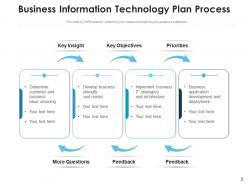
Business Information Technology Plan Process
-
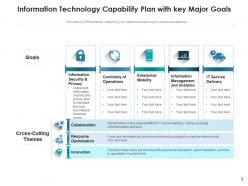
Information Technology Capability Plan with Key Major Goals
-
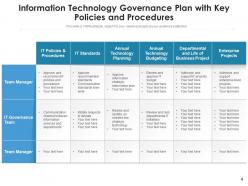
Information Technology Governance Plan with Key Policies and Procedures
-
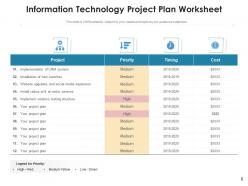
Information Technology Project Plan Worksheet
-
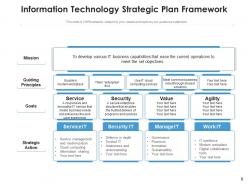
Information Technology Strategic Plan Framework
-
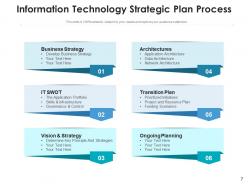
Information Technology Strategic Plan Process
-

Key Phases of Information Technology Roadmap Plan
-
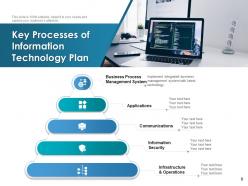
Key Processes of Information Technology Plan
-
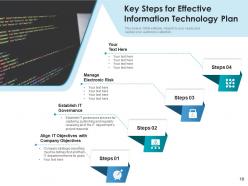
Key Steps for Effective Information Technology Plan
-
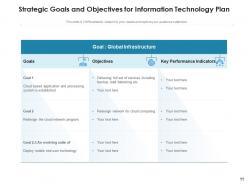
Strategic Goals and Objectives for Information Technology Plan
-

Thank You
FAQs for Information technology plan strategies
Honestly, most of this comes down to nailing your basics first. Business alignment is huge - like, you can't skip that step. Then focus on your infrastructure, security, and governance stuff. Data architecture trips up literally everyone I know, so definitely don't sleep on that. Pick standard tech that actually integrates well together instead of creating a mess of disconnected tools. Your roadmap needs to handle today's problems while setting you up for growth later. I'd start by figuring out what you've got now, then spot the biggest gaps between that and where you're trying to go. The whole thing falls apart if these pieces don't work together.
Honestly? It's all about what you're optimizing for. Cloud lets you scale fast and deploy quickly, but you're stuck with their pricing and rules. On-prem means you control everything - performance, security, the works - though maintaining it yourself is a total pain. Your whole architecture changes too. Data flow, backups, how things connect... it'll look different depending which way you go. I'd actually start with a mix of both. Test your workloads first before committing fully to either side.
Scalability is like insurance for when your app actually takes off. Plan for both vertical scaling (bigger servers) and horizontal scaling (more servers) right from the start. Retrofitting this stuff later? Total nightmare - I've seen teams waste months on it. Microservices and load balancers are your friends here. Cloud solutions make everything way easier too. The trick is spotting your bottlenecks early. Don't wait until you're drowning in traffic to figure out where things'll break. Short bursts of planning now save you from 3am crisis calls later.
Honestly, AI and IoT will make you rethink everything architecture-wise. Your old monolithic stuff? Probably won't handle it. These techs pump out crazy amounts of data that need quick, secure processing. You'll want microservices and cloud-native designs - the whole predictive approach instead of just reactive. Real-time analytics become huge too. Most teams I know had to do major infrastructure upgrades just to handle the computational load. Oh, and scalable data pipelines are basically non-negotiable now. I'd start by auditing what you've got against these new requirements.
Don't try to rip out everything at once - that's a recipe for disaster. Wrap your old systems with APIs first so they can actually talk to newer stuff without exposing all the messy legacy code. Those ancient COBOL systems are honestly like tanks though, they just keep chugging along! You'll need some kind of data pipeline too - ETL or event streaming works. The whole point is getting your old and new systems to play nice together. I'd start with just one small integration project first, see how it goes.
Look, you gotta bake security into your system from the start - don't try adding it later like some band-aid fix. Zero trust, solid identity management, encrypt everything. SOC 2 and ISO 27001 sound scary but they're actually decent guides once you dig in. Oh, and document literally everything as you build - trust me on this one. When audit season hits, you'll be so glad you did. Regular security checks plus automated monitoring will save your butt. The frameworks feel like overkill at first, but honestly? They keep you organized.
Dude, biggest mistake is over-engineering right off the bat. You'll burn weeks solving problems that don't even exist yet. Also avoid designing stuff in a vacuum - I've watched architects build these "flawless" systems that are impossible to actually use or maintain. Cloud vendor lock-in will bite you hard later too. Oh and documentation always gets pushed to "next sprint" but then six months later you're staring at code like wtf was I thinking here? My advice? Start stupid simple, get your team involved early, and constantly ask yourself what actual business problem you're fixing.
Honestly, just start by writing down what you actually have running right now - not the ideal setup you wish you had. Business-critical stuff comes first because documenting everything at once is a nightmare (learned that the hard way). Make visual diagrams showing how your systems talk to each other. When things break at 2am, nobody wants to dig through pages of text. Simple beats comprehensive every time. Update it regularly though - stale docs are basically worthless. Oh, and don't let just one person own this. You'll regret it when they leave.
Track both tech and business stuff to get the real picture. Response times, uptime, how you handle traffic spikes - that's your technical side. But honestly, the business metrics matter just as much. Cost per transaction, how fast you ship features, user happiness scores. Security response times too, obviously. Don't go crazy measuring everything though - I'd pick maybe 5-7 that actually match what your company cares about. Figure out what winning looks like first, then find the numbers that'll tell you if you're getting there. Way easier than drowning in dashboards nobody checks.
So DevOps will totally flip how you think about architecture. Everything has to be built for automation and constant deployments now. Microservices beat monoliths every time. Infrastructure as code is huge. API-first design too - honestly, once you go that route you can't imagine doing it any other way. No more tossing stuff to ops and hoping for the best. Your whole system needs to handle the pipeline from development straight through production. Quick rollbacks are crucial. Real-time monitoring becomes non-negotiable. I'd start by finding your worst deployment headaches and designing around those pain points first.
Honestly, the scalability thing is huge - you can beef up just the parts that need it instead of your whole app. Teams stop blocking each other too, which is nice. If something breaks, it won't kill everything else. Oh and each service can use whatever tech stack actually makes sense for that problem (I'm probably too excited about this part lol). But you really need your DevOps game tight first or it'll be a mess. I'd just pick one obvious piece to split off and see how it goes before doing anything crazy.
Honestly, start with what your business actually needs, then figure out the tech stuff. Too many companies I've worked with build these insane technical setups that don't solve any real problems - it's wild how disconnected things get. Get your business people talking regularly with IT so they can map out which tech actually drives results. Set up clear metrics tying your tech investments to stuff like revenue or efficiency gains. You'll want some formal process where business folks review big architecture calls. Oh, and don't let your IT team just go crazy building cool things without purpose. Architecture should serve the business, not the other way around.
Look, UX is honestly everything in IT architecture. I don't care how brilliant your backend is - if users hate using it, you've failed. Design around real workflows, not just how data moves through your system. Too many architects get caught up in technical elegance and forget actual humans have to click through this stuff daily. Fast load times matter. Fewer clicks matter. I've watched "perfect" systems get abandoned because they were painfully slow or counterintuitive. Always test with real users first - saves you from rebuilding later when everyone complains.
Look, build disaster recovery right into your system from the start - don't try to slap it on later. Figure out your RTO and RPO first (how fast you need things back up, how much data you can afford to lose). Set up redundancy across different zones, automate backups, write up those failure playbooks. But here's the thing - most teams totally bomb the testing part. You've got to actually run those DR drills and fail over to backup systems regularly. Oh, and document everything! Trust me, when stuff hits the fan at 2am, you'll be so glad you did.
TOGAF and Zachman are solid picks - they're standards for a reason. TOGAF walks you through their ADM process step by step. Pretty comprehensive. Zachman's great for organizing all those different architectural views so you don't lose your mind. If you're doing lots of cloud stuff, AWS Well-Architected or Azure's frameworks might make more sense since they're built for that world. Really depends on how complex your setup is and where your team's at maturity-wise. I'd probably start with TOGAF if you want the full roadmap, or just grab a cloud framework if that's your main focus.
-
Presentation Design is very nice, good work with the content as well.
-
Designs have enough space to add content.
-
Very unique, user-friendly presentation interface.
-
Unique and attractive product design.
-
Best way of representation of the topic.
-
Easy to edit slides with easy to understand instructions.
-
Best way of representation of the topic.
-
Excellent Designs.