


Information Technology Services Information Technology Company Profile Ppt Information




Try Before you Buy Download Free Sample Product
 Impress Your
 Audience
 100%
100% Editable
 Save Hours
 of Time


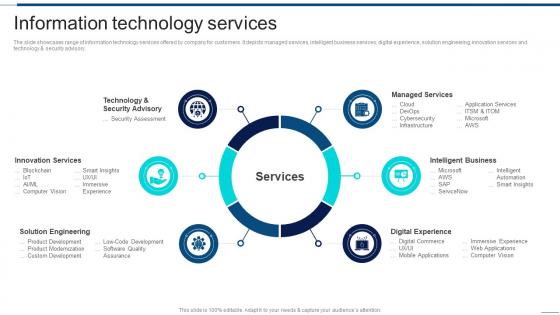
The slide showcases range of information technology services offered by company for customers. It depicts managed services, intelligent business services, digital experience, solution engineering, innovation services and technology and security advisory.
People who downloaded this PowerPoint presentation also viewed the following :
Information Technology Services Information Technology Company Profile Ppt Information with all 6 slides:
Use our Information Technology Services Information Technology Company Profile Ppt Information to effectively help you save your valuable time. They are readymade to fit into any presentation structure.





FAQs for Information Technology Services Information Technology Company
So you'll want the core ITIL stuff - service catalog, incident/problem management, change management, asset tracking. Monitoring tools are crucial because you can't fix what you can't see. Knowledge management is a lifesaver too, stops people from bugging you with the same dumb questions constantly. SLAs keep everyone's expectations realistic. Automate whatever you can or you'll lose your mind. Oh, and start with incident management first - honestly, that's where you'll make users happiest the fastest. Way better ROI than trying to build everything at once.
Dude, just move your stuff to the cloud - way less headache. No more 2 AM server meltdowns ruining your weekend. You'll pay for what you use instead of maintaining expensive hardware that sits there doing nothing half the time. Your team can access everything from anywhere, updates happen automatically, and scaling up or down is actually simple. The cloud provider deals with security and backups while you focus on running your business. Honestly? Start small with something non-critical first. Test it out before going all-in.
Look, cybersecurity isn't some separate thing anymore - it's woven into literally everything we do in IT. Every service layer needs protection baked in from the start. I had to learn this the messy way a few years ago, trust me on that one. Cloud management, software updates, user support? All of it follows security protocols now. Access controls, encrypted comms, constant threat monitoring. The vulnerability assessments never stop either (kind of exhausting honestly). But here's the thing - if you build security into your foundation instead of slapping it on later, your whole IT operation runs way smoother.
Look, automation just takes care of all that boring stuff that kills your day - ticket routing, password resets, monitoring alerts. Your team gets to actually solve real problems instead. The cool part is incident response though, where it can catch and fix issues before users start complaining (which honestly saves everyone's sanity). Human errors go way down too since we're all prone to brainfarts. I'd start with something simple like user provisioning, see how much time you save, then build from there. Way less painful than trying to automate everything at once.
You'll want solid monitoring that spots problems before your users start complaining - trust me on this one. Create a simple priority system like P1 for outages, P2 for slower stuff. Make sure everyone knows who to contact when things break (and they will break). Document everything religiously because you'll definitely encounter the same bizarre issue six months later. Set realistic SLAs too, not whatever makes the executives happy. Oh, and always do post-incident reviews - sounds boring but you actually learn from the chaos that way.
Dude, AI and IoT are totally flipping IT services on their head. Instead of just fixing stuff when it breaks, you can actually predict failures before they happen - which honestly feels like magic sometimes. All those IoT sensors pump out crazy amounts of data that AI crunches to automate tasks and optimize everything in real-time. You'll need to start offering predictive analytics, automated monitoring, edge computing support. The security AI stuff is huge too. Bottom line? Don't just be the "fix it" guy anymore. Position yourself as the strategic partner who helps clients actually use this tech smartly.
Track uptime first - shoot for 99.9% if you can swing it. Response times matter too, along with how long it takes to actually fix stuff. Customer satisfaction scores are obvious but honestly super telling. Oh and if your boss is budget-obsessed (aren't they all?), throw in cost per ticket. Here's the thing though - don't just measure what's easy. Ask your users what actually drives them crazy, then build your dashboard around that. Monthly trends work way better than daily numbers since you'll catch real patterns instead of random noise.
Start with a data governance framework covering GDPR and CCPA - sounds boring but it'll save your ass later. Regular audits are crucial, plus you need solid access controls and documentation (ugh, so much paperwork). Train your people on compliance stuff and set up automated monitoring for breaches. Encrypt literally everything - data in transit, at rest, all of it. Don't hoard data you don't actually need; create retention policies that make sense. Oh, and schedule quarterly reviews to catch problems early. Trust me, being proactive beats scrambling when regulators come knocking.
Honestly, remote IT is rough. Security becomes a total headache since everyone's scattered across different home networks with their own sketchy devices. Troubleshooting turns into this whole ordeal - no more walking over to fix things in person. Instead you're stuck doing endless screen shares while dealing with people's ancient routers and terrible WiFi. Users need way more help too, which I guess makes sense but still. Get a good VPN setup first, then invest in remote monitoring tools. Oh and document everything - you'll thank yourself later when the same weird issues keep popping up.
So basically, IT service integration just breaks down those annoying silos where your systems don't talk to each other. Your data flows better, decisions happen faster, and nobody's doing tedious manual workarounds anymore. Employees stop juggling five different platforms - which honestly saves everyone's sanity. Customer response times improve big time when everything's actually connected. I'd start by figuring out where your biggest headaches are right now, like where info gets stuck between systems. It's one of those things that sounds boring but makes a huge difference once you actually do it.
Honestly, most people screw this up by not testing their backups regularly - like, when's the last time you actually tried restoring from one? Daily automated backups are a must, and keep copies both locally and in the cloud because stuff fails. Document every step clearly so if you're sick or whatever, someone else can handle it. Create a contact list for emergencies too. Oh, and figure out which systems would absolutely kill your business if they went down - those get priority. The automation part's pretty straightforward, but the testing? That's where people get lazy.
Dude, stop thinking "we're the IT department" and start thinking "we fix problems for actual humans." Talk to your users - not just when they're pissed about tickets, but like, really listen to what makes their day suck. Map out their whole experience from start to finish. Most IT people are awful at this because we love our technical rabbit holes, but whatever. Set up real feedback systems that go beyond "was it fast?" Give your team permission to bend rules when it actually helps someone. Oh, and train everyone on people skills too - trust me on this one.
Okay so technical troubleshooting skills are a must, obviously. But honestly, communication might be even more important - you're constantly dealing with frustrated people who just want their computer to work and don't care about the technical details. ITIL certification is pretty much expected now, so grab that first if you don't have it. You'll be juggling like 5 different fires at once, so project management skills help tons. Oh and staying calm when everything's broken? That's huge. I learned that one the hard way lol. Problem-solving is basically your entire job though.
So your IT strategy has to get way more agile and customer-focused now. You're not just keeping systems running anymore - you're actually enabling business innovation with cloud stuff, automation, data analytics. It's a massive shift from that old "keep the lights on" approach, honestly. Start thinking about your services like actual products that deliver business value, not just tech fixes. DevOps practices become crucial here. You'll need APIs for integration and self-service tools for users too. Oh and definitely look at which legacy processes are blocking your business goals first - that's basically your roadmap right there.
Look, you gotta keep tweaking your IT processes or everything falls apart. I learned this the hard way when our old ticketing system made everything take like 3x longer than it should've. Regularly checking your workflows helps catch problems early - way better than dealing with angry users later. New tech comes out constantly, business needs shift, and your processes need to keep up. Honestly, most teams skip this step and then wonder why nothing works smoothly. Start with whatever's been annoying your team most recently and figure out where it's getting stuck.
-
I can say with full confidence that all your business, academic, or professional work requirements will be sufficed with SlideTeam. Their gallery is as rich as 2Million+!!
-
No second thoughts when I’m looking for excellent templates. SlideTeam is definitely my go-to website for well-designed slides.