

Software Company Profile Powerpoint Presentation Slides




Try Before you Buy Download Free Sample Product
 Impress Your
 Audience
 100%
100% Editable
 Save Hours
 of Time


A company profile is a professional introduction of an organization that aims to inform stakeholders about products and services offered by the firm. It also highlights the strengths of the company and its business plan. The Software company profile provides a brief overview of the company with business information, key financials, and awards and recognition along with an executive summary. It further shows the mission, vision, and core values of an organization to define work ethics and integrity. The slides showcase the business model canvas to describe operations, cost structure, value proposition, and revenue streams of the firm. It also includes historic timeline, international presence, and key people of the management team. Furthermore, it shows the workforce structure inside the company and organizational structure depicting hierarchy based on employee roles. The profile also covers shareholding patterns, work culture report, company clients, and clients testimonials. Additionally, It highlights the financials by illustrating recent trends of revenue, gross profit, EBITDA, operating profit, net profit, revenue split by geography, global revenue trend, and financial statements. It further shows SWOT analysis, expansion strategies, CSR activities and spend, and a case study. To know more in detail download our 100 percent company profile editable and customizable deck.
People who downloaded this PowerPoint presentation also viewed the following :
Content of this Powerpoint Presentation
Slide 1: This slide displays the title Software Company Profile.
Slide 2: This slide exhibit table of content.
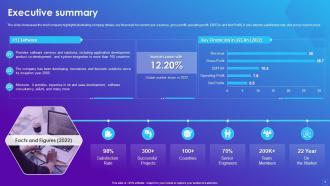
Slide 3: The slide showcases the brief company highlights illustrating company details.
Slide 4: The slide describes the company overview.
Slide 5: The slide showcases the company Vision mission and values for software company.
Slide 6: This slide depicts Digital products and solutions.
Slide 7: The slide highlights four domains of exclusive Software development expertise provided by company.
Slide 8: The slide showcases four areas of Customized services from our experienced team of engineers.
Slide 9: This slide showcases the latest technologies leveraged in organisation to provide improved the services and new solutions.
Slide 10: This slide highlights the four categories of solutions and services developed on Ruby on Rails technology.
Slide 11: This slide showcases tools and solutions for predictive modelling, natural language processing and artificial vision developed by machine learning technology.
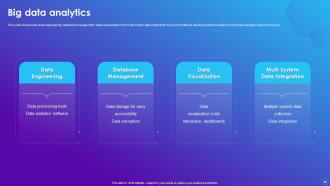
Slide 12: This slide showcases software developed with assistance of big data analytics and processing.
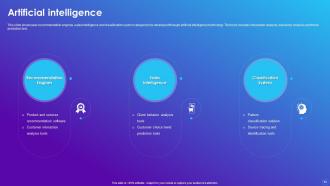
Slide 13: This slide showcases recommendation engines, sales intelligence and classification system tools developed through artificial intelligence technology.
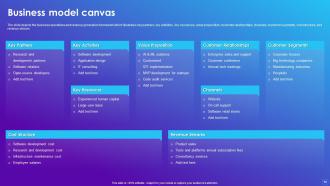
Slide 14: The slide depicts the Business model canvas.
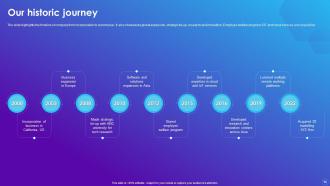
Slide 15: The slide highlights the timeline of the company from incorporation to current year.
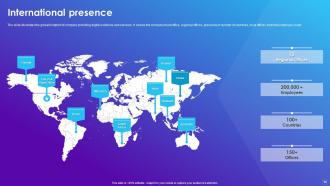
Slide 16: The slide illustrates the global footprint of company providing digital solutions and services .
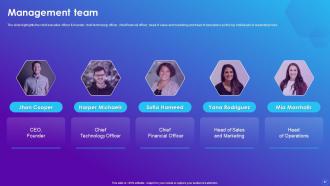
Slide 17: The slide highlights the Management team of the software company.
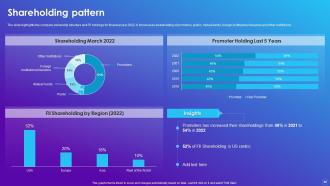
Slide 18: This slide represents the ownership structure of the software company.
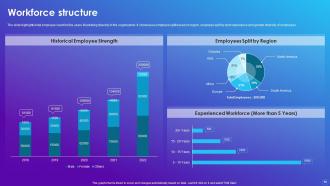
Slide 19: The slide highlights Workforce structure for five years illustrating diversity in the organization.
Slide 20: The slide highlights the company ownership structure and FII holdings for financial year 2022.
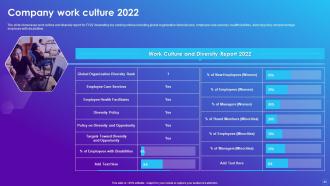
Slide 21: The slide showcases work culture and diversity report for FY22.
Slide 22: The slide highlights the list of major business clients for software companies.
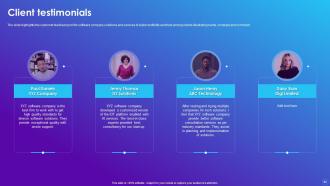
Slide 23: This slide focuses on client reviews and testimonials post experiencing services offered for software company.
Slide 24: The slide shows annual revenue growth of the company with the CAGR for last five financial years from 2018 to 2022.
Slide 25: This slide illustrates a graph of gross profit and gross margin in percentage for software company.
Slide 26: This slide illustrates a graph of EBITDA and margin in percentage for software company.
Slide 27: This slide illustrates a graph of operating profit and operating margin in percentage for software company.
Slide 28: This slide illustrates a graph of net profit and net margin in percentage for software company.
Slide 29: The slide highlights the historical revenue split for software company.
Slide 30: The slide highlights the global revenue earnings for FY22 to understand the major customers based on geography.
Slide 31: The slide showcases income statement, balance sheet and cashflow statement of last five years to represent current financial position of organisation.
Slide 32: The slide compares top competitor comparison of software company.
Slide 33: The slide showcases strength, opportunity, weakness and threats of company to estimate company’s future prospects.
Slide 34: The slide showcases business expansion, joint venture and acquisition as the form of expansion strategies.
Slide 35: The slide highlights the major corporate social responsibility activities performed by company.
Slide 36: The slide describes the spending on corporate social responsibility for last five years.
Slide 37: This slide shows the Case study.
Slide 38: This slide represents the icons slide.
Slide 39: This slide presents title for additional slides.
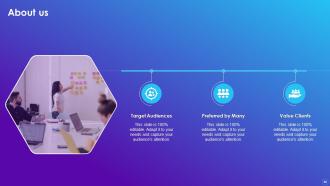
Slide 40: This slide presents about us of the company.
Slide 41: This slide presents your company's vision, mission and goals.
Slide 42: This slide shows details of team members like name, designation, etc.
Slide 43: This slide shows puzzle for displaying elements of company.
Slide 44: This slide displays Venn.
Slide 45: This slide depicts 30-60-90 days plan for projects.
Slide 46: This slide shows the target of the company.
Slide 47: This is thank you slide & contains contact details of company like office address, phone no., etc.
Software Company Profile Powerpoint Presentation Slides with all 52 slides:
Use our Software Company Profile Powerpoint Presentation Slides to effectively help you save your valuable time. They are readymade to fit into any presentation structure.
-
Software Company Profile
-
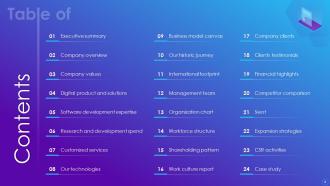
Table of Contents
-
Executive Summary
-
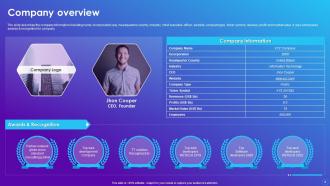
Company overview
-
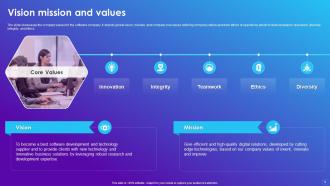
Vision mission and values
-
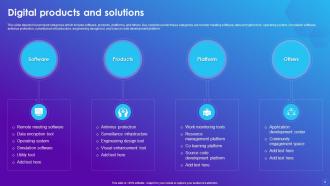
Digital products and solutions
-
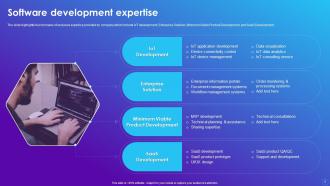
Software development expertise
-
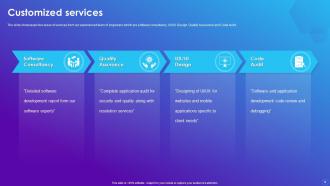
Customized services
-
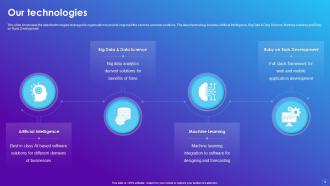
Our technologies
-
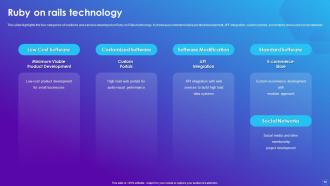
Ruby on Rails Technology
-
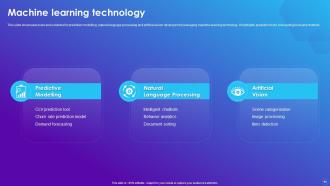
Machine learning technology
-
Big data analytics
-
Artificial intelligence
-
Business model canvas
-
Our historic journey
-
International presence
-
Management team
-
Organisation structure
-
Workforce structure
-
Shareholding pattern
-
Company work culture 2022
-
Company clientele
-
Client testimonials
-
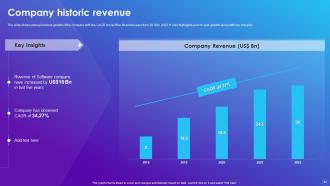
Company historic revenue
-
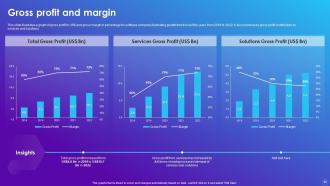
Gross profit and margin
-
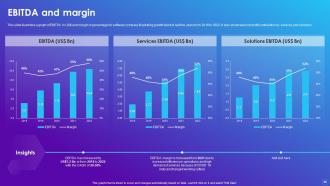
EBITDA and margin
-
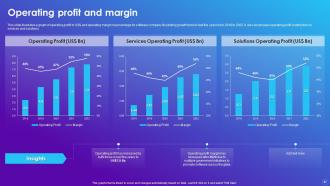
Operating profit and margin
-
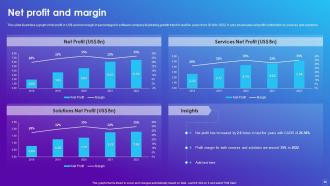
Net profit and margin
-
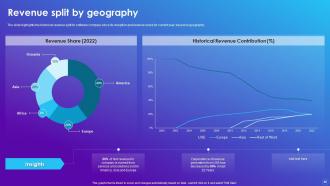
Revenue split by geography
-
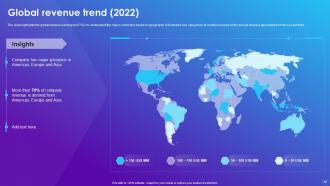
Global revenue trend 2022
-
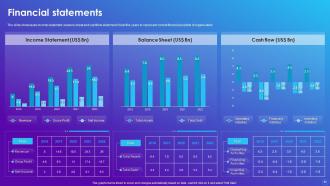
Financial statements
-
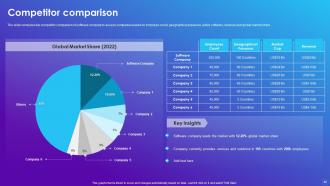
Competitor comparison
-
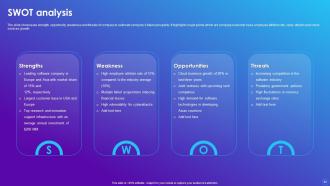
SWOT analysis
-
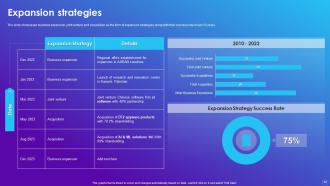
Expansion strategies
-
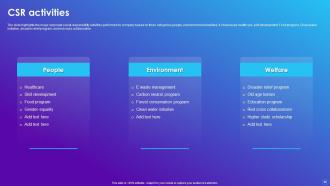
CSR activities
-
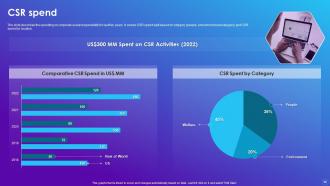
CSR Spend
-
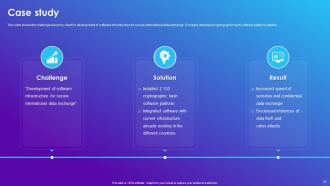
Case study
-
Icons slide for software company profile
-

Additional slides
-
About us
-
Our vision and mission
-
Our team
-
Puzzle
-
Venn
-
Software Company Profile
-
Our target
-
Thank You Slide
-

-

-

-

-

FAQs for Software Company Profile
So we do three main things - custom software development, cloud migration, and tech support. Development covers web apps, mobile stuff, enterprise solutions, whatever you need built. Cloud migration's been crazy popular lately since companies are finally dumping their ancient servers (thank god). Oh, and we handle all the maintenance too so you won't be debugging code at midnight. Honestly, most people start with just one service but end up needing all three eventually. I'd peek at our case studies to see what matches your situation best.
So we've got this layered thing going on with testing. Automated tests run at every stage - unit, integration, end-to-end - before anything goes live. Code reviews are huge too because someone else always spots the dumb mistake you missed. QA does manual testing plus automated regression stuff, and we've got monitoring that'll scream if production breaks. Oh, and there's this thing where quality really starts with how you write your code in the first place, not just dumping it on QA later. Works pretty well honestly.
So we mostly do Agile with two-week Scrum sprints, though maintenance stuff gets handled through Kanban. Honestly the short sprints are a lifesaver when clients inevitably change their minds halfway through. DevOps and continuous integration too - trust me, you don't want to be the person deploying on a Friday. Getting regular feedback from stakeholders is clutch because you're actually shipping real features instead of planning forever. Oh and when you start, just check with your team lead about which meetings you'll need to join.
We actually just finished this mobile banking app for a credit union - built it from scratch using React Native. Got biometric login, real-time alerts, AI spending insights, the works. Your members can deposit checks right from their phone, transfer money, track budgets. Backend's totally secure obviously. Honestly the craziest part? We delivered two weeks early, which like... never happens. But their requirements were crystal clear from the start, so everything just clicked. Want me to show you the UI mockups or dive into technical stuff?
So we're pretty much a JavaScript and Python shop. React and Node.js handle most of our web stuff, though we'll throw Django in when clients want something beefier on the backend. TypeScript is a lifesaver honestly - cuts down on so much debugging nonsense. Mobile-wise, React Native covers most bases, plus Swift when iOS gets weird about something. Oh, and we mess around with Go for microservices. PostgreSQL for databases. Honestly? I'd stick with the JS/Python route for your thing since that's where we can actually move fast and not trip over ourselves.
So we do weekly or bi-weekly check-ins depending on how big the project is. Your PM sets up a Slack channel or Teams thing where clients can bug you with questions and see updates in real time. Sprint demos happen every 2-3 weeks to show off what actually works. Some clients eat this stuff up, others get totally overwhelmed at first - though they usually figure it out. Oh, and definitely nail down response times and how they want to communicate upfront. Nobody wants to be that person constantly wondering if their message got lost in the void.
Year two nearly broke us - scaling the dev team while keeping code quality intact was brutal. We were cranking out features but accumulating so much technical debt it almost sank us. The fix? Code reviews plus pairing juniors with seniors for six months straight. People grumbled at first since it slowed everything down. But honestly, once everyone's following the same standards, your codebase doesn't turn into a nightmare. Set up those processes way earlier than you think you need to - I wish someone had told us that.
So we do a few things that actually work. Team leads hit the big conferences - AWS re:Invent, Google I/O, that stuff. Monthly "tech radar" meetings where departments share what they're seeing in the wild. Everyone gets learning budgets for courses and books too. Our devs are honestly like magpies with new tech anyway, so that helps. We've got partnerships with vendors who show us beta features early. But here's the thing - you can't just read about everything. We sandbox new tools first to see if they're actually worth the hype or just marketing fluff. Half the "revolutionary" stuff ends up being meh.
Look, we've got you covered after launch - 24/7 support, monitoring, bug fixes for 90 days free. Most people end up picking our middle plan afterward because it hits that sweet spot. Training sessions, performance tweaks, new features based on what you actually tell us you need. Here's the thing though - we stick around instead of ghosting you like half the dev shops out there do. Oh, and definitely set up a support call during your last sprint so we can figure out what makes sense for your team specifically.
Honestly, I look at three main things when measuring if a project worked out. Did we hit our timeline and budget? Are users actually using the features we built? And is the code quality decent enough that we won't hate ourselves later? User feedback is probably the biggest tell though - if people are constantly complaining or just not adopting it, something's wrong no matter how clean your code looks. I also track team velocity and post-launch bugs. But the real moment of truth? When it goes live and you see if it actually fixes what it was supposed to fix. Oh, and set your KPIs early or you'll be making them up afterwards.
Honestly, we're just way faster at actually doing something with user feedback. Most companies take forever to ship updates - we're talking months. We don't do that. Our whole dev process is built around quick iteration cycles, and our support team is all in-house so you're not dealing with those weird communication gaps. The API-first thing is probably our biggest advantage though - everything plays nice with whatever tools you're already using. Oh, and definitely check out our integration marketplace if you want to see what's actually possible with your current setup.
Oh totally - UX basically runs our whole development process. We map out user journeys first, then build around actual pain points people have. Can't tell you how many "perfect" apps I've seen tank because they're impossible to navigate lol. Testing happens constantly, not just at launch. The key thing? Always ask if your feature helps users accomplish their goal, or if you're just building it because it's technically cool. Sometimes the simplest solution wins over the clever one.
Honestly, we just build security right into everything from the start instead of scrambling to add it later. Threat modeling happens during design, then automated scans run through our CI/CD pipeline. Regular pen testing too. It's pretty much muscle memory now - which is kinda the whole point, right? Data-wise, we're all about zero-trust, encrypting everything (transit and at rest), plus strict access controls. Oh and start with solid coding standards. Make security reviews part of your normal sprint routine and you'll be golden.
So we've got this system where clients drop requests in our project portal, then every week we sort through them by priority and timeline stuff. Document everything though - seriously, clients have zero memory of what they actually asked for half the time. Smaller changes usually happen within two weeks, but big stuff means we need to have the awkward scope conversation. Oh and for active projects, feedback either fits the current sprint or gets shoved into the backlog. Main thing is just being upfront about turnaround times so they don't blow up your phone expecting everything yesterday.
Honestly, we're trying to make coding accessible to everyone - like, your mom could build an app without knowing Python or whatever. AI tools and low-code stuff are huge right now. The whole idea is removing those annoying barriers between having a cool idea and actually making it happen. Visual development is where things are headed for sure. Oh, and your team should probably start thinking about integrating more of these tools into what you're already doing. It's wild how fast this space is moving - feels like every week there's some new platform that makes programming easier.
-
I've been looking for a good template source for some time. I'm happy that I discovered SlideTeam. Excellent presentations must try!
-
Excellent work done on template design and graphics.