


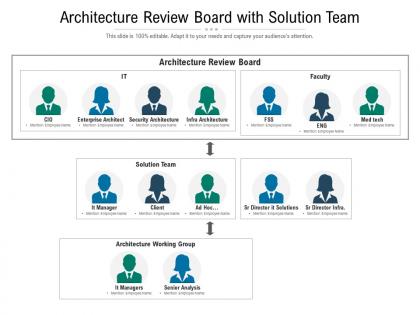
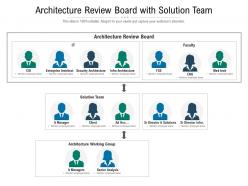
Architecture review board with solution team




Try Before you Buy Download Free Sample Product
 Impress Your
 Audience
 100%
100% Editable
 Save Hours
 of Time


Our Architecture Review Board With Solution Team are topically designed to provide an attractive backdrop to any subject. Use them to look like a presentation pro.
People who downloaded this PowerPoint presentation also viewed the following :
Architecture review board with solution team with all 2 slides:
Use our Architecture Review Board With Solution Team to effectively help you save your valuable time. They are readymade to fit into any presentation structure.
FAQs for Architecture review board
So basically the ARB checks that your architecture stuff doesn't go against company rules or create problems later. They look at your system designs and big tech decisions before you start building. Honestly, it's like having senior engineers double-check your work - they've probably seen similar projects blow up before. Yeah, it can feel like extra bureaucracy sometimes, but it's way better than having to redo everything later. Check if your company needs ARB sign-off before you dive into major architectural work. Trust me on this one.
So basically an ARB stops you from building something completely wrong for the business. They'll check if your design actually makes sense against budget, compliance stuff, and what the company's trying to do. Honestly wish I'd used them more early on - could've avoided some pretty dumb mistakes. Plus they catch when you're way overthinking a solution or missing systems you could just reuse instead. Oh, and definitely loop them in during design phase, not after you've already coded half of it. Trust me on that one.
Look at technical feasibility first - can you actually build this thing? Then check if it plays nice with your current architecture and whether it'll scale when you need it to. Security compliance is non-negotiable, obviously. Resource requirements matter too. Be realistic about timelines or you'll hate yourself later. Performance impact is massive, especially with high-traffic stuff. Oh, and don't skip the boring parts like maintainability - trust me on this one. Documentation quality seems dumb now but you'll be grateful in six months when you're trying to remember why you built something a certain way. Make a simple scoring system beforehand so you stay objective.
So basically, your ARB becomes the middleman translating tech speak into business language. They make visual diagrams and write stuff in plain English so everyone gets it. Instead of boring technical details, they frame things like "this change cuts customer wait times by 30%." Regular meetings help too - both sides can actually ask questions face-to-face. Honestly, the trick is finding ARB people who genuinely understand both worlds. Oh, and here's a quick win: make them add a "business impact" section to every tech review they present. Makes a huge difference.
So ARB members review architectural decisions and make sure they fit with company standards and long-term goals. You'll look at proposed designs, spot potential risks, and give technical guidance to dev teams. Some people specialize in areas like security or scalability. Honestly? You're gonna feel like the "bad guy" a lot when rejecting proposals - comes with the territory though. The whole point is balancing innovation with keeping things consistent across projects. Oh, and definitely get familiar with your org's architectural principles first. Always explain your reasoning when giving feedback - trust me on that one.
So ARBs basically set up architectural standards using frameworks like TOGAF or Zachman, then check all major design decisions against those rules. They keep checklists for security, performance, scalability - basically everything that'll screw you over later if you skip it. Most boards stay updated through training and vendor partnerships. Sometimes they bring in outside experts too, which honestly can be hit or miss depending on who they pick. The key thing is getting them involved early in your project planning. Don't wait until the end and try to force compliance afterward - that's just asking for headaches.
So there's a few ways to measure if your ARB is actually working. Decision speed matters - are you reviewing stuff quickly or creating bottlenecks? Compliance rates tell you if people follow the decisions you make (spoiler: they often don't). I'd track architectural debt items getting fixed over time too. Quality stuff is obvious - fewer bugs after deployment, better performance. Stakeholder surveys help but honestly they're kinda annoying to run. Oh, and don't try measuring everything right away. Pick like 2-3 metrics first or you'll drown in data.
Set up formal debates where each side gets equal time to present their case - trade-offs, risks, the whole thing. Don't just go with whoever yells loudest (seen that disaster too many times). Use a decision matrix to score options against your architectural principles objectively. Still tied? Run small proof-of-concepts or loop in the teams who'll actually be affected by this. Honestly, sometimes getting fresh eyes on it breaks the deadlock. Document everything though - someone's gonna question your call later and you'll need that paper trail to back yourself up.
Look, ARBs are basically your safety net for catching design issues before they blow up in production. They'll spot the stuff your team misses - security holes, performance problems, integration headaches. Really worth getting them involved early, especially on anything customer-facing. The board brings tons of experience from past projects, so they've already seen these disasters unfold elsewhere. They also keep everyone following the same standards across teams, which honestly saves so much pain later. Don't wait until you're deep into development - that's when fixes get expensive and messy.
ARB committees can be a real pain - everyone's waiting around for approvals while some members nitpick tiny details to show their authority. Plus you get inconsistent decisions when the architects don't really get the business side. Here's what actually works: set clear review criteria and deadlines upfront. Include people who work with these systems daily, not just ivory tower types. Document your reasoning so you stay consistent later. Focus on big architectural principles instead of getting stuck debating implementation stuff (that's where things drag on forever). Short reviews with real value beat marathon sessions every time.
We usually do ours every two weeks, but monthly works too if you're not shipping as fast. The process is pretty straightforward - teams send in their proposals with decent docs, board reviews beforehand, then we hash it out in meetings. Time limits are your friend here because these things can drag on forever otherwise. Pick monthly to start, then see how swamped you get. Whatever schedule you pick, just stick with it so people know when to expect reviews. Oh and have your decision criteria sorted out upfront - saves a ton of arguing later.
Check out Archimate for architecture modeling - it's solid. TOGAF gives you good evaluation frameworks too. Sparx Enterprise Architect works well but honestly? The learning curve is brutal if your team's new to it. Lucidchart or draw.io are way easier for basic diagrams. Throw in a simple Excel scoring matrix and you're set for consistent evaluation. I'd probably start there tbh. Here's the thing - pick whatever your ARB folks will actually use. Doesn't matter if it's the fanciest tool out there. Start with simple stuff you already have, then upgrade once your process gets more mature.
Look, make your ARB feel more like a teammate than the fun police. When people pitch wild ideas, don't just shut them down - explain WHY your standards exist and brainstorm together. I've watched so many ARBs accidentally kill good innovation because they got too rigid about everything. Set up clear principles instead of super strict rules. That gives teams guardrails but leaves room to mess around with new stuff. Fast-track the low-risk experiments, maybe do monthly pitch sessions where people can float ideas. Honestly, the best ARBs I've seen protect what actually matters while still letting teams take smart risks.
Grab your best senior devs and solution architects - people who've actually built stuff at scale. Technical chops are obvious, but honestly? The soft skills matter way more than you'd think. Nobody wants some genius who makes everyone feel stupid during reviews. Make sure they know your business domain inside out, not just the tech stack. Oh, and definitely rotate people out every couple years - trust me on this one. Fresh eyes prevent those weird group-think situations where everyone just agrees with each other.
Don't wait until the end to loop in your ARB - that's just asking for pain. Bake their feedback right into sprint planning and your definition of done. I've watched teams burn entire weeks because they saved architectural discussions for code review (brutal). Set up quick check-ins during development instead. Hit them up at key points: design docs, proof of concepts, big implementation calls. Actually document what they say in your project tracker too, or it'll disappear into some email chain you'll never find again. Oh and definitely factor their input into your timeline estimates because they're probably gonna change your whole approach anyway.
-
Out of the box and creative design.
-
Very well designed and informative templates.
-
Very unique and reliable designs.
-
Great designs, Easily Editable.