Data warehouse model with staging area and end users

Data warehouse model with staging area and end users
Slide 1 of 2
Favourites Favourites

Try Before you Buy Download Free Sample Product

Audience Impress Your
Audience
Editable 100%
Editable
Time Save Hours
of Time
The Biggest Sale is ending soon in
0
0
:
0
0
:
0
0
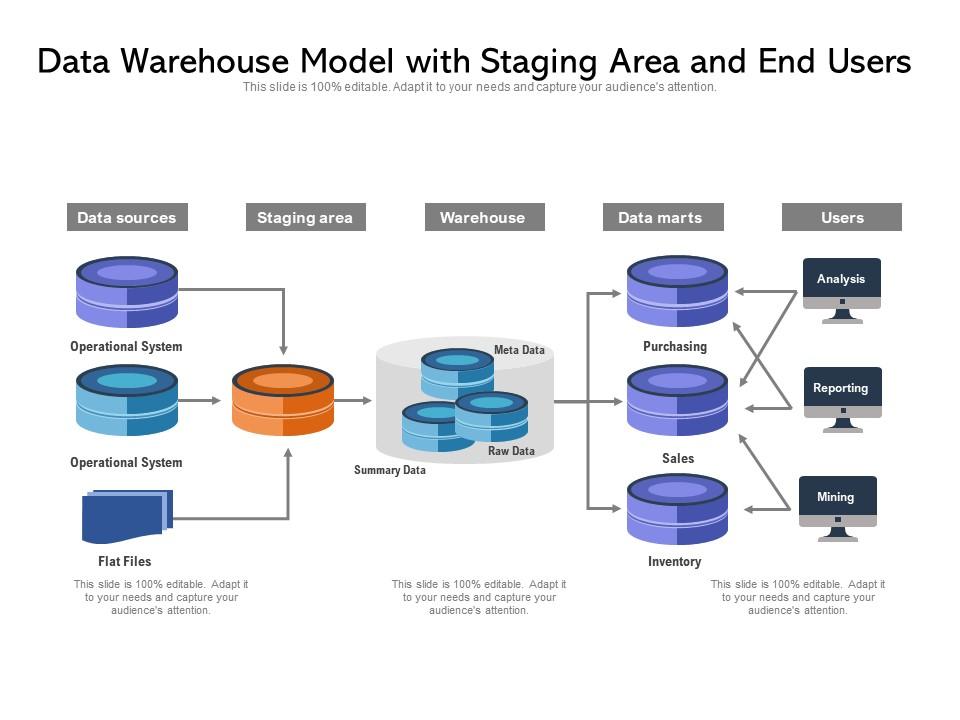
Presenting this set of slides with name Data Warehouse Model With Staging Area And End Users. The topics discussed in these slides are Data Warehouse, Model, Staging Area, End Users. This is a completely editable PowerPoint presentation and is available for immediate download. Download now and impress your audience.

People who downloaded this PowerPoint presentation also viewed the following :

FAQs for Data warehouse model with staging area

So you've got a few main pieces to think about. Source systems hold your raw data, then ETL processes pull and clean everything up. Your actual warehouse stores it all, plus you need a presentation layer for reports and analytics. Metadata repository sounds deadly boring but honestly it's clutch for tracking where stuff comes from. Most setups also have data marts - think smaller, focused warehouses for different teams. Oh and monitoring tools to catch things when they break. My advice? Map your current data sources first. Makes designing everything else way easier.

Okay so basically star schema keeps your dimension tables flat - like one huge Product table with everything stuffed in there. Snowflake breaks that apart into separate tables for Product, Category, Subcategory, whatever. Star's way easier to query since you don't need tons of joins. Performance is usually better too. Snowflake does save storage space though, which matters if you're dealing with crazy big dimensions. Honestly? Start with star schema. Your queries will be cleaner and your team won't hate you for making them write complicated joins every time they need basic product info. You can always normalize later if storage becomes an issue.

So ETL is basically how you get data from wherever it lives into your warehouse in a way that actually makes sense. First you pull it from databases, APIs, random files - whatever. Then comes the fun part (kidding) - you clean and standardize everything because source data is usually a hot mess. Finally you load it into the warehouse. Honestly, the work itself is pretty boring but your warehouse turns into complete chaos without good ETL. Oh and definitely build in error handling right away. Trust me, you don't want to troubleshoot broken data pipelines when you're half asleep.

Honestly, go with a hybrid setup - mix your regular batch processing with some streaming stuff. Kafka or Kinesis work great for getting data into your warehouse in real-time while everything else is still running. Snowflake and BigQuery are actually pretty solid at handling this now (way less painful than waiting around for those old ETL jobs). You can set up separate real-time tables or use change data capture to keep things in sync. Oh, and definitely figure out what data actually needs to be real-time first - most stuff can probably wait for daily batches.

Dude, cloud warehouses are a game changer. No more worrying about buying servers or dealing with maintenance - that stuff's such a pain. You literally just pay for what you use, which saves a ton of money. When things get busy, it scales up automatically. The performance is actually better too since these big cloud companies have crazy good infrastructure. Oh, and backups happen without you thinking about it, which honestly saved my butt once. I'd try a small test project first - you'll probably wonder why you waited so long to make the switch.

So dimensional modeling is basically organizing your data the way people actually think about it. You get fact tables for metrics and dimension tables for all the descriptive stuff. Way fewer messy joins that way. The star schema makes queries super predictable too - analysts don't have to guess how tables connect. Honestly, most performance issues come from hunting across multiple normalized tables. With this approach you're not doing constant lookups. If your dashboards are crawling or reports keep timing out, this'll probably fix it. It's just more intuitive to work with overall.

Honestly, the worst part is always messy source data - like, who documented this stuff? Nobody, apparently. Your ETL processes will crawl once volumes pick up, and good luck getting departments to agree on how they want things modeled. Everyone's got opinions. Performance becomes a nightmare when users start whining about slow queries. Start with something small first, spend real time profiling your data upfront (trust me on this), and nail down what stakeholders actually want before you build anything. Otherwise you'll be rebuilding it three times.

Dude, governance basically dictates everything about your warehouse setup. Quality rules, security stuff, compliance - it all feeds into your architecture decisions. I learned this the hard way watching teams try to add governance later... total mess. You gotta bake in lineage tracking and access controls from day one. Your ETL design? Influenced by retention policies. Storage approach? Privacy rules matter there too. Even your data models get shaped by standardization requirements. Honestly just map out governance needs first, then build around those. Way cleaner than retrofitting everything.

So basically, data warehouses can team up with big data tools now to handle the crazy amounts of messy data that would break traditional systems. You've got Hadoop, Spark, NoSQL databases - all that stuff can work with your existing warehouse. Here's how it works: use the big data platforms to clean up and process all the unstructured junk first (social media posts, IoT data, web logs, whatever). Then you feed that cleaned-up data into your warehouse for actual business insights. Honestly, it's like giving your warehouse superpowers. Just figure out which data sources are too wild for regular ETL first.

Honestly, start with your slowest queries - that's where you'll see the biggest wins. Get proper indexing set up and partition tables by date or whatever key dimensions make sense. SELECT * will absolutely destroy your performance, even when you think you need everything. Be specific about columns instead. Materialized views are clutch for aggregations you run all the time. Push filters down close to your data source too. Oh, and columnar storage helps a ton if you can swing it. Query caching is worth checking if your platform has it - sometimes the simplest fixes give you the best results.

So I'd go modular - separate your staging, processing, and presentation layers so you can scale pieces independently. Cloud platforms are definitely worth it since they auto-scale without you babysitting everything. Design your data models using dimensional principles, makes adding new sources way easier later. You'll need a solid ETL/ELT pipeline that handles both batch and real-time stuff. Oh, and start with star schema - I know it sounds basic but it's actually perfect for evolving requirements. Way more flexible than people give it credit for.

Ok so three big things to think about here. Role-based access controls are huge - basically making sure only the right people see sensitive stuff. Encrypt everything in transit and at rest, maybe throw in a VPN too. Data masking is honestly a lifesaver when you're dealing with PII or financial data. Audit logging is non-negotiable because you'll need to track who looked at what. Oh, and start by figuring out how sensitive your different data types are first - that kinda drives everything else. Network security can get complex but it's worth the headache upfront.

So data lineage is like breadcrumbs for your data - shows exactly where everything came from and how it changed along the way. Super helpful when stuff breaks (which happens more than we'd like). You can trace back to see where things went sideways and figure out what else might be messed up downstream. Makes fixing problems way faster. Also saves your butt during compliance checks since you've got the full paper trail. Honestly, just start mapping your data flows now. Trust me, you'll be grateful when you're debugging some random issue later and actually know what's connected to what.

So data marts are like mini versions of your main data warehouse, but they're built for specific teams. Your sales department gets their own little data mart with just their stuff. Way better for performance too - people aren't constantly hammering your central warehouse for reports. You've got two options: pull data from your main warehouse (dependent) or go straight from source systems (independent). Honestly though? Start with dependent ones first. They're less of a headache to keep running smoothly, trust me on that one.

Honestly, there are tons of ways to mix ML into your data warehouse. Automated data quality checks are huge - plus you can do predictive stuff for capacity planning and smart data classification. Anomaly detection is probably my favorite though, catches data problems before they screw up your reports. ETL pipelines can have ML models baked right in for real-time scoring. Some teams even get fancy with ML optimizing queries and suggesting better indexes. But seriously, don't go crazy at first. Pick something simple like automated data profiling and see how it goes from there.

Ratings and Reviews

0% of 100
Review Form
Write a review
Most Relevant Reviews

No Reviews