

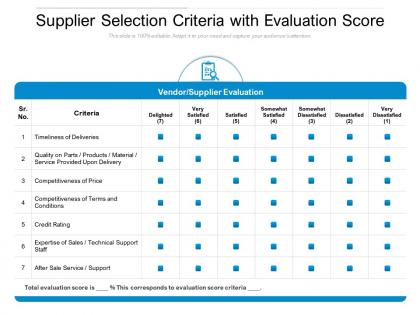
Supplier selection criteria with evaluation score




Try Before you Buy Download Free Sample Product
 Impress Your
 Audience
 100%
100% Editable
 Save Hours
 of Time


Our Supplier Selection Criteria With Evaluation Score give birth to inventive ideas. It allows ingenuity to flourish.
People who downloaded this PowerPoint presentation also viewed the following :
Supplier selection criteria with evaluation score with all 2 slides:
Encourage budding investors with our Supplier Selection Criteria With Evaluation Score. Applaud attempts to display ingenuity.
FAQs for Supplier selection criteria
Definitely start with on-time delivery rates and defect percentages - those are your bread and butter metrics. Order accuracy matters too, obviously. But honestly? Communication is where most suppliers totally blow it. Track how fast they respond when shit hits the fan because radio silence will drive you insane. Financial stability's worth checking through credit scores, and look at their capacity so they don't buckle when you need more volume. Monthly tracking works well. I'd shoot for 95% on-time delivery as a starting point, but that might vary depending on your industry.
Start with their financial statements - cash flow, debt ratios, profit margins from the last couple years. Dun & Bradstreet credit reports are gold for this stuff. Check for any recent bankruptcies or lawsuits (seriously, people miss this all the time). Customer concentration is huge too - if one client makes up most of their revenue, that's sketchy. I'd also ask around about their payment history with other vendors. Shows you how they actually handle money day-to-day. Request their latest audited financials first and see what they're willing to share.
Honestly, QA is make-or-break when picking suppliers. I'd dig into their ISO certs and defect rates first - those numbers don't lie. Ask for last year's quality metrics too. Their testing procedures matter way more than their sales pitch, trust me. You should definitely visit their facilities if you can swing it. Seeing their QA setup in person tells you everything. How do they handle screw-ups when things go wrong? That's huge because their quality becomes your quality. Skip this step and you'll probably regret it later when customers start complaining.
Oh man, supplier communication is huge - definitely top 3 things to check. Here's the thing: if they suck at responding during the sales process when they're trying to win your business, you're screwed once you're actually paying them. Look for quick responses and clear updates. The good ones will actually warn you about problems before they hit. I always tell people to test how fast they get back to you during the RFP stuff, and honestly? Call their existing clients to ask about communication. Trust me on this one.
Track your suppliers by calculating on-time delivery percentage - just divide on-schedule deliveries by total deliveries. Lead time consistency matters too, so check how much actual times differ from what they promised. Honestly, I've seen companies obsess over on-time stats but ignore quality issues. Don't forget order accuracy and damage rates because punctual but wrong deliveries are useless. Your ERP probably has this data already, or make a basic scorecard. Monthly supplier reviews work well for discussing trends. Then you've got solid numbers when making supplier decisions instead of going with gut feelings.
Ask them for real examples of handling volume spikes - actual numbers, not BS marketing speak. Most suppliers will say whatever sounds good, so demand proof of their backup plans and surge capacity. Their financial health matters too since broke suppliers can't be flexible. I'd honestly just run a small test order first and throw some intentional changes at them to see how they react. Check if they've got backup suppliers lined up and flexible processes. Oh, and get documentation on everything - their track record with demand fluctuations will tell you way more than any sales pitch.
So for picking suppliers, carbon footprint is huge - check their waste management and how efficient they are with resources. ISO 14001 certification is a good sign. Do they use renewable energy? Have actual emissions targets? Supply chain transparency matters too, though honestly some companies are sketchy about sharing that info. Compliance with environmental regs is obvious but still worth checking. Water conservation policies are becoming more important these days. Oh and sustainable sourcing practices. I'd make a simple scoring system based on what matters most to your company, then use it for everyone you're evaluating.
Dude, cultural fit with suppliers is huge - seriously underestimated. You want your values to actually line up, otherwise you're setting yourself up for headaches later. Like if you're all about sustainability and they couldn't care less about the environment? That's gonna blow up eventually. Check how they treat employees, their ethics, innovation stuff. Conflict resolution too - that one's weirdly telling about a company. I'd throw some culture questions into your usual supplier reviews. Site visits help too, gives you the real vibe of how they operate day-to-day.
Look at their ERP setup and inventory systems first - that's where most headaches start. How well do they play with your current tech? Data security is massive too, especially with sensitive stuff. I'd definitely test their systems during evaluation instead of just trusting what they tell you. Their automation level matters, plus check out communication tools and how smooth their electronic transactions run. Oh, and ask about backup systems - you don't want to be screwed if something goes wrong. Honestly, I've watched partnerships crash just because systems couldn't talk to each other.
Honestly, compliance isn't optional when picking suppliers - it's the bare minimum before you even look at pricing or delivery. Check they meet all the industry regs and safety standards first. Trust me on this one, I've seen what happens when a supplier screws up compliance... not fun dealing with regulators breathing down your neck! Their track record matters too - do they actually have systems to keep up when rules change? I'd make a checklist for your specific industry and just use it every time. Way easier than scrambling later.
Track their R&D spending and patent filings - that's your innovation baseline. Response times matter too, plus how fast they actually roll out changes when you need them. Quarterly scorecards work great for this stuff. Honestly, the best intel comes from your own people who deal with these suppliers daily - they'll tell you who's really responsive vs. just talks a good game. Oh, and count how many new solutions they're pitching you. Some suppliers get lazy once they've got the contract. Survey your internal teams every few months since they see the real day-to-day behavior.
So basically just tack on risk stuff to your scorecard - financial health, where they're located, backup plans, that kind of thing. Check their credit scores and see if they're sitting in sketchy political areas. Do they have other facilities if one goes down? Weight it maybe 20-30% against your normal quality/cost stuff. Honestly, I've watched companies get completely screwed because they skipped this part. Pick your top 3 worries for each supplier type first. Then build actual questions around those. Way easier than doing it backwards.
So first things first - ask for their sustainability reports and certifications upfront. Labor compliance and environmental certs like ISO 14001 are must-haves. Third-party audit scores don't lie either. Look at diversity programs, community investment, ESG ratings if they have them. Safety incident rates are a dead giveaway if something's sketchy. Fair wages too. Supply chain transparency is huge - do they actually know where their stuff comes from? I mean, some companies just wing it and hope for the best. The ones that track everything down to raw materials are usually the real deal.
Honestly, you'll want to keep your main standards the same everywhere but tweak how you evaluate based on where suppliers are located. Different regions have their own compliance rules and business cultures - plus stuff like political issues or natural disasters that matter more in certain areas. Some suppliers are amazing at innovation but suck at paperwork, which happens a lot depending on the market. I'd weight things differently too - maybe labor practices are huge in one region while environmental stuff matters more somewhere else. Build scorecards that work globally but leave room for local context. Map out what you've got now first.
Honestly, the worst thing you can do is overcomplicate your criteria - you'll just confuse yourself and end up all over the place. Price matters, but don't make it everything because cheap suppliers can bite you later when stuff falls apart. Weight things based on what actually matters to YOUR business. Like, reliable delivery is probably way more important than whether they have some slick website, you know? Keep criteria simple and measurable. Also watch out for accidentally creating rules that only work for suppliers you already use. Test it on a few vendors first to see if it actually tells you anything useful.
No Reviews