


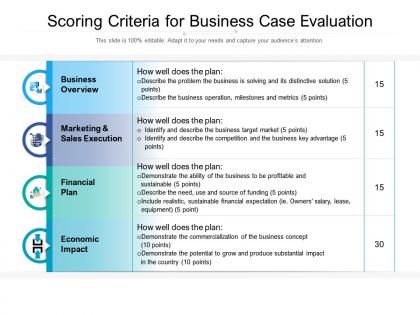
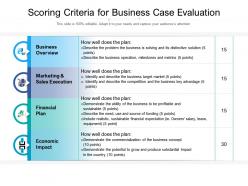
Scoring criteria for business case evaluation




Try Before you Buy Download Free Sample Product
 Impress Your
 Audience
 100%
100% Editable
 Save Hours
 of Time


Our Scoring Criteria For Business Case Evaluation are explicit and effective. They combine clarity and concise expression.
People who downloaded this PowerPoint presentation also viewed the following :
Scoring criteria for business case evaluation with all 2 slides:
Give your audience a fulfilling experience. They will find our Scoring Criteria For Business Case Evaluation elevating.
FAQs for Scoring criteria for
Honestly, I'd break it down into five main things. Financial stuff first - ROI, payback period, net present value, the usual suspects. Does it actually fit with your business strategy? That's huge. Risk assessment matters too, obviously. Then look at whether you can realistically pull it off with your current setup. Resources are always the killer - time, people, money. Oh, and don't ignore how this'll affect different stakeholders because you're gonna need them on board anyway. The real key is figuring out which of these actually matter most to your company right now and weighting them accordingly.
So quantitative stuff is your hard data - ROI, cost savings, revenue projections, payback periods. You can actually crunch those numbers and stack them against other investments. Qualitative metrics are trickier to pin down but just as crucial: brand reputation, employee morale, customer satisfaction, how well it fits your strategy. Real talk? Sometimes the "soft" stuff carries more weight than finance bros want to admit. You need both though. Start with the numbers to grab their attention, then hit them with the qualitative benefits to close the deal and calm any worried stakeholders.
Stakeholder analysis can make or break your business case - seriously, I've watched solid projects die because someone missed a key player. Map out everyone who'll be affected early on. Budget holders, end users, that one department head who always complains about changes. Each group cares about different things, so you've got to tweak your pitch accordingly. Executives want ROI numbers, users want ease of implementation, IT wants to know it won't break everything else. Oh, and don't forget the people who seem unimportant but could torpedo your project later. Customize your metrics and messaging to what actually matters to each stakeholder.
Honestly, most people mess this up because they only look at the money side. Add risk categories right into your evaluation - stuff like operational risk, market risk, implementation risk. Score each proposal against these factors too. Weight everything based on how much risk your company can actually handle. That way you're not comparing a safe bet against some moonshot project without accounting for the difference. I'd start small though - just pick 2-3 key risk areas and add them to whatever template you're using now. Makes a huge difference in your final rankings.
Honestly, the worst thing you can do is be super vague with your criteria. Like saying "strategic fit" - what does that even mean? I'd stick to maybe 5-6 criteria tops because more than that gets messy fast. Weight them too since some stuff obviously matters more. Oh and don't accidentally create criteria that basically favor the solution you already want - I've totally seen that happen before. Keep things specific enough that your whole team would score the same option similarly. Simple beats complicated every time.
Honestly, market trends can totally make or break your business case. You've gotta check if your idea actually fits where things are headed - consumer habits, new tech, all that stuff. Nobody wanted to back Blockbuster when streaming was obviously the future, you know? These trends help validate your revenue numbers too. Going against clear market direction? You better have some serious data to prove why you're right. Oh, and definitely add a trends section to your business case - investors expect it.
Look, financial projections are what make your pitch actually credible to decision-makers. They want to see ROI potential, when cash starts flowing, break-even points - basically proof your idea isn't just wishful thinking. Executives are weird about spreadsheets but they genuinely need them to compare your proposal against other investments. The numbers also force you to really think through your costs and revenue assumptions instead of just winging it. Do yourself a favor and build out three scenarios - best case, worst case, and realistic. Shows you've actually considered what could go wrong.
Honestly, this is make-or-break stuff. Leadership tosses profitable projects all the time if they can't see how it fits the bigger strategy. I've watched so many good ideas get killed just because people couldn't draw that line clearly enough. You need to show exactly how your project pushes forward their main goals - whether that's growing into new markets, cutting costs, whatever they're focused on. Map it directly to what they've said matters most. That connection is basically your golden ticket. Without it, you're just another expense they don't understand.
Mix financial stuff with strategy when you're ranking these. ROI and payback period are obvious ones to check. But also think about how well each project fits your company's actual goals right now. Risk matters too - some projects just aren't worth the headache. Honestly, I've seen teams pick the simpler project over the "perfect" one because execution trumps perfection most of the time. Market timing can make or break things. Maybe throw together a basic scoring system? Weight the factors that matter most to your situation, then compare them head-to-head.
Start by figuring out who your key stakeholders are. Then hit them up through different channels - surveys work great for casting a wide net, but interviews give you the real dirt. Workshops are honestly my favorite though because people just feed off each other's energy and come up with better stuff. Ask specific questions about what success actually looks like to them, not just "what do you think?" Create criteria that reflect what matters most - like if three departments keep bringing up the same issue, that's obviously a big deal. Document it all so people can see their input wasn't just thrown into some black hole.
Honestly, skip the wishful thinking and dig into what actually happened on similar projects at your company. Not the pretty PowerPoint versions - the messy reality. I'd grab maybe 3-5 comparable projects and see how they really performed. Aim for like the 80th percentile of those results. That way you're being ambitious but not delusional. Oh, and don't forget your team's current skill level and whatever constraints you're dealing with. I've watched too many business cases completely tank because someone got starry-eyed about best-case scenarios instead of being realistic about performance.
Sensitivity analysis is basically stress-testing your business plan by tweaking key variables to see what happens. Run scenarios like "what if costs jump 20%" or "revenue drops 15%" - sounds boring but trust me, it beats getting blindsided later. The whole point is figuring out which assumptions are make-or-break so you can plan around them. I'd start with your three biggest assumptions and test them at ±20%. It's one of those unglamorous things that actually matters. You'll quickly see which factors could tank your whole case.
Compliance stuff can literally kill your business case, even if the numbers look amazing. Factor in all those costs upfront - implementation, monitoring, penalties, training your team. Healthcare and finance are especially brutal with this. But honestly, you've got to check how your idea fits with current regs AND what's coming down the pipeline. Non-compliance risks will destroy even your best projects. Oh, and definitely bring legal and compliance people into conversations early - learned that one the hard way. They'll save you from major headaches later.
Honestly, Excel's your best starting point for ROI calculations - everyone knows it already. Monday.com or Asana beat the hell out of endless email threads when you're tracking feedback and timelines. Tableau makes your numbers look way less intimidating to executives, which is half the battle. If you're dealing with enterprise-level stuff, Planview's solid but probably overkill for most situations. Power BI's decent too if you're already in the Microsoft ecosystem. I'd say start with whatever tools you already have access to, then figure out what's actually missing. No point overcomplicating things right off the bat.
So here's what I'd do - build out a few different scenarios instead of just one perfect forecast. Best case, worst case, and realistic middle ground. Think different market conditions, budget cuts, new competitors jumping in. Honestly, it's like stress-testing but for business plans instead of bridges. When you present it, show how your idea holds up across all three situations, not just the sunny day version. Makes you look way more prepared and gives everyone a real sense of what could actually happen. Plus stakeholders love seeing you've thought through the messy stuff.
No Reviews