


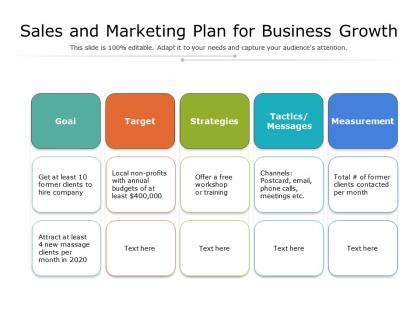
Sales and marketing plan for business growth




Try Before you Buy Download Free Sample Product
 Impress Your
 Audience
 100%
100% Editable
 Save Hours
 of Time


Our Sales And Marketing Plan For Business Growth are explicit and effective. They combine clarity and concise expression.
People who downloaded this PowerPoint presentation also viewed the following :
Sales and marketing plan for business growth with all 2 slides:
Give your audience a fulfilling experience. They will find our Sales And Marketing Plan For Business Growth elevating.

FAQs for Sales and marketing plan
Sales strategies focus on direct customer interactions, closing deals, relationship building, lead conversion, and revenue generation through personalized approaches and tactical execution. Marketing strategies emphasize brand awareness, market positioning, lead generation, customer segmentation, and demand creation through broader campaigns, with many organizations finding that aligning both strategies delivers enhanced customer experiences and accelerated growth.
Companies can effectively align sales and marketing teams through shared goals, integrated communication systems, unified customer data platforms, joint planning sessions, and coordinated lead scoring processes. This strategic alignment streamlines the customer journey, reduces friction between departments, and enhances conversion rates, with many organizations finding that synchronized teams deliver significantly higher revenue growth and improved customer experiences.
Customer segmentation enables businesses to tailor their sales and marketing strategies by dividing audiences based on demographics, behaviors, purchasing patterns, and preferences. This strategic approach allows companies to create targeted campaigns, personalize messaging, and allocate resources more effectively, with retailers and financial services finding that segmented strategies deliver higher conversion rates and improved customer experiences.
Data analytics enhances sales and marketing decision-making by providing customer behavior insights, predictive forecasting capabilities, campaign performance metrics, and market trend analysis. Through advanced analytics tools, organizations streamline targeting precision, optimize resource allocation, and accelerate response times to market changes, with many companies finding that data-driven strategies deliver significantly higher conversion rates and competitive advantage.
Effective social media strategies include targeted advertising, influencer partnerships, content marketing, customer engagement, and social listening. These approaches streamline lead generation by building brand awareness, fostering direct customer relationships, and enabling real-time feedback, with many businesses finding that strategic social media integration ultimately delivers enhanced customer acquisition and significantly improved conversion rates.
Buyer personas influence sales and marketing strategies by enabling targeted messaging, personalized content creation, and strategic channel selection that resonates with specific customer segments. Through detailed demographic and behavioral insights, organizations streamline their approach across email campaigns, social media, and sales presentations, ultimately delivering higher conversion rates and more efficient resource allocation in an increasingly competitive marketplace.
Content marketing significantly enhances sales strategies by building trust with prospects, educating customers throughout the buyer's journey, generating qualified leads, and positioning companies as industry authorities. Through valuable blog posts, case studies, and educational resources, businesses streamline their sales cycles, reduce customer acquisition costs, and ultimately deliver higher conversion rates, with many organizations finding that strategic content directly supports revenue growth.
Businesses can assess strategy effectiveness through key performance indicators like conversion rates, customer acquisition costs, revenue growth, market share analysis, and customer lifetime value tracking. These metrics enable organizations to identify successful campaigns, optimize resource allocation, and adapt approaches based on performance data, ultimately delivering improved ROI and competitive advantage in increasingly dynamic markets.
Innovative sales tactics include social selling through LinkedIn engagement, interactive product demos, personalized video outreach, account-based marketing campaigns, and AI-powered lead scoring systems. These approaches complement traditional marketing by enabling real-time customer interactions, targeted messaging, and data-driven insights, with many organizations finding that strategic integration delivers enhanced conversion rates and competitive advantage.
Technology and automation tools streamline sales and marketing processes by automating lead nurturing, personalizing customer communications, and tracking prospect interactions across multiple touchpoints. These solutions enable sales teams to focus on high-value activities while marketing departments deliver targeted campaigns, ultimately reducing conversion times and increasing revenue efficiency across organizations.
Creating a multi-channel sales and marketing strategy requires considering customer journey mapping, channel integration capabilities, resource allocation across platforms, performance measurement systems, and brand consistency protocols. These factors work together by ensuring seamless customer experiences, optimizing budget efficiency, and maintaining unified messaging, with many organizations finding that strategic channel coordination ultimately delivers higher conversion rates and stronger customer relationships.
Businesses can leverage customer feedback to refine sales and marketing approaches by analyzing purchase patterns, identifying pain points, personalizing messaging, and optimizing channel strategies. Through systematic feedback collection and analysis, companies in retail, financial services, and healthcare enhance targeting accuracy, streamline customer journeys, and develop more compelling value propositions, ultimately delivering higher conversion rates and stronger customer relationships.
**INPUT**: What challenges arise when integrating digital marketing into traditional sales strategies? **OUTPUT**: Integration challenges include misaligned messaging across channels, inconsistent customer data management, conflicting timelines between digital campaigns and sales cycles, and resistance from traditional sales teams. While these obstacles initially create complexity, organizations increasingly find that strategic alignment through unified CRM systems, cross-team training, and shared performance metrics ultimately delivers enhanced customer experiences and improved conversion rates. [Word count: 60 words]
Businesses leverage partnerships by accessing new customer bases, sharing marketing resources, co-creating content, cross-promoting products, and utilizing partner distribution channels. Through strategic alliances, companies in retail, technology, and financial services streamline market entry, reduce acquisition costs, and enhance brand credibility, while ultimately expanding reach and delivering faster growth than traditional solo marketing approaches.
**INPUT**: What are the emerging trends in sales and marketing that companies should pay attention to? **OUTPUT**: Emerging trends include AI-powered personalization, social commerce integration, video-first content strategies, conversational marketing through chatbots, and data-driven customer journey mapping. These technologies streamline lead generation, enhance customer experiences, and accelerate conversion rates, with many organizations finding that strategic combination of these approaches delivers significantly improved ROI and competitive advantage. [Word count: 54 words]
No Reviews