


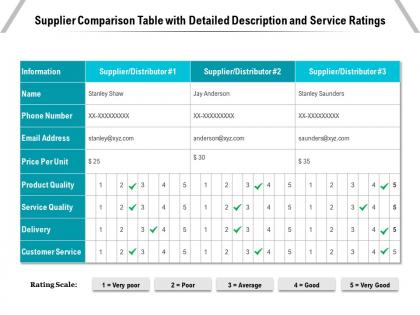
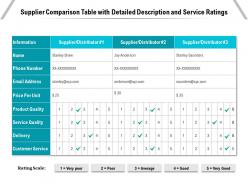
Supplier comparison table with detailed description and service ratings




Try Before you Buy Download Free Sample Product
 Impress Your
 Audience
 100%
100% Editable
 Save Hours
 of Time


Our Supplier Comparison Table With Detailed Description And Service Ratings are topically designed to provide an attractive backdrop to any subject. Use them to look like a presentation pro.
People who downloaded this PowerPoint presentation also viewed the following :
Supplier comparison table with detailed description and service ratings with all 2 slides:
Use our Supplier Comparison Table With Detailed Description And Service Ratings to effectively help you save your valuable time. They are readymade to fit into any presentation structure.
FAQs for Supplier comparison table with detailed description
Honestly, just stick to what actually matters when you're buying stuff - price, quality ratings, delivery times, and payment terms. Those are your bread and butter. Location of the supplier is pretty key too, plus any certifications they've got and whether they can handle the volume you need. Oh, and don't ignore the relationship stuff like how fast they respond to emails - I've seen great deals turn into nightmares because the supplier was impossible to work with. But seriously, don't go overboard with columns or you'll never use the damn thing. Start basic and add more later if you need to.
Look, these comparison tables are game-changers when you're dealing with multiple suppliers. You can line up all the important stuff - pricing, delivery times, quality scores, contract details - and actually see what you're working with. Way better than trying to remember which vendor said what during those endless calls. The visual layout makes it obvious who's offering the best deal and who's trying to pull a fast one. Oh, and make sure you're actually comparing similar services or you'll end up more confused than when you started. Trust me, your sanity will thank you later.
Dude, visuals are a game changer for supplier stuff. Charts let you spot the winners and losers instantly instead of squinting at endless spreadsheet rows. Color coding is your friend - highlight the rockstars, flag the problem children. Stakeholders actually look at pretty charts instead of zoning out (I swear some people see numbers and their brain just shuts off). Radar charts work great, or even just a simple color-coded table. You'll catch patterns way faster, and honestly? Decision meetings go so much smoother when people can actually see what you're talking about.
Define your evaluation criteria first - before you even peek at suppliers. Otherwise you'll end up like me, falling for the first smooth-talking vendor who promises the moon. Set measurable stuff: price, delivery times, quality certs, support response. Weight each factor based on what your project actually needs, not what sounds good in presentations. Score everyone with the same rubric - no exceptions. Make a simple matrix and don't deviate from it, even when your gut screams otherwise. Trust me, the numbers won't lie to you later.
Oh absolutely, reputation matters a ton when picking suppliers. I'd check their track record with other clients first - like, do they actually deliver what they promise? How do they handle screw-ups when things go sideways? References are clutch here, and honestly I'd ask around your network too if you can. Sure, going with the cheapest option is tempting (we've all been there), but I've watched companies get completely burned by suppliers who looked great on paper but were disasters in practice. A solid reputation might cost you a bit more upfront. Trust me though, it beats dealing with quality nightmares later.
Focus on delivery times first - are they actually hitting deadlines? Quality stuff like defect rates and returns matter too. Cost is obvious. Financial stability though - you don't want them folding halfway through a project, trust me on that one. Check their capacity and lead times, plus how they handle rush jobs or changes. Honestly, communication is huge and gets overlooked. Suppliers who disappear when problems hit are the absolute worst. I'd start with these basics in a spreadsheet, then add whatever specific metrics actually affect your day-to-day operations.
Honestly, just let the tech do the work for you. Procurement software pulls all that vendor data and pricing automatically - way better than copying stuff between a million spreadsheets. There's AI now that reads through supplier proposals and picks out the important bits to compare. Airtable's pretty solid for this, or you could go with actual procurement platforms that update everything in real-time. I'd start by figuring out what supplier info you're always comparing, then find tools that grab those specific things automatically. Trust me, it beats doing it manually every time.
Honestly, the biggest trap is overcomplicating your comparison table. You'll just stare at it forever and never make a decision. Stick to maybe 5-7 things that actually matter - price, quality, delivery, support, whatever's crucial for you. And don't score everything the same weight! Some stuff matters way more than others. Oh, and limit yourself to like 3-5 suppliers max. I know it's tempting to research everyone under the sun, but you'll go crazy. Make sure you're getting quotes for identical specs too, otherwise you're just wasting time. Start simple - you can always add more later if needed.
Honestly? I'd say monthly if you can swing it, especially with how crazy pricing has been lately. Quarterly works too for stuff that's not super critical. Just don't let it sit longer than three months or you'll be making decisions off stale info. Set those calendar reminders though - I've seen people totally forget about this stuff. Oh, and if you hear something big happened (like your supplier got bought out or whatever), update it right away. Markets move fast now. Your data's only useful if it's actually current, you know?
Your industry totally shapes what matters most in those supplier tables. Manufacturing? Quality certs and delivery times are everything - one delay kills your whole production line. Tech companies need to obsess over security compliance and scalability (learned that the hard way at my last job). Healthcare and food are all about regulatory stuff and traceability, which honestly makes sense. Figure out what keeps you up at night in your specific industry, then weight those factors heaviest when you're scoring suppliers. Short answer: your biggest pain points should drive the whole comparison.
Add a "buyer experience" column to your comparison table with ratings and review themes. Honestly, complaints tell you way more than the glowing reviews do. Grab feedback from your internal team, industry forums, and ask suppliers for references directly. Weight newer feedback heavier, especially from companies similar to yours. Track both delivery performance and how they are to work with - some vendors are technically solid but total nightmares relationship-wise. Oh, and create a simple scoring system so you can actually compare them side by side instead of just going with your gut.
So satisfactory basically means keep doing what you're doing - they're hitting your quality, delivery, and cost targets. Unsatisfactory though? That's when you gotta act. Maybe they're missing deadlines (which honestly makes my eye twitch), or quality's gone downhill, or prices are creeping up. You've got three moves: work out a performance plan together, start hunting for backup suppliers, or just cut them loose if it's really bad. The whole point is making these calls based on actual data instead of just winging it on feelings, you know?
Location is huge for supplier comparisons, trust me. Shipping costs and delivery times can totally change which option makes sense. We've all seen how supply chain stuff can go sideways - especially lately. Time zones matter too if you need quick responses from vendors. Currency swings, local regulations, compliance requirements... it all adds up fast. When you're building your comparison, make separate columns for the location stuff like shipping and lead times. Otherwise you'll just focus on unit prices and miss the real cost. Been there, done that mistake myself!
Honestly, Excel or Google Sheets work fine for basic stuff and you probably already know them. Airtable's my favorite though - it's basically a database that doesn't make you want to cry. If you're dealing with bigger procurement stuff, platforms like Coupa handle the heavy lifting automatically. Monday.com and Notion are solid too if you want something more visual. Oh, and if you're at a company with actual budget, Ariba's pretty powerful but might be overkill. I'd just start with whatever you can access right now and see how complex your needs actually get.
So here's what works for me - set up a weighted scoring thing where cost gets like 40-50% of the total points. Price and payment terms go in that bucket. Then split the rest between quality stuff, how reliable their delivery is, customer service, whatever matters to you. Honestly, most people make cost way too important and then wonder why their suppliers suck. Stay consistent with how you score each vendor though. I just use a basic spreadsheet that adds everything up automatically. Makes it way easier to compare apples to apples instead of just going with whoever's cheapest.
No Reviews