


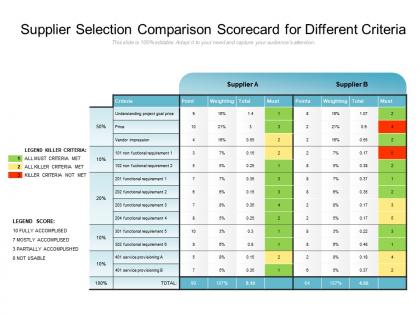
Supplier selection comparison scorecard for different criteria




Try Before you Buy Download Free Sample Product
 Impress Your
 Audience
 100%
100% Editable
 Save Hours
 of Time


Interest in your idea will increase exponentially due to our Supplier Selection Comparison Scorecard For Different Criteria. It generates intense focus.
People who downloaded this PowerPoint presentation also viewed the following :
Supplier selection comparison scorecard for different criteria with all 2 slides:
Folks invariably find it easy to focus due to our Supplier Selection Comparison Scorecard For Different Criteria. It facilitates intense concentration.
FAQs for Supplier selection comparison scorecard
For your supplier scorecard, hit these five areas. Quality stuff first - defect rates, certifications, how they handle quality control. Cost obviously matters too: pricing, payment terms, total ownership costs. On-time delivery is make-or-break honestly, so track their delivery rates and lead times. Risk assessment saved my butt once - check their financial health, location, backup plans. Oh and don't underestimate the relationship side. Communication and cultural fit matter more than you'd think. Just weight everything based on what's critical for your industry. Some suppliers look great on paper but are nightmare to work with.
So basically a supplier scorecard takes all your random "I like this vendor better" feelings and makes them into actual numbers. You score each supplier on stuff like price, quality, delivery - way better than trying to explain gut instincts to your boss later. Different projects need different priorities too, so maybe cost is huge for one purchase but quality matters more for another. Honestly it's saved me from so many awkward stakeholder meetings. The data helps you spot trends over time which is pretty useful. Just start with like 4-5 simple criteria and don't overthink it.
Focus on what'll actually hurt your business most. Yeah, cost usually lands around 30-40%, but honestly? If quality disasters would wreck you more than paying a bit extra, weight accordingly. I've watched people waste entire weeks arguing over tiny percentage differences that literally don't matter. Quality, delivery reliability, financial stability - those typically fill out your main buckets. Stick to 4-6 categories max and make sure everything adds to 100%. Pro tip: run a couple suppliers you already know through it first. If the results seem off, your weighting probably is too.
Just add some risk stuff right into your regular scorecard - works way better than doing it separately. Check their financials, like credit scores and if revenue's trending up or down. Also look at operational things - are they your only source for something critical? Geographic issues? Their compliance track record matters too. Use a 1-5 scale where 5 means lowest risk, then weight it based on how much you'd be screwed if they disappeared tomorrow. I learned this the hard way after picking a "great deal" supplier that went under six months later. Don't just chase the cheapest option - factor the risk scores into your final ranking so you're actually protected.
Look, supplier performance history carries serious weight - like 30-40% of your total scorecard. Past results tell you everything about delivery times, quality issues, and how they handle problems. Don't just take their word for it though. Get real numbers from their other clients - actual delivery percentages, defect rates, response times. References are nice but data doesn't lie. Honestly, I've seen too many people skip this step and regret it later. Use what you find to catch red flags early and push for better contract terms upfront.
Honestly, automating your data collection is a game changer - no more manually tracking supplier metrics. You can set up systems to pull real-time info on quality, delivery times, pricing, all that stuff. The AI weighting features are actually pretty neat too, helps predict which suppliers might be risky. Dashboards make comparing everyone super easy since you can see trends at a glance. I'd start small though - pick one or two data sources to automate first, then expand once you get the hang of it. Way less room for human error this way.
Track these five things: on-time delivery, quality defects, and order fill rates first - they're your bread and butter metrics. Lead time variability matters too because unreliable timelines will drive you nuts. Financial stability scores are worth checking if it's critical stuff you can't afford to lose. Oh, and communication response time - you'll know pretty quick which suppliers actually pick up the phone when things go sideways. Honestly, suppliers who ghost you during problems aren't worth the headache. Start there and you'll catch most issues before they bite you.
Definitely add sustainability as like 15-20% of your scorecard weight. Track stuff like carbon targets, waste practices, renewable energy, and any certs they have (ISO 14001, B-Corp). I've watched companies get totally blindsided when customers suddenly care about this stuff. Can they actually tell you where their materials come from? That supply chain transparency thing is huge now. Don't just look at their pretty policies though - you want real performance data. Oh, and throw a sustainability questionnaire into your RFP process from the start.
Honestly, the biggest mistake is weighting stuff wrong. Don't make price like 70% of your decision - I've watched teams do this and pick absolute garbage suppliers every time. Also those generic template scorecards? Trash. You need something that actually fits your industry. Make sure everyone on your team gets what each criterion means so they're not scoring all over the place. Oh and here's what really matters - once you get your scorecard results, check them against your gut and how suppliers performed before. Sometimes the numbers lie.
Honestly, I'd say every 6 months if you're in something fast-paced, but annually works for most industries. Your priorities change, regulations shift, and honestly the market's been wild lately. Don't stick to the schedule if you've had major disruptions though - just update it right away. I learned that the hard way when we waited too long after a supplier mess last year. Set a reminder now or you'll totally forget. Pull in your procurement and ops people when you do it - they usually catch stuff you miss. Short sentences mixed with longer ones feel more natural than that corporate speak nonsense.
Honestly, the numbers only tell part of the story. Look at how they actually communicate and handle problems - I've worked with suppliers who looked amazing on paper but became total headaches when things went sideways. Do they assign you a real account rep or just bounce you around? Check their innovation stuff and sustainability practices too. Get references from other clients, that's huge. Maybe create a simple rating system for all the soft skills and make it like 30-40% of your decision. Trust me, cultural fit matters way more than most people think.
Honestly, you'll want to loop in other people before picking your supplier - it makes a huge difference. Get finance, operations, and procurement involved because they'll catch stuff you'd totally miss. Finance spots weird cost risks, operations sees delivery red flags, that kind of thing. Short review meeting works great. The best part? Everyone's already on board when you announce the winner, so no drama later. I learned this the hard way when I picked what seemed like the obvious choice and then got absolutely roasted by three different departments afterward.
Oh man, global sourcing totally changes your scorecard game. You'll need way more criteria now - shipping costs, currency swaps, those crazy long lead times. Communication gets weird too (trust me on this one). Quality control becomes huge since you can't just pop over to check on things. Honestly, the regulatory stuff alone will make your head spin. Plus cultural differences are real - had a supplier once who thought our deadlines were more like... suggestions? Anyway, definitely beef up those categories and reweight everything before you start comparing suppliers. Way more moving parts than domestic.
Honestly, these scorecards are game-changers because your suppliers actually know what you want from them. Quality, delivery times, costs - whatever matters to you. No more guessing games on their end. You'll have real data for those performance reviews too, which makes conversations way less awkward. I mean, nobody likes feeling attacked over vague complaints, right? Short sentences work. Longer ones give you room to explain why consistent scoring builds actual trust with your best suppliers. Just don't use it like a weapon - think partnership tool instead.
Honestly, it's all about what kills suppliers in your industry. Manufacturing? You're looking at quality certs and production capacity first. Tech companies obsess over security compliance and innovation stuff. Healthcare is just a regulatory mess - good luck with that one! Financial services need solid risk management, retail cares about logistics and scaling up fast. Pick your industry's biggest 3-4 failure points and weight those at like 60-70% of your scoring. Everything else is secondary. Just think about what usually goes wrong with your suppliers and build your weights around that.
No Reviews