

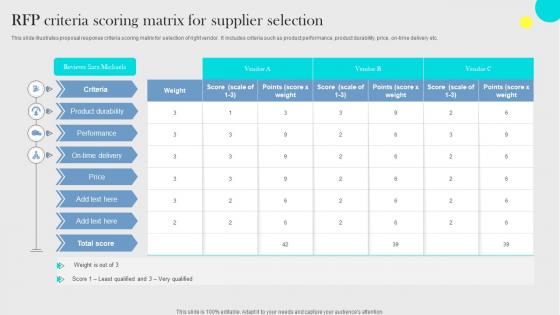
RFP Criteria Scoring Matrix For Supplier Selection




Try Before you Buy Download Free Sample Product
 Impress Your
 Audience
 100%
100% Editable
 Save Hours
 of Time


This slide illustrates proposal response criteria scoring matrix for selection of right vendor. It includes criteria such as product performance, product durability, price, on time delivery etc.
People who downloaded this PowerPoint presentation also viewed the following :
RFP Criteria Scoring Matrix For Supplier Selection with all 6 slides:
Use our RFP Criteria Scoring Matrix For Supplier Selection to effectively help you save your valuable time. They are readymade to fit into any presentation structure.





FAQs for RFP Criteria Scoring Matrix
So basically an RFP scoring matrix lets you compare vendors without just winging it. You set up criteria beforehand - stuff like price, experience, technical skills - then weight them by what matters most to your project. Score each vendor the same way against these criteria. Honestly saves you from awkward conversations later when someone asks why you didn't pick the cheapest option. The whole thing becomes way more defensible to stakeholders. Oh, and figure out your must-haves vs nice-to-haves before you even write the RFP. Trust me on that one.
So basically you score all the vendors on the same stuff - cost, experience, how fast they can deliver, whatever matters to you. Gives each factor a weight too. Way better than just going with your gut, which honestly can lead you astray. The numbers make it super easy when your boss asks why you picked vendor A over vendor B - you've got actual data to back it up. Plus once you figure out what criteria work, you can just reuse the whole thing next time. Makes the whole process way less stressful.
So for your scoring matrix, definitely hit the basics: technical skills, cost, experience, and timeline stuff. Vendor stability is huge too - had a client whose contractor literally disappeared halfway through, nightmare. Also throw in their project approach and references from similar gigs. Honestly, don't overcomplicate it with a million sub-categories right off the bat. Weight everything based on your priorities - tight budget means cost gets like 30%, technical maybe 25%. Oh, and figure out what "good" actually looks like for each thing before you start scoring. Trust me, you'll save yourself so many headaches later when your team's debating scores.
Just weight the criteria differently based on what actually matters for each project. Like if it's a complex tech thing, maybe do 40% technical skills and 20% cost. Simple service contract? Flip it around. I swear half the companies I've worked with just use the exact same template every time - drives me nuts. Sometimes you need to add whole new categories or dump ones that don't make sense. The main thing is matching your scoring to what'll actually make the project succeed, then tell vendors upfront what you care about most. Saves everyone time.
So basically, weighted scoring lets you focus on what actually matters instead of treating everything the same. Like, you'd weight technical skills and cost way higher than something random like how big their office is. Otherwise you end up with vendors who look great on paper but suck at the important stuff - seen it happen so many times. The math does the work for you once you set it up right. I'd start with your top 3-4 non-negotiables and weight those heavy. Makes the whole ranking thing way more realistic.
Okay so first thing - set up your scoring criteria before you even peek at the proposals. That's like rule
-
“Detailed and great to save your time.”
-
SlideTeam is the way to go when you are in a time crunch. Their templates have saved me many times in the past three months.