


RFP Evaluation Matrix For Vendor Selection




Try Before you Buy Download Free Sample Product
 Impress Your
 Audience
 100%
100% Editable
 Save Hours
 of Time


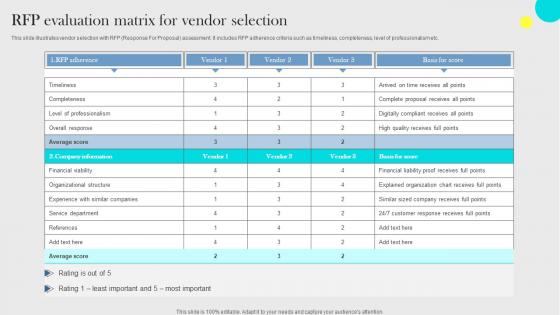
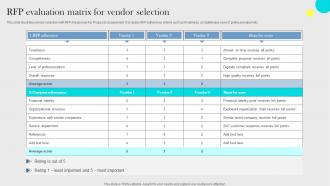
This slide illustrates vendor selection with RFP Response For Proposal assessment. It includes RFP adherence criteria such as timeliness, completeness, level of professionalism etc.
People who downloaded this PowerPoint presentation also viewed the following :
RFP Evaluation Matrix For Vendor Selection with all 6 slides:
Use our RFP Evaluation Matrix For Vendor Selection to effectively help you save your valuable time. They are readymade to fit into any presentation structure.





FAQs for RFP Evaluation Matrix
So basically an RFP Evaluation Matrix is just a fancy spreadsheet where you score each vendor proposal against stuff that matters to you - price, tech skills, past experience, whatever. You assign point values to each thing beforehand so nobody can say you played favorites later. Trust me, procurement people love having numbers to point to when someone inevitably complains about who got picked. Without it you're just winging it based on feelings, which never ends well. The key is building it before you even send the RFP out, not scrambling after proposals come in.
Look, RFP evaluation matrices are honestly lifesavers. Instead of going "hmm, this vendor seems nice," you set up weighted criteria first - cost, experience, tech stuff, whatever matters. Then you score everyone against the exact same standards. No more gut-feeling decisions that you can't explain later. I learned this the hard way on a project where we picked based on best PowerPoint skills (terrible idea). The scoring keeps everything fair and transparent. Stakeholders love it because they can see exactly why you chose vendor A over B. Just pick your 5-7 biggest priorities, weight them properly, then stay consistent with scoring.
Definitely focus on the big stuff first - technical capabilities, cost, vendor experience, and timeline. References matter too, obviously. But here's what nobody talks about: cultural fit is huge. Seriously, you'll hate your life if they're impossible to communicate with when things get stressful. Weight everything based on your project - like if it's super technical, maybe give those skills 40% of your scoring. Use a simple 1-5 scale so everyone's evaluating consistently. Oh, and don't forget a risk assessment section because there's always something that could go sideways.
Match your scoring to what actually matters for the project. Tech stuff? Weight technical skills and approach heavier. Service work usually cares more about experience and team quality. Don't let cost take over everything - I've watched projects crash when price got like 60% of the scoring, it's brutal. High-risk projects need vendors who won't disappear on you. Your whole evaluation team should agree on weights before you start, then write down why you chose them. Trust me, someone will question it later and you'll want that backup.
So scoring is just turning your gut feelings into actual numbers you can compare. Pick a scale (1-5 works fine) and rate each vendor on every criterion in your matrix. Short sentences make ranking super obvious afterward. You'll have hard data backing up your choice instead of just "they seemed nice in the meeting" - which honestly happens more than people admit. The key thing? Stick to whatever scale you pick for every single proposal. Don't get creative halfway through or you'll mess up the whole comparison.
Honestly, I'd split it roughly 40-50% for the hard numbers (cost, timeline) and 50-60% for the softer stuff like team experience and whether you actually think they'll be decent to work with. The key is being real about what matters for YOUR specific project. Sometimes the lowest bidder ends up being a total headache - learned that one the hard way. Make sure you've got clear ways to score the qualitative stuff though, otherwise it's just random feelings. Start with your absolute must-haves, then figure out the weights from there.
Don't make your criteria too vague - you'll get inconsistent scores that mean nothing. And please don't weight everything equally just because it seems fair. Price obviously matters more than what color paper they use, right? Define each criterion clearly so your team actually understands what they're rating. I learned this the hard way when our evaluation was all over the place. Also resist adding new criteria halfway through when vendors surprise you with responses you didn't think of. Test your matrix on a sample proposal first. Trust me, it'll save you from discovering major gaps when it's too late to fix them.
At minimum, once a year - but honestly? Do it right after each big procurement while everything's still stuck in your head. Your priorities change, markets shift, and you'll realize some criteria that looked great on paper were totally useless for actual decisions. Fast-moving industries or new tech might need updates every 6 months (which sounds exhausting but whatever). I'd keep notes during each evaluation about what actually helped vs. what was just bureaucratic fluff. Makes the yearly review so much easier when you're not trying to remember what happened 8 months ago.
Yeah, tools help a ton with RFP evaluations. You'll get way better scoring consistency and no more stupid math mistakes. Multiple people can work on it at once without those awful version control issues - you know how that goes. The automated calculations are clutch, and most tools let you weight criteria properly. Honestly, the reports look so much more professional than whatever franken-spreadsheet you'd normally cobble together. Everything stays in one place too. I'd start with Airtable if you want simple, or go bigger with actual RFP software if you've got budget for it.
Get stakeholder input super early - like when you're still figuring out what criteria even matter. Have IT, procurement, and end users rank their priorities, then find where they overlap. I've watched too many people build these matrices alone and completely miss dealbreakers that should've been obvious. Run workshops or send surveys to collect what they care about. Just don't let it turn into one of those nightmare committee situations where nothing gets decided. Once you know their priorities, let different groups evaluate the parts they actually understand. The key is getting them involved in building the framework, not just nodding along at the end.
Okay so first thing - lead with an executive summary of your top 2-3 vendors and what makes them shine. Color coding is your friend here because honestly, no one wants to decode boring spreadsheets in a meeting. Walk them through your criteria upfront so they get why you scored things the way you did. Heat maps work great for showing differences quickly. If there were any close calls or tough tradeoffs, just say so from the start. People will find out anyway and you'll look more credible. Wrap up with next steps and timeline so everyone's clear on what happens moving forward.
Yeah, so basically each industry tweaks these evaluation matrices completely differently. Healthcare's obsessed with compliance and security stuff - which honestly makes sense given all the regulations they deal with. Manufacturing cares way more about whether something can scale up and integrate with their existing systems. Tech companies? They'll usually pay more for innovation and technical expertise over just going with the cheapest option. Government RFPs are their own beast - everything's about regulatory boxes and transparency. My advice is to find templates from companies in your specific field first. Figure out what your industry absolutely can't compromise on, then build your scoring around that instead of some cookie-cutter approach.
Look, a good RFP matrix honestly saves your ass. You'll actually know what success looks like instead of just picking whoever sounds the smoothest. Score everyone against the same stuff and you won't get burned by flashy presentations that can't deliver. Weighting your criteria right? That's the secret sauce - spend time there. Your stakeholders will thank you later when they ask why you chose vendor X and you've got solid numbers backing it up. Way better than "they seemed cool" as your reasoning, trust me.
Oh man, cultural stuff totally changes your whole scoring approach. Local compliance becomes huge - way more than domestic deals. Time zones matter too if you need ongoing support. Some regions are all about relationships first, cost second (found that out the painful way on a project in Japan). Language skills and regional experience suddenly jump to the top of your priorities. Business practices vary like crazy between countries, so vendors need to actually get that. Quick tip though - definitely bounce your criteria off someone local from each region before you lock it in. They'll catch blind spots you'd never think of.
So you want to know if your RFP matrix actually worked? Check if the vendor you scored highest delivered what you expected - pretty basic stuff. Did they hit budget and timeline targets? Most teams totally forget to circle back on this part, which is honestly a huge mistake. Track how happy stakeholders are with who you picked and whether you missed any big requirements during the evaluation. The real proof is comparing what your matrix predicted versus what actually happened. Document all of it because those insights will save you next time around. Success rates tell the whole story.
-
The content is very helpful from business point of view.
-
I loved the hassle-free signup process. A few minutes and, I had this giant collection of beautiful designs.