

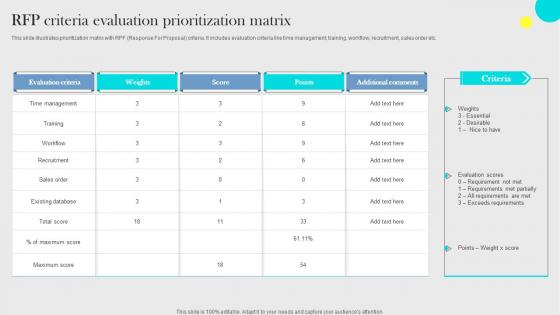
RFP Criteria Evaluation Prioritization Matrix




Try Before you Buy Download Free Sample Product
 Impress Your
 Audience
 100%
100% Editable
 Save Hours
 of Time


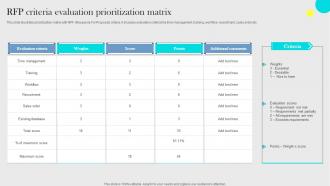
This slide illustrates prioritization matrix with RPF Response For Proposal criteria. It includes evaluation criteria like time management, training, workflow, recruitment, sales order etc.
People who downloaded this PowerPoint presentation also viewed the following :
RFP Criteria Evaluation Prioritization Matrix with all 6 slides:
Use our RFP Criteria Evaluation Prioritization Matrix to effectively help you save your valuable time. They are readymade to fit into any presentation structure.





FAQs for RFP Criteria
Key criteria include technical capabilities, cost structure, vendor experience, implementation timeline, security compliance, and ongoing support services. These elements enable organizations to systematically assess proposals by comparing qualifications, project approaches, and resource allocation, with many IT departments finding that structured evaluation matrices streamline vendor selection while ensuring comprehensive risk assessment and strategic alignment.
Organizations ensure transparency by establishing clear evaluation criteria, standardized scoring methods, documented decision rationales, consistent reviewer training, and stakeholder communication protocols within their RFP matrix. This structured approach enables procurement teams to demonstrate objectivity, reduce vendor disputes, and maintain audit trails, while ultimately delivering fair competitive processes and defensible award decisions that stakeholders can trust.
Weighting assigns relative importance to different evaluation criteria in an RFP matrix, ensuring that critical factors like technical capability, cost-effectiveness, and implementation timeline receive appropriate emphasis during vendor assessment. Organizations typically determine weights through stakeholder collaboration, with procurement teams, technical experts, and end-users collectively prioritizing criteria based on strategic objectives, ultimately delivering more accurate vendor comparisons and informed selection decisions.
An RFP evaluation matrix accommodates both quantitative and qualitative criteria by assigning weighted scores to measurable factors like cost and timeline alongside subjective elements such as vendor experience, cultural fit, and innovation approach. Through standardized scoring rubrics and defined evaluation criteria, organizations streamline vendor comparisons while ensuring comprehensive assessments, ultimately delivering more balanced procurement decisions and strategic vendor partnerships.
Common pitfalls include using vague criteria without specific metrics, weighting factors incorrectly, creating overly complex scoring systems, lacking stakeholder input during design, and failing to align evaluation criteria with actual project requirements. These issues can lead to inconsistent vendor assessments, biased decision-making, and ultimately selecting suppliers who cannot deliver optimal results, with many procurement teams finding that clear, measurable criteria streamline vendor comparison and enhance selection accuracy.
Vendor references significantly influence RFP evaluation by providing third-party validation of performance claims, past project success rates, and client satisfaction levels across similar implementations. These references enable evaluation teams to verify vendor capabilities beyond proposals, assess real-world delivery track records, and gauge long-term partnership potential, ultimately delivering greater confidence in vendor selection and reducing implementation risks.
RFP evaluation tools include automated scoring platforms, collaborative decision-making software, vendor comparison dashboards, weighted criteria calculators, and cloud-based assessment systems. These technologies streamline procurement by standardizing evaluation processes, enabling real-time stakeholder collaboration, and providing transparent audit trails, with many organizations finding that automated tools reduce evaluation time while improving decision accuracy and compliance.
Organizations customize their RFP evaluation matrix by adjusting weighting criteria, scoring methodologies, and evaluation parameters to reflect unique project priorities, budget constraints, and strategic objectives. Through tailored scoring frameworks, companies in sectors like healthcare technology procurement or financial services outsourcing can emphasize factors most critical to success, ultimately ensuring vendor selection aligns with operational requirements and delivers optimal project outcomes.
The best way to score RFP responses involves establishing weighted criteria with numerical scales, using multiple evaluators, and implementing blind review processes where possible. This systematic approach minimizes subjective bias through standardized scoring rubrics, cross-evaluator calibration sessions, and documented justifications for each score, with many procurement teams finding that structured matrices with predefined benchmarks deliver more objective vendor selections and stronger contract outcomes.
Collaboration among team members improves RFP evaluation matrix outcomes by bringing diverse expertise, reducing individual biases, and ensuring comprehensive vendor assessment across all criteria. Through structured team discussions and shared scoring processes, organizations achieve more balanced evaluations, identify overlooked risks or opportunities, and ultimately select vendors that better align with strategic objectives and operational requirements.
Key factors include evaluation criteria weights, scoring scales, stakeholder input requirements, compliance benchmarks, and cost-benefit analysis parameters. These components enable procurement teams to assess vendor proposals systematically through standardized metrics, transparent scoring methodologies, and objective comparison frameworks, with many organizations finding that well-structured rubrics streamline decision-making while ensuring regulatory compliance and strategic alignment.
An RFP evaluation matrix supports better decision-making by standardizing vendor comparisons, eliminating subjective bias, and ensuring consistent scoring across all proposals and evaluators. Through weighted criteria and transparent scoring, procurement teams streamline vendor selection, reduce evaluation time, and demonstrate compliance with organizational policies, ultimately delivering more defensible procurement decisions and improved stakeholder confidence.
Visual elements in RFP evaluation matrices include color-coded scoring, progress bars, charts, icons, and conditional formatting that highlight critical data points. These visual enhancements streamline decision-making by enabling faster pattern recognition, reducing cognitive load, and improving stakeholder communication, with many procurement teams finding that visual matrices accelerate consensus-building and ultimately deliver more transparent, defensible vendor selections.
Feedback from previous RFP processes reveals gaps in evaluation criteria, scoring inconsistencies, and overlooked vendor capabilities that inform matrix refinement. Organizations leverage these insights to enhance weightings, add missing assessment categories, and streamline decision frameworks, ultimately delivering more accurate vendor selections and improved procurement outcomes while minimizing evaluation blind spots.
RFP evaluation matrix findings should be presented through clear scoring summaries, objective criteria explanations, detailed vendor comparisons, and transparent decision rationales that stakeholders can easily understand. Organizations should include executive summaries with recommendations, supporting documentation for each score, and implementation timelines, with many procurement teams finding that visual scorecards and structured presentations enhance stakeholder buy-in while streamlining final approval processes.
-
I took a chance with SlideTeam. I never looked back. Great products and great service.
-
Attractive design and informative presentation.