


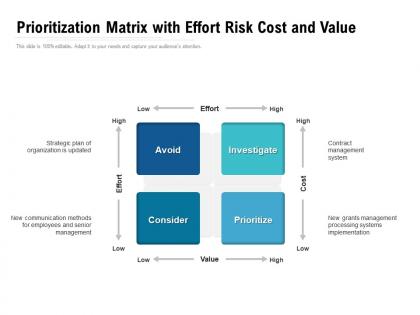
Prioritization matrix with effort risk cost and value




Try Before you Buy Download Free Sample Product
 Impress Your
 Audience
 100%
100% Editable
 Save Hours
 of Time


Our Prioritization Matrix With Effort Risk Cost And Value are topically designed to provide an attractive backdrop to any subject. Use them to look like a presentation pro.
People who downloaded this PowerPoint presentation also viewed the following :
Prioritization matrix with effort risk cost and value with all 2 slides:
Use our Prioritization Matrix With Effort Risk Cost And Value to effectively help you save your valuable time. They are readymade to fit into any presentation structure.
FAQs for Prioritization matrix with effort risk
So a prioritization matrix is just a visual way to rank your tasks or projects against different factors - impact, effort, urgency, whatever matters to you. Plot everything on a grid and boom, you can actually see what needs attention first. Honestly, it's a lifesaver when everything feels urgent (aka every day at work). Instead of going with whoever complains loudest, you're making decisions based on actual criteria. Start simple with a 2x2 impact vs effort grid - I swear it'll end those painful meetings where everyone claims their stuff is top priority. Way better than just winging it.
Figure out what you're actually trying to accomplish first - revenue, customer happiness, whatever your main thing is. Then be realistic about your budget and timeline constraints. Honestly, the biggest mistake I see is trying to evaluate too many factors at once. Stick to 3-4 max or you'll get stuck in analysis paralysis. Get people from different teams involved since they'll catch stuff you missed. Each criterion needs to be super clear and measurable so everyone's on the same page when scoring. Oh and definitely test it out on a few items first - you'd be surprised how often the criteria look good on paper but don't actually help you decide.
So there's basically three you'll run into all the time. Eisenhower Matrix is that urgent vs important thing - honestly saved my butt so many times with daily stuff. Then there's Impact/Effort which is perfect when you need those quick wins for projects. Value/Risk is more for the big strategic calls where you're worried about what could go wrong. I always tell people to start with Impact/Effort if they're not sure. Most flexible one. Though really depends what you're optimizing for - could be time, resources, or just trying to make smart long-term moves. The Eisenhower one gets overhyped but it really does work.
Try a prioritization matrix - plot your features on impact vs effort axes. Quick wins live in that sweet high-impact, low-effort quadrant. Focus there first. Honestly, I've watched so many teams chase features that look cool but don't actually matter to users. The matrix saves you from that trap. Each feature becomes a dot, and suddenly it's obvious which ones deserve attention. Plus stakeholder meetings get way less painful when everyone can literally see why you're doing X before Y. Visual beats endless debate every time.
So basically a prioritization matrix saves you from drowning in all those competing project requests. You plot each project against stuff like impact, cost, strategic alignment - way better than just funding whoever yells the loudest (which honestly happens more than it should). The scores show you where to actually put your budget and people. I love the visual part too - you can see which projects deserve top resources vs. ones that should wait. Just don't BS your scoring or you'll be back to square one.
Set clear, measurable criteria before you start scoring anything - trust me on this one. Numbers work way better than "high/medium/low" because they force you to actually think through your choices. Get a few team members to score things separately, then average it out. Individual biases basically cancel each other out, which is pretty cool. Oh, and write down why you gave each score so you can look back later. The criteria thing though - you'll want to revisit those regularly. Business priorities shift and you don't want to be stuck using outdated assumptions that made sense six months ago but are totally irrelevant now.
Honestly, the biggest mess-ups happen right at the beginning when you pick bad criteria or weight them weird. Don't score stuff based on gut feelings either - I've watched entire teams implode over that nonsense. Also, cramming like 20 options into one matrix? Total nightmare. Keep your scoring discussions balanced too because there's always that one person who talks over everyone else. Try to make your criteria actually measurable when you can. Oh, and get the right people involved in scoring - not just whoever's available that day. If your results look completely bonkers, just go back and adjust the weights.
Yeah, prioritization matrices work great in agile - you just gotta keep them simple. Do quick 15-minute sessions during sprint planning instead of those marathon meetings nobody wants. I usually stick with basic stuff like "user value vs effort" because fancy criteria just slow everything down. Update it every couple sprints since priorities change constantly anyway (they always do, trust me). The trick is treating it like a living document, not something carved in stone. Maybe try a mini session during your next sprint planning? See how your team vibes with it. Way better than arguing about what to build next without any framework.
For prioritization matrices, I'd start with Excel or Google Sheets - dead simple for 2x2 grids and you can tweak them however. Miro's great if you want something more visual, or honestly even PowerPoint works fine. I'm probably weird but I still love sketching these out on whiteboards first before going digital. If you need weighted scoring and fancy criteria, Smartsheet or Airtable handle that stuff better than basic spreadsheets. But seriously, don't overthink it - grab a simple template first and see what clicks with your team before you go buying specialized tools.
Hit your prioritization matrix at big milestones and when stuff changes - new requirements, scope shifts, deadline chaos. I usually do monthly updates on longer projects, though some weeks I'm constantly messing with it lol. Don't go overboard though. Daily updates? You're overthinking it. Calendar reminders help for regular check-ins, but get your team to speak up when priorities shift. Quick matrix review should kick off sprint planning. The trick is staying flexible without becoming that person who changes everything constantly.
So I'd go with a 2x2 grid first - the classic effort vs impact thing. Most people get it right away. Heat maps are clutch too, especially if you're presenting to executives since the color coding makes everything super obvious. Bubble charts work where the size shows priority level, or honestly just do a ranked list if you want something dead simple. Oh, and if you have a ton of items? Definitely switch to heat maps because scrolling through endless grids gets annoying fast. But yeah, start with that 2x2 - it's foolproof.
So basically, grab feedback from your stakeholders first - surveys, quick interviews, whatever works. Use what they tell you to build your criteria (like impact, urgency, all that stuff). Then actually get them involved in the scoring part too. They usually know way more about feasibility than we think they do. Weight everything based on what they care about most - honestly saves you from missing obvious stuff later. Oh, and definitely write down who said what so you can loop back with them. Trust me, they'll appreciate seeing how their input actually got used. Makes the whole process way less of a black box.
Honestly, ground rules save your sanity here - make sure everyone speaks up before you start ranking anything. Get people to score stuff independently first, then compare. The big disagreements? That's where you actually need to talk things through. Focus on your criteria instead of just "I like this better" - way more productive that way. Got data? Use it. When you're torn between close calls, ask what happens if you totally mess up the priority order. Oh, and timebox discussions or you'll be there forever - like 5 minutes per item max. Write down why you made each decision because people will definitely question your choices later.
So basically a prioritization matrix stops your team from just chasing whatever's screaming loudest at the moment. You score each project against stuff that actually matters - revenue impact, strategic value, customer benefit. Game changer when everyone's pushing their favorite ideas! Everything becomes transparent because people can see exactly why Project A beats Project B. Short sentences work. Longer ones help explain the reasoning behind decisions. I'd tie your scoring directly to quarterly OKRs so you're not accidentally working on random stuff that doesn't move the needle. Trust me, it'll save you from so many pointless meetings about "priorities."
Yeah, you'll see these everywhere! Tech companies use them constantly for deciding which features to build next or which bugs to tackle first. Hospitals rely on them for patient care decisions when they're short-staffed. Manufacturing uses them for quality issues and production schedules. Oh and consulting firms - they're obsessed with any 2x2 grid framework, honestly. The thing is, any industry juggling multiple priorities with limited resources benefits from this stuff. Start simple though - just do an impact vs. effort matrix for your next project and see how it goes.
No Reviews