


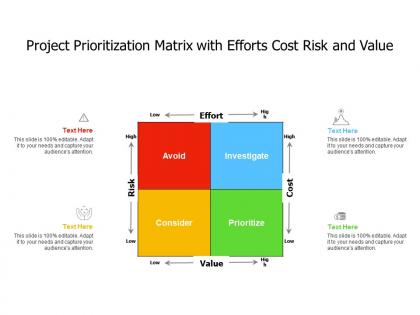
Project prioritization matrix with efforts cost risk and value




Try Before you Buy Download Free Sample Product
 Impress Your
 Audience
 100%
100% Editable
 Save Hours
 of Time


Our Project Prioritization Matrix With Efforts Cost Risk And Value are explicit and effective. They combine clarity and concise expression.
People who downloaded this PowerPoint presentation also viewed the following :
Project prioritization matrix with efforts cost risk and value with all 2 slides:
Give your audience a fulfilling experience. They will find our Project Prioritization Matrix With Efforts Cost Risk And Value elevating.
FAQs for Project prioritization matrix with efforts cost
Keep it simple - pick 4-6 things that actually matter for your business. Strategic fit is obvious (does it help your main goals?). Budget and time constraints are make-or-break. ROI matters, but honestly, some projects are just gut calls on future impact. Implementation difficulty can kill good ideas fast. Risk assessment is huge - I've seen too many "sure thing" projects blow up spectacularly. Timeline pressure and what else depends on it round out my list. Weight them based on what's driving your business right now. Simple 1-5 scoring works fine - don't overcomplicate it.
Okay so basically a prioritization matrix is like your referee when everyone's fighting over budget. You score each project on stuff like impact and effort, then boom - you can see which ones actually deserve resources. No more endless debates about whose pet project matters most (we've all been there lol). The cool thing is it forces you to be real about your capacity instead of saying yes to everything and doing it all half-assed. First define what matters to you - strategic fit, ROI, whatever. Then just score consistently across all projects. Honestly wish more teams did this instead of just winging it with resource decisions.
So basic matrices are pretty straightforward - you just score stuff by how important it seems. But frameworks like Eisenhower and MoSCoW actually give you structure to work with. Eisenhower breaks everything into four boxes: urgent/important, important/not urgent, etc. Works great for managing your day. MoSCoW is more for project stuff - Must have, Should have, Could have, Won't have. The acronym's kinda dorky but whatever, it gets the job done. The real benefit? These methods make you think about trade-offs instead of just slapping numbers on things. I'd go Eisenhower for daily tasks, MoSCoW when you're planning features or projects.
You absolutely need stakeholder input - it's the difference between a matrix that actually works and one that just looks good on paper. Getting different perspectives helps you figure out what criteria really matter and how to weight them. People will actually support the decisions too when they've been part of making them (basic psychology, right?). I've seen too many people skip this step and then wonder why their priorities feel totally wrong. My take? Find your key stakeholders early and check in with them while you're building the thing, not just when you're done. Don't make it some big formal process either - just get their input.
Risk assessment is a major piece of your project scoring matrix - helps you spot which ones might explode later on. Rate each project as low, medium, or high risk, then weave that into your priority score with business impact and resources needed. Trust me, I've watched teams get completely wrecked by chasing "easy wins" that became total disasters. High-impact, low-risk stuff usually gives you the best ROI. Just be brutally honest when you're scoring - don't sugarcoat the technical complexity, dependencies, or whatever roadblocks you can see coming.
Yeah, they totally work for both! Just tweak your criteria a bit. Short-term stuff? Focus on immediate impact and what resources you actually have right now. Quick wins are your friend there. Long-term projects need different thinking - strategic fit, can it scale, future value, all that. Honestly, I just use the same template and swap out maybe 1-2 criteria depending on the timeline. Way easier than starting from scratch each time. The scoring part matters though - make sure it reflects what's actually important for whatever window you're planning for. Oh, and figure out your timeframe first, then pick criteria that make sense for it.
Set up quarterly reviews minimum—though if you're in a fast-moving industry, maybe more often. Check if your criteria still match what leadership actually cares about now and current market stuff. Priorities shift all the time, so you might need to adjust weights or even toss criteria completely. Honestly, I've seen too many teams just build these matrices and never touch them again. Bad idea. Work the review into your regular planning cycle and definitely get buy-in from stakeholders before changing anything major. The whole thing falls apart if it's based on outdated assumptions.
Honestly, Excel or Google Sheets are probably your best bet - everyone already knows how to use them and they're super flexible. If you want something fancier, Airtable and Monday.com have better visuals and automation stuff. There are specialized tools like ProductPlan too, but I've seen way too many teams get caught up picking the "perfect" tool when a basic spreadsheet does the job just fine. My old manager spent like three weeks researching options when we could've just started using Sheets immediately. Pick whatever your team will actually stick with and update regularly.
Get everyone together for your prioritization sessions instead of doing it alone. Have each person score the projects using whatever criteria you've got - impact, effort, strategic alignment, all that stuff. Honestly, the best conversations happen when people disagree on scores. Different perspectives always come up that you wouldn't think of solo. Mix things up by letting different people lead discussions for each project too. Oh and make sure the whole scoring thing is transparent from day one - nobody likes feeling left out of decisions. Trust me, multiple voices beats going it alone every time.
So here's what I'd do - give everything a number scale, like 1-10. Revenue and cost savings are easy since you've got real numbers already. Just normalize them to fit your scale. The tricky part is stuff like strategic alignment or customer satisfaction - you'll have to get a bit creative translating those into numbers using clear criteria. Weight everything based on what actually matters to your company right now (this part's honestly pretty crucial). Oh, and be super consistent with how you score things across projects. Otherwise you're just comparing random stuff and your decisions won't make sense.
Honestly, the worst thing you can do is cram in like 8 different criteria. You'll just second-guess everything and lose focus on what actually moves the needle. Stick to 3-4 max. Office politics will absolutely wreck your scoring too - I've watched teams rank pet projects way higher than they deserved just because the VP was pushing for them. Your scale needs to be crystal clear so everyone's on the same page. Don't overthink this thing either. Start basic, try it on a couple projects, then tweak what doesn't work. The whole point is making decisions easier, not turning it into some complex spreadsheet nightmare.
Your industry totally shapes what matters most in your prioritization matrix. Healthcare companies obsess over regulatory stuff and patient safety way more than a scrappy tech startup that just wants to ship fast. Manufacturing? They're all about supply chain headaches and whether they can actually produce enough stuff. There's no one-size-fits-all approach, which is honestly refreshing. Just figure out what your industry's biggest pain points are - like the top 3-5 things that stress everyone out. Then build your matrix around those and weight them accordingly. Way more useful than some generic template.
Check your matrix every few months - trust me on this one. Ask people if the criteria still make sense, then see if finished projects actually hit their predicted value. Priorities change way faster than you'd think! New business goals or market shifts might mean tweaking your weightings. Also, if you're rating everything as "medium priority," that's basically useless. Short sentences work better sometimes. Your scoring scale needs to actually differentiate between options. Set a calendar reminder right now or you'll totally forget to do this regularly.
So here's the thing about prioritization matrices - they basically give you backup when stakeholders question your decisions. You're not just throwing out "we're doing Project A first" anymore. Instead, you can point to actual criteria like ROI or strategic fit that led to that choice. The visual part is honestly pretty great because people get it immediately. They see how their favorite project ranks against business goals without you having to explain everything twice. And when things change (which, let's be real, they always do), you just update the matrix and boom - everyone sees what shifted. Try it in your next meeting, seriously.
Honestly, visualization is a game-changer for priority matrices. Your brain just processes visuals way faster than scanning through endless numbers. Heat maps and color-coded grids make the high-impact, low-effort stuff pop out immediately - like those bright green boxes in your top-right quadrant. Stakeholders actually stay awake in meetings too when there's something visual instead of another deadly spreadsheet (we've all been there). Try bubble charts where size shows resource needs, or just start simple with Excel's conditional formatting. Different colors for impact vs effort work great. You'll be shocked how much clearer everything becomes once you can actually see the patterns.
No Reviews