

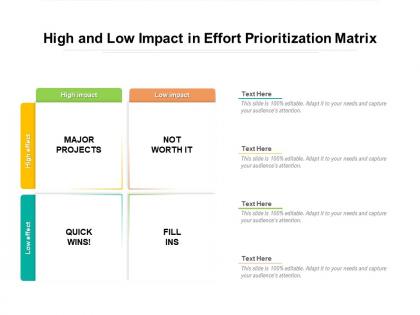
High and low impact in effort prioritization matrix




Try Before you Buy Download Free Sample Product
 Impress Your
 Audience
 100%
100% Editable
 Save Hours
 of Time


Our High And Low Impact In Effort Prioritization Matrix are explicit and effective. They combine clarity and concise expression.
People who downloaded this PowerPoint presentation also viewed the following :
High and low impact in effort prioritization matrix with all 2 slides:
Give your audience a fulfilling experience. They will find our High And Low Impact In Effort Prioritization Matrix elevating.
FAQs for High and low impact in
An Effort-Impact Matrix is a strategic decision-making tool that plots initiatives based on required effort versus potential impact, creating four quadrants for prioritization. This framework assists organizations by enabling systematic evaluation of projects, streamlining resource allocation, and identifying quick wins, with companies across retail, healthcare, and manufacturing finding it accelerates strategic planning while minimizing wasted investment.
The Effort-Impact Matrix helps project managers prioritize tasks and allocate resources by plotting initiatives based on implementation difficulty versus business value delivered. Through this strategic framework, teams can identify quick wins, focus on high-impact deliverables, and avoid resource-intensive activities with minimal returns, ultimately streamlining project execution and maximizing organizational outcomes.
Creating an effective Effort-Impact Matrix involves defining clear evaluation criteria, gathering diverse stakeholder input, plotting initiatives on impact and effort axes, and categorizing projects into priority quadrants. This strategic approach enables organizations to identify quick wins, major projects, and low-priority items systematically, with many teams finding that regular matrix reviews streamline resource allocation and accelerate decision-making processes.
The Effort-Impact Matrix is widely used across technology, healthcare, finance, manufacturing, and consulting industries for strategic decision-making and resource allocation. Organizations in these sectors leverage it to prioritize initiatives, product development, process improvements, and digital transformation projects, with many finding that it streamlines complex decision processes while maximizing operational efficiency and competitive advantage.
Common challenges when using an Effort-Impact Matrix include subjective scoring inconsistencies, oversimplified effort estimates, inadequate stakeholder input, and limited consideration of external factors like resource constraints or market timing. While these matrices streamline decision-making across organizations, many teams find that combining quantitative data with collaborative workshops enhances accuracy, ultimately delivering more strategic resource allocation and sustainable competitive advantage.
Teams ensure accurate assessment by establishing clear evaluation criteria, gathering input from diverse stakeholders with relevant expertise, and using historical data from similar projects as benchmarks. Regular calibration sessions help align team perspectives on scoring, while breaking complex initiatives into smaller components enables more precise estimation, ultimately delivering more reliable prioritization decisions and strategic resource allocation.
Yes, various tools can streamline Effort-Impact Matrix creation, including project management platforms like Asana and Trello, specialized prioritization software such as ProductPlan and Roadmunk, and presentation tools like PowerPoint and Google Slides. These solutions enhance team collaboration through real-time editing, automated scoring, and visual templates, with many organizations finding that digital tools significantly reduce setup time while improving decision-making accuracy and stakeholder alignment.
The Effort-Impact Matrix fosters better prioritization by visually categorizing tasks based on implementation difficulty and potential outcomes, enabling teams to quickly identify high-impact, low-effort opportunities while avoiding resource-intensive activities with minimal returns. This strategic approach streamlines decision-making across project management, product development, and resource allocation, with many organizations finding that it significantly enhances operational efficiency and competitive advantage.
The Effort-Impact Matrix uniquely visualizes prioritization through dual-axis plotting of implementation difficulty versus potential outcomes, while tools like MoSCoW or weighted scoring use rankings or numerical calculations. This visual quadrant approach enables teams to quickly identify "quick wins" and strategic initiatives simultaneously, with many organizations finding that the intuitive grid format accelerates decision-making and stakeholder alignment across diverse business contexts.
The Effort-Impact Matrix can effectively enhance personal productivity by helping individuals categorize tasks based on required effort and potential impact on their goals. Through this strategic approach, professionals streamline daily workflows, prioritize high-impact activities, and minimize time spent on low-value tasks, ultimately delivering improved focus and measurable progress toward career objectives.
Cultural differences significantly affect effort-impact matrix interpretation through varying work styles, risk tolerance levels, resource availability, and decision-making approaches across different organizational contexts. While Western cultures often emphasize individual accountability and quick wins, many Asian and Latin American organizations prioritize collective consensus and long-term relationship building, ultimately requiring matrix adaptations that reflect local business practices and strategic priorities.
Teams frequently misinterpret their Effort-Impact Matrix by overestimating impact without considering implementation complexity, undervaluing low-effort initiatives that deliver consistent results, and failing to reassess priorities as market conditions change. These evaluation errors often lead organizations to pursue resource-intensive projects while overlooking strategic quick wins, ultimately reducing operational efficiency and competitive advantage in increasingly dynamic business environments.
Visual design enhances Effort-Impact Matrix effectiveness by using distinct colors for each quadrant, clear axis labels, and intuitive bubble or dot sizing to represent project scale. Strategic color coding, consistent typography, and clean grid layouts enable stakeholders to quickly identify high-impact, low-effort opportunities, ultimately streamlining decision-making processes and improving resource allocation across organizations.
Stakeholder feedback provides crucial validation for effort estimates, impact assessments, and strategic priorities within an Effort-Impact Matrix, ensuring decisions reflect diverse perspectives and organizational realities. Through collaborative input from teams, executives, and subject matter experts, organizations refine their matrix positioning, identify overlooked considerations, and build consensus around prioritization, ultimately delivering more accurate resource allocation and stronger stakeholder buy-in.
Iterative approaches enhance Effort-Impact Matrix accuracy by incorporating real project data, stakeholder feedback, and evolving business priorities into regular reassessments. Through quarterly reviews and post-project analysis, organizations refine their scoring criteria, adjust impact measurements, and calibrate effort estimates, with many teams finding that systematic iteration delivers increasingly precise prioritization and ultimately stronger strategic decision-making capabilities.
No Reviews