


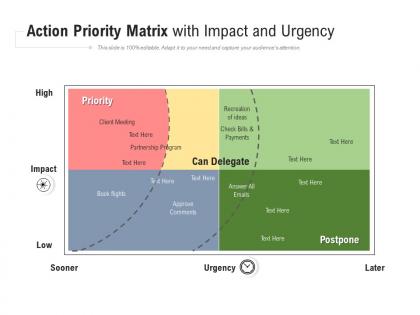
Action priority matrix with impact and urgency




Try Before you Buy Download Free Sample Product
 Impress Your
 Audience
 100%
100% Editable
 Save Hours
 of Time


Our Action Priority Matrix With Impact And Urgency are explicit and effective. They combine clarity and concise expression.
People who downloaded this PowerPoint presentation also viewed the following :
Action priority matrix with impact and urgency with all 2 slides:
Give your audience a fulfilling experience. They will find our Action Priority Matrix With Impact And Urgency elevating.
FAQs for Action priority matrix with
So basically you plot your tasks on a 2x2 grid - impact vs effort. High impact, low effort? Those are your quick wins, do them first. High impact but tons of work? Major projects worth doing eventually. I swear this thing saved my sanity last month when I had like 15 deadlines. Low impact stuff either becomes filler work or just... doesn't happen. Write down what you're dealing with right now and be brutally honest about how much each thing actually matters versus how much energy it'll suck out of you.
So basically you plot your tasks on impact vs effort. High impact, low effort stuff? That's your goldmine - throw your best people at those first. I swear this matrix thing actually works once you get the hang of it. Quick wins get immediate attention and budget. Save your A-team for the big high-impact projects that'll take forever. Random low-priority tasks? Let whoever's free handle those. Honestly, just map out what you're doing now and you'll probably realize you're burning money on stuff that doesn't matter. Game changer for real.
So basically you've got two things to consider: impact (how much it'll actually matter) and effort (time/energy it takes). Draw a simple grid with those as your axes. High impact, low effort = your golden tasks - do these first! High impact but tons of effort? Those are your big projects to plan for. I always get stuck overthinking this part honestly. Low impact stuff is either quick busywork or trash it completely. Just list what you're dealing with right now and plot them out. You'll see patterns emerge pretty quick and know exactly where to start.
Honestly, what I love about the Action Priority Matrix is how it cuts through the chaos. Most prioritization methods only look at one thing - like MoSCoW just ranks importance, or the Eisenhower Matrix focuses on urgent vs important stuff. But this one? It plots both impact AND effort on a simple 2x2 grid. Super practical when you're overwhelmed and need quick answers. You'll spot those "quick wins" immediately - high impact tasks that won't drain your energy. Takes maybe 5 minutes to map everything out, then boom - you can see what actually matters versus what's just keeping you busy.
Dude, use this when you're totally swamped and don't know where to start. Perfect for project planning or daily stuff when you're stuck doing busy work that doesn't matter. Being brutally honest here - I really wish someone had shown me this years ago! Works best when you're short on time, money, or people and need maximum bang for your buck. The trick? Don't lie to yourself about how hard something is versus how much it'll actually move the needle. Next time you're juggling like ten priorities, just try it.
Oh totally! I actually think it works better in agile than regular project management. During sprint planning, just sort your backlog items by impact vs effort - the high impact, low effort stuff becomes perfect "quick wins" to fill your sprint. We use it for retrospectives too, helps you figure out which improvements are actually worth doing. Priorities change so fast in agile though, so don't get too attached to your matrix. Honestly, try it next sprint and see what happens. Makes everything way clearer than just arguing about what's "important."
Start with your own context - what actually matters to your team? Revenue, user happiness, whatever. Impact means how much each thing moves the needle toward that goal. Effort covers time, people, money, complexity - all that stuff. I'd stick with 1-5 scoring because honestly anything more detailed just makes people overthink it. Plot some obvious ones first (quick wins vs huge projects) so everyone's on the same page. Then score the rest consistently. That calibration step is clutch - saves you from arguments later about whether something's a 3 or 4.
Honestly, the worst thing you can do is get stuck trying to nail the perfect impact/effort scores. Just ballpark it and keep moving. Another trap? Shoving everything into "quick wins" because it feels good - but realistically, most high-impact stuff takes actual work. Those big strategic projects in the high-effort zone are usually where the magic happens, so don't write them off. Oh, and definitely check back on your matrix every few weeks. I've had "someday" tasks suddenly become urgent when priorities shifted. Trust me on that one.
Get everyone involved in placing stuff on the matrix - don't let one person call all the shots. Seriously, you need the whole team arguing about what counts as "high impact" versus "low effort" because those definitions are way more subjective than people think. I've watched teams spend forever debating if something's medium or high effort, but honestly? That's when the real clarity happens. Write down whatever criteria you agree on and stick it somewhere everyone can see it. Oh, and revisit the thing regularly since priorities change constantly. The whole point is making it collaborative.
You definitely need other people for this - trying to score impact and effort solo is basically guessing. Pull in your dev team for realistic effort estimates, and get product folks or actual customers to weigh in on business value. Different perspectives catch the stuff you'd totally miss. I've seen teams argue for like 20 minutes over whether something is "medium" or "high" impact, and honestly? That debate is where you figure out what actually matters. Get everyone in the same room when you're scoring things. It's way better than going back and forth over Slack forever.
Oh yeah, totally! Most project management tools let you add custom tags or fields for impact/effort levels. Trello, Asana, Monday - they all work. Some even have matrix templates already built in, which is pretty cool. I'd just add "Impact" and "Effort" labels to whatever you're using now. Then sort your tasks into the four quadrants - quick wins, major projects, fill-ins, and those thankless time-wasters we all hate. Way easier than switching between different apps. Honestly, start simple with just the tags and see how it feels. You can always get fancier later.
Yeah, culture totally affects how people use those priority matrices. People from individualistic backgrounds usually go straight for personal wins and quick results. But in more group-oriented cultures? They'll actually rank collaborative stuff higher even when the immediate payoff isn't obvious. Time perspective plays into it too - some cultures are all about tackling urgent things first, others are fine with longer strategic moves. I've watched this create real tension in mixed teams where what seems like a no-brainer priority to one group makes zero sense to another. So definitely talk through what "high impact" means to everyone before you start.
So Quick Wins are basically those tasks that don't take forever but actually move the needle - you know, like finally sending that follow-up email or organizing your messy desktop. Usually takes 15-30 minutes max. I'm obsessed with these when I'm in a productivity rut because they get you rolling again. Could be responding to messages you've ignored, scheduling a meeting, or just tidying your workspace. The magic happens when you find stuff that barely requires effort but creates obvious improvements. Honestly, updating my LinkedIn felt pointless until I started getting way more connection requests.
Honestly, I'd check it every 2-4 weeks or whenever you hit a major milestone. Projects are chaos - what felt super important last month can become totally pointless after one stakeholder meeting (learned that one the hard way lol). Quick reviews when you hit roadblocks help too. Set a calendar reminder because otherwise you'll forget. Takes maybe 15 minutes but stops you from wasting hours on stuff that doesn't matter anymore. Priorities shift constantly as you finish tasks and face new problems, so don't let your matrix get stale.
Oh totally! The standard "impact vs effort" thing gets old fast. Product teams do way better with "revenue potential vs time to market." Healthcare folks should try "patient outcomes vs resource requirements" - that one actually makes sense for what they're dealing with. Manufacturing could use "quality improvement vs implementation cost." Really though, just think about what your team argues about during meetings. Survey people on what they actually care about when making decisions, then build your axes around those two biggest factors. Way more useful than generic templates.
No Reviews