


Action priority matrix with quick wins




Try Before you Buy Download Free Sample Product
 Impress Your
 Audience
 100%
100% Editable
 Save Hours
 of Time


Get folks to focus on each detail with our Action Priority Matrix With Quick Wins. It encourages an assiduous approach.
People who downloaded this PowerPoint presentation also viewed the following :
Action priority matrix with quick wins with all 2 slides:
Ensure an assiduous examination with our Action Priority Matrix With Quick Wins. Give every detail the focus it deserves.
FAQs for Action priority matrix
So basically you plot your tasks on a grid based on impact vs effort. High impact, low effort = quick wins you should definitely prioritize. Low impact, high effort = avoid those time sucks completely. When I first tried this it was kinda shocking to see how much busy work I was doing that felt important but wasn't really moving anything forward. The visual aspect really helps - like you can't lie to yourself anymore about what's actually worth your time. Just grab 5-10 of your current projects and plot them out to start. You'll get the hang of it pretty quick.
So you plot your tasks on this thing based on impact vs how much effort they take. The high-impact, low-effort stuff jumps out as obvious wins - that's where you start. Honestly, it's kind of genius how simple it is. You'll also spot those busy-work tasks that eat up time but don't actually accomplish much (we all have way too many of those). Instead of drowning in your endless to-do list, you can see what's actually worth your team's time. Maybe try it with your current project stuff?
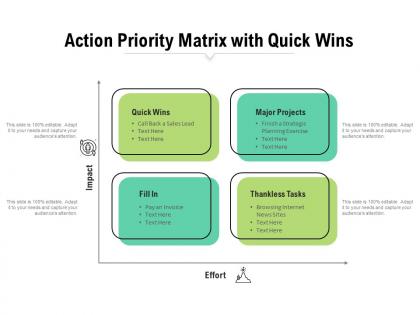
So the Action Priority Matrix breaks things into four boxes based on impact versus effort. Quick Wins are high impact but low effort - basically your dream tasks that you should jump on immediately. Major Projects? High impact AND high effort, so they need actual planning and resources. Fill Ins are those low impact, low effort things you can do when you're bored or waiting around. Then you've got Thankless Tasks - high effort for minimal payoff, which honestly sounds like half my job sometimes. But seriously, avoid those completely. Start by finding your Quick Wins and crush those first.
So basically you've got four boxes when you map out your tasks. Impact vs effort, right? Quick wins are your goldmine - high impact but easy to knock out. Do those first obviously. Then you've got your big projects that matter but take forever - those need actual planning. Low impact, easy stuff? Fine for when you're brain-dead at 3pm I guess. But seriously avoid anything that's hard work for minimal payoff - that's just self-torture. I'd start by dumping everything on paper, then being brutally honest about what actually moves the needle versus what just feels productive.
Oh totally! It works pretty much anywhere because it's just about figuring out what gives you the biggest bang for your buck effort-wise. Healthcare teams use it for patient protocols. Manufacturing folks figure out which processes to fix first. Even retail people plan their campaigns with it. The whole thing is basically "high impact, low effort = do this now" - which makes sense no matter what you're doing. I mean, everyone's drowning in tasks these days. You just tweak the specifics to match your situation and you're set. Tech startups love it, construction companies use it... honestly can't think of where it wouldn't help.
Honestly, the worst thing you can do is be too wishy-washy with your scoring - like rating everything a 3 because you're scared to make tough calls. Keep your scale simple, maybe 1-5 max. I've literally watched people waste weeks perfecting some crazy weighted formula instead of just getting stuff done lol. Don't treat it like gospel either. Priorities change, so your matrix should too. Oh, and definitely get your team involved in the scoring - you'll catch your own blind spots and they'll actually buy into whatever you decide. Trust me on that one.
So the Action Priority Matrix is basically just impact vs effort - super simple compared to other frameworks. You plot stuff on a 2x2 grid and you're good to go. No weird calculations like RICE scoring or anything. The Eisenhower Matrix does urgency/importance instead, but honestly that gets confusing when everything feels urgent, you know? This one cuts through the noise. I literally use it whenever my to-do list gets out of control. Just throw your tasks on there and it's pretty obvious what needs attention first. Sometimes the simple tools work best.
Totally! Using them together actually works really well. Start with SWOT to map out all your options and opportunities. Then take those results and plug them into the Action Priority Matrix to see what you should actually focus on first. SWOT shows you the whole landscape, while the matrix helps you figure out what's worth your time based on impact vs. effort. Honestly, I think most people overthink this stuff, but these two complement each other perfectly. Teams I've worked with always get better outcomes when they don't just stick to one tool.
Dude, you HAVE to get other people involved in building your Action Priority Matrix - seriously. Flying solo means you're just making wild guesses about what matters and how hard things actually are. Different stakeholders know stuff you don't about resources, roadblocks, and what'll actually make a difference. Like, your IT team knows way better than you how long that system upgrade will take. Plus people are way more likely to get behind priorities they helped create. I learned this the hard way when I spent weeks on a project nobody wanted. Don't skip this step!
Honestly, forget the whiteboard approach - digital is so much easier for Action Priority Matrices. I'd grab whatever your team's already using (Asana, Trello, Monday.com) and just set up visual quadrants there. You can drag stuff around when priorities change, which happens constantly let's be real. Spreadsheet templates work fine too if you want something basic. The cool part is everyone sees updates instantly instead of wondering if the matrix is even current. Some tools will actually auto-score your tasks based on criteria you set, though I haven't tried that feature yet. Just don't overcomplicate it by learning a whole new platform.
Honestly, I just look at two things: how much impact something will have vs how much effort it takes. Impact stuff - think revenue, how many people it affects, if it's actually urgent. Effort is time, resources, how complicated it gets. I do this weird 1-10 scoring thing in my head because I'm lazy like that. High impact but easy? Those are your quick wins, obviously. Low impact but tons of work? Maybe save those for when you're bored or something. Try scoring like 10 tasks first and you'll start seeing patterns pretty fast.
Yeah for sure! Get your team together during planning and have everyone weigh in on impact vs effort before you place stuff on the matrix. We use Miro but honestly a shared Google Sheet works fine too. Different people can own different quadrants based on what they're good at. The main thing is everyone needs to agree on how you're measuring impact and effort - otherwise it's chaos lol. Maybe try a quick 15-minute session next week with your current tasks? Some teams get really into it once they see how it works.
So when your team gets into the habit of using this matrix thing, they actually start recognizing what matters vs just random busy work. Decision-making gets faster since everyone's thinking through the same lens. You'll waste less time on pointless stuff and hit your goals more often. People naturally start asking "is this high impact but easy to do?" before jumping into projects. Honestly, the best part is avoiding that chaos where everything feels urgent - you know that feeling? Track what quadrant your finished tasks land in each week. You'll see the shift pretty quickly.
Hey! So for the Action Priority Matrix, visuals are a total game-changer. Color coding works great - red for those low impact/low effort tasks you should ditch, green for the high impact/low effort wins. Nobody wants to stare at boring text slides, right? Charts and real examples plotted on the matrix help people see exactly where their work fits. Icons make it even clearer. Oh, and interactive stuff is gold - let them move sticky notes around the quadrants themselves. People actually get it when they can physically place their tasks. Way better than just talking at them.
Honestly, there aren't a ton of formal case studies on the Action Priority Matrix since it's pretty straightforward as tools go. But I see tech startups and marketing teams talking about it all the time on Reddit and Medium - they just don't always use the official name. Works great when you're drowning in tasks and have zero clue what to tackle first. Marketing agencies especially love it for campaign planning. The real success stories are buried in project management forums where people actually share what worked. Medium's probably your best starting point, though some of the most honest takes are definitely on Reddit.
No Reviews