


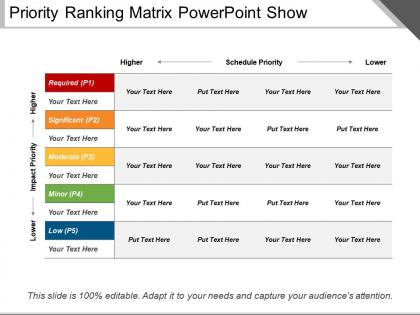
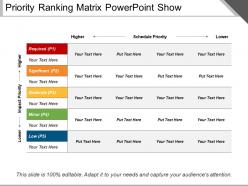
Priority ranking matrix powerpoint show




Try Before you Buy Download Free Sample Product
 Impress Your
 Audience
 100%
100% Editable
 Save Hours
 of Time


The priority matrix PowerPoint template is helpful in explaining that it is an analysis as well as decision-making tool used in project management, business analysis, or in business process improvement systems such as Six Sigma. By using the priority matrix tool presentation slide you can demonstrate that project prioritization or selection is a practical application of project planning and analysis techniques as well. The prioritization matrix presentation slide design is perfect for the user who wants to explain that this prioritization matrix is capable of providing project stakeholders with a resource to resolve disagreements openly, verify all proposals to the best solutions, and increase the chances of a successful project by avoiding hidden agendas or promoting consensus. You can use this prioritization matrix tool template PPT design when you want to highlight that it is necessary to evaluate several criteria as well as to avoid influence of context, the different views of multiple stakeholders, and the clients or the user needs in project or product prioritization and planning phases. The priority matrix method presentation template is perfect to project towards the different priority matrix method such as full analytical criteria, consensus criteria, combination matrix, etc. Bring in a breath of fresh air with our Priority Ranking Matrix Powerpoint Show. Awaken the enthusiasm in folks again.
People who downloaded this PowerPoint presentation also viewed the following :
Priority ranking matrix powerpoint show with all 5 slides:
Your earnings are bound to improve due to our Priority Ranking Matrix Powerpoint Show. It will help draw in fresh customers.
FAQs for Priority ranking
So basically you list all your options and score them against whatever factors matter most - cost, impact, how doable they are, etc. I usually just do 1-10 for each thing. Then add up the totals to see what wins. Honestly it's super helpful when you're torn between a bunch of decent choices and your brain's just spinning in circles. Forces you to actually think through the trade-offs instead of flip-flopping every five minutes. I mean, sometimes your gut still overrides the numbers anyway, but at least you'll have done the math first.
So basically you plot your tasks against stuff like impact vs effort to see what's actually worth doing. Honestly saved my butt when I had like 5 stakeholders all wanting different things. The visual makes it way easier to show people why you're prioritizing X over Y - way better than just explaining it. Quick wins jump out immediately when you use a simple 2x2 grid. I usually go with impact on one side, effort on the other. Stops you from getting stuck on those tasks that feel important but don't actually move the needle much.
You need three things: what you're ranking, criteria to judge them by, and a scoring system. Pick factors that actually matter for your decision - impact, cost, how long it'll take, whatever. I always screw up the scoring at first, but just use 1-5 or 1-10 for everything. Score each item against all your criteria. Here's where it gets good - multiply scores by weights if some criteria matter way more than others. Honestly, start simple with maybe 3-5 criteria max. Don't overthink it initially since you can always make it fancier once you see how the whole thing works in practice.
Figure out what actually matters for your specific situation first - your goals, constraints, what stakeholders care about. Keep it to 3-5 criteria tops, otherwise things get way too complicated. Impact, effort, cost, time, strategic fit are pretty standard, but honestly? Go with whatever your team genuinely cares about. Each one should be measurable and different from the others - you don't want weird overlap messing up your rankings. Oh, and definitely get your key people involved when you're picking these criteria. Trust me, it saves you from questioning everything later when you see the results.
Don't go crazy with criteria - 3 to 5 max or you'll be there forever. Define your scoring scale first, otherwise everyone's using different standards. Oh, and watch out for that one team member who hijacks everything (we all have one). You can't make everything "extremely important" when weighting criteria - be real about priorities. Stop overthinking individual scores too. Debating whether something's a 7 or 8? Just pick one already. Get everyone aligned on the process before you start, or it'll be chaos.
Yeah, priority ranking matrices are perfect for agile! During sprint planning, just score your backlog items on stuff like business value, effort, and risk. Most teams update theirs every few sprints since priorities change all the time. Keep your scoring simple though - I've seen teams waste hours arguing over whether something's a 7 or 8. Make sure everyone knows what the scores actually mean first. Honestly, it's way better than just guessing what to work on next. Try it in your next sprint planning and see how it goes.
Honestly, visuals are game-changers for priority matrices. Color coding is clutch - red for urgent, green for chill stuff. People get it instantly. Heat maps work really well too, way better than those boring spreadsheet-style ones everyone uses. Charts make the relationships obvious at a glance, which saves you when presenting to executives (they have the attention span of goldfish sometimes). Icons help break up text so slides don't look overwhelming. I learned this the hard way after watching people's eyes glaze over during a presentation last month. Trust me, anything that makes data look less like homework gets better engagement.
Honestly just start with Excel or Google Sheets - they're perfect for basic priority matrices and you probably already know how to use them. Most people I know never even bother upgrading from there. If your team's really into visual stuff, Miro and Lucidchart are pretty slick for collaboration. Monday.com and Asana have some decent built-in templates too, which is nice if you're already using them for project management anyway. My advice? Don't overthink it. Pick whatever spreadsheet tool you've got and see how it goes. You can always get fancier later once you figure out what actually works for your process.
Get your stakeholders involved in the actual scoring and weighting - don't just ask for their thoughts afterward. First thing is nailing down the criteria together since they probably care about different stuff than you think. Have them score each option independently, or honestly, group workshops work better because you can argue through the disagreements right then and there. Different groups can weight things differently too based on what matters to them. Oh and make sure it feels collaborative from the start - that's when people actually buy into the results instead of just nodding along.
Track decision consistency first - are people ranking stuff the same way? Then check if your "high priority" items actually turned out to be important after you finished them. That second one's probably the most useful metric, honestly. Also watch adoption rates because if everyone keeps ignoring the matrix, your criteria are probably off. Oh, and time-to-decision is worth tracking too - nobody wants to spend forever debating priorities. I'd start with just consistency and outcome accuracy though. You can always add more metrics later once you've got some baseline data to work with.
Honestly, these matrices are lifesavers when you're juggling a million competing priorities. Use one whenever stakeholders are screaming that everything's urgent - during project planning, budget cuts, feature decisions, that kind of stuff. Product managers love them for choosing which features to build next. IT teams use them too for system upgrades. The whole point is forcing yourself to be objective instead of just going with your gut (though sometimes gut instincts aren't wrong, you know?). Just list out your criteria, give them weights, then score each option systematically. Way better than the usual "let's just pick something" approach most teams default to.
Yeah, totally works for teams! Start by having everyone score independently, then get together to talk through the differences. That's honestly where the good stuff happens - people see angles you'd never think of. Use a shared spreadsheet so everyone can throw in comments about their reasoning. My team tried this last month and it was way less painful than our usual "let's just wing it" approach. Takes maybe 30 minutes to test drive it. Plus you won't get those annoying "wait, why are we doing this again?" questions down the road since everyone helped decide.
Honestly, it's a game-changer because you stop making decisions based on who yells the loudest or just going with your gut. Score each project against criteria like impact, cost, feasibility - then let the numbers do the talking. Budget season becomes so much less painful when everyone's pet project suddenly isn't "critical." Stakeholders can see exactly why something ranked where it did, which kills most of the political drama. I'd start with maybe 3-4 simple criteria and you'll immediately notice your resource decisions get way clearer. Seriously saves your sanity.
Oh man, cultural stuff makes such a huge difference with priority matrices! Different cultures handle decision-making totally differently - some want everyone's input before ranking anything, others just follow whatever the senior person says. Risk tolerance is all over the place too. What looks urgent to us might seem crazy impulsive to other teams. And don't get me started on timeframes - some offices think in quarters, others plan years out. I totally bombed this with our Tokyo team once, whoops. Best move? Get your international colleagues involved in setting up the criteria from day one instead of just dropping your framework on them.
Get everyone to explain why they picked their scores - it stops confusion and gets people on board. Talk about what your criteria actually mean before you start rating stuff. Like what counts as "high impact" vs "low effort"? When people disagree (they always do), ask what would make them change their mind instead of arguing over numbers. Try dot voting first so the loudest person doesn't sway everyone. Oh, and set a timer! Give disagreements maybe 5-10 minutes then move on. You can circle back later if needed, but don't get stuck perfecting every little thing.
-
Easily Understandable slides.
-
Great designs, really helpful.