


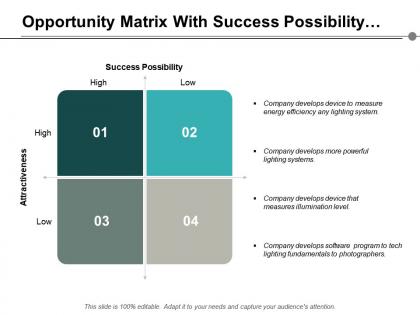
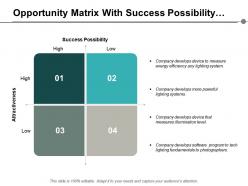
Opportunity matrix with success possibility and attractiveness




Try Before you Buy Download Free Sample Product
 Impress Your
 Audience
 100%
100% Editable
 Save Hours
 of Time


Our Opportunity Matrix With Success Possibility And Attractiveness have an discerning impact. Build an atmosphere that encourages acceptance.
People who downloaded this PowerPoint presentation also viewed the following :
Opportunity matrix with success possibility and attractiveness with all 5 slides:
Our Opportunity Matrix With Success Possibility And Attractiveness exemplify a can do approach. They create attitudinal changes.
FAQs for Opportunity matrix with success
So it's basically a 2x2 grid where you plot opportunities based on two factors - like impact vs effort or how attractive something is vs your chances of actually pulling it off. Each opportunity becomes a dot, and you can instantly see your "quick wins" from the big projects or stuff that's honestly not worth your time. I'm obsessed with these for planning sessions because the visual makes prioritizing so much clearer. The trick is choosing the right criteria for your axes based on what actually matters in your situation. Definitely try making one next time you're stuck on where to focus - it cuts through all the noise and makes decisions way easier.
Here's what I'd do - grab a simple 2x2 grid and plot opportunities based on impact vs effort (or probability vs reward, whatever makes sense). Each opportunity gets a dot somewhere on there. Honestly, I always go straight for the high-impact, low-effort stuff first because why wouldn't you? It's like finding money in your old jeans. The visual makes it super obvious which things need your attention now vs what can wait. Don't stress about being precise with the plotting either. You're just trying to see the big picture and figure out priorities, not win a math contest or anything.
So you basically need two axes - impact/value on one side, effort/difficulty on the other. Plot your ideas as dots across it. The sweet spot? High impact, low effort stuff - that's your "quick wins" quadrant and honestly where you'll see the best results fast. High impact but high effort becomes your major projects worth real investment. Low impact, low effort are decent time-fillers when you've got spare capacity. Avoid that bottom corner though - low impact, high effort is just a waste. Oh, and define what "impact" actually means for your situation first, otherwise you're just guessing.
Okay so SWOT gives you the full picture - strengths, weaknesses, opportunities, threats. Pretty comprehensive but honestly it can feel all over the place sometimes. An Opportunity Matrix is way more focused. It just takes your opportunities and plots them on two axes, like impact vs effort. Super visual for prioritizing stuff. I'd do SWOT first to get everything mapped out, then grab those opportunities and throw them into the matrix. That's where you actually figure out what to do next - way better than staring at a messy SWOT grid trying to make decisions. The matrix just makes it obvious which opportunities are worth your time.
So the Opportunity Matrix is basically this grid where you plot your options based on impact vs how much work they'll take. High impact, low effort stuff? That's your goldmine - tackle those first. I actually love using this because it stops me from getting distracted by cool projects that would eat up all my time but not really help. You map everything out visually and suddenly it's super obvious which opportunities are worth pursuing. The whole point is finding those quick wins that actually move you forward instead of just keeping you busy. Game changer honestly.
So market research is basically what feeds your Opportunity Matrix - without it you're just throwing darts blindfolded. You need actual data to figure out market size, growth potential, what customers actually want, plus how tough the competition is. That's how you plot where each opportunity sits on the matrix. Otherwise you're making expensive guesses about where to put your money, which is kinda pointless. I'd start by nailing down what metrics matter for your specific situation - then go dig up the info through surveys, industry reports, or just talking to customers. Trust me, the upfront work pays off.
Get everyone together first - video call's fine if you can't meet in person. Have people brainstorm solo before discussing as a group, otherwise the loudest voices dominate everything. Then map out each idea on impact vs effort. Honestly, the effort estimates are where teams always mess up - we're terrible at being realistic about timelines. Make sure you've got different departments involved because sales and product see "high impact" totally differently. I'd use something like Miro so people can drag ideas around live. Wrap up by actually assigning owners to the easy wins.
Honestly, the worst thing you can do is score everything yourself - you'll just bias toward your own priorities. Get other people involved and use the same criteria across the board. Don't treat it like some holy document either. Sometimes those "high effort" items are actually worth doing for strategic reasons, you know? Business stuff changes fast too, so revisit it regularly. Oh and here's what worked for me - start with rough numbers just to get people talking, then tighten it up once you've got real feedback and data. Way less painful that way.
Dude, you've gotta start using actual data instead of just winging it. Pull real numbers from your CRM - conversion rates, customer behavior, all that stuff. Analytics tools can grab market data automatically, which honestly saves so much time. Machine learning is crazy good at catching patterns you'd totally miss otherwise. I've been using competitive intelligence platforms lately and they're game-changers for seeing what competitors are actually doing. The trick is combining multiple data sources so you're not just guessing based on internal stuff. Figure out what you're currently estimating and find tools that'll give you real numbers instead.
Honestly, I'd check it monthly if your industry moves quick - quarterly at bare minimum though. When big stuff happens (new competitors, market shifts, your priorities change), update it right away. You don't want to be making decisions with old info. I usually set a reminder every 4-6 weeks to look at mine. What looked amazing three months ago might be total garbage now - markets are weird like that. Block out like 30 minutes next month to review yours. You'll probably be surprised what's changed since you last looked at it.
Okay so basically every industry uses these things. Tech companies plot features by impact vs effort - super useful for deciding what to build next. Retail does the same for store locations, looking at foot traffic potential against setup costs. Healthcare orgs use them for new services or tech investments. Manufacturing, finance, consulting... they all have their own versions instead of just winging decisions (which honestly happens way too often). The whole point is comparing opportunities systematically. Start with your top 5-10 opportunities and just plot them on impact vs. feasibility. Works way better than gut feelings alone.
Honestly, visuals are a game-changer for your Opportunity Matrix. Color code everything - green for quick wins, red for the heavy-lift stuff. Icons beat dense text every time (trust me, nobody's reading paragraphs in meetings). Make your bubbles different sizes to show impact or investment needed. Charts work way better than boring tables for showing that effort vs. reward relationship. Oh, and throw in some symbols so people can scan fast. The goal? Anyone should get your matrix in like 30 seconds max. It's all about making it stupid-simple to digest.
Honestly, the Opportunity Matrix is pretty clutch for catching risks early. You map out all your potential moves against stuff like probability and impact - suddenly the sketchy opportunities jump right out at you. Way more reliable than trying to keep track mentally (which I'm terrible at anyway). The visual aspect really helps too because you can spot when you're betting everything on one thing or totally missing backup plans. I'd definitely use it to reality-check your assumptions before you dump time and money into something. Those gaps become super obvious once it's all laid out on a grid.
Draw a simple 2x2 grid - impact on one side, effort on the other. Plot all your growth ideas on it, from new products to marketing stuff. The magic happens in that high-impact, low-effort corner - those are your quick wins. Most people (myself included sometimes) just jump at whatever sounds exciting without thinking it through. Start with the easy wins first. They'll give you momentum and probably some cash flow too. Save the big strategic moves for later when you're not scrambling for resources.
Just stick to impact vs effort - that's really all you need. Impact means stuff like revenue boost, cost cuts, happier customers, whatever actually matters for your goals. Effort is how long it'll take, resources needed, how complicated it gets. Some people add strategic alignment as a third thing but honestly that just makes it messy. Plot it all on a simple 2x2 grid. You're looking for high impact, low effort - those are your goldmine quick wins. I'd probably tackle one of those obvious winners first and build momentum from there.
No Reviews