


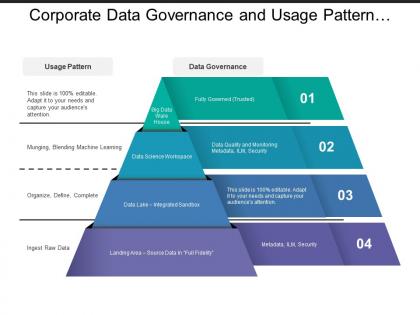
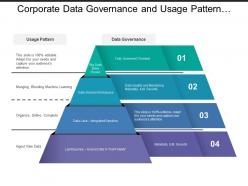
Corporate data governance and usage pattern pyramid




Try Before you Buy Download Free Sample Product
 Impress Your
 Audience
 100%
100% Editable
 Save Hours
 of Time


Our Corporate Data Governance And Usage Pattern Pyramid offer you the needful to organize your thoughts. Use them to list out your views in a logical sequence.
People who downloaded this PowerPoint presentation also viewed the following :
Corporate data governance and usage pattern pyramid with all 5 slides:
Cover distances with our Corporate Data Governance And Usage Pattern Pyramid. They wish your thoughts Godspeed.

FAQs for Corporate data governance and
So basically you need five things: someone who owns the data (like actually owns it, not just "manages" it), clear rules everyone follows, quality checks, access controls, and monitoring. Most people nail the setup then completely ignore the monitoring part - huge mistake. Oh, and you'll want some kind of committee to settle fights when they happen. Honestly? Start by figuring out who owns what data first. Everything else builds from there. I've seen too many companies skip that step and wonder why their fancy governance framework doesn't work.
Honestly, just look at five main things: data quality, governance policies, who's responsible for what, your tech setup, and compliance stuff. Grab one of those free maturity frameworks online - they're everywhere and give you a decent starting point. Check if departments handle data consistently (spoiler: they probably don't). Do you have clear data owners? Are people actually following policies or just pretending they exist? The real trick is figuring out where you're falling short. I'd start with a workshop to get everyone's take on this - different perspectives will surprise you.
So data stewardship is basically the people who actually DO the governance stuff day-to-day. Your stewards handle data quality, fix problems when they pop up, and make sure everyone follows the rules. Honestly, without them your governance strategy just becomes paperwork that nobody looks at. They're the bridge between your fancy governance committee and the folks actually using the data - which is huge. Oh, and definitely pick your stewards early in the process. Give them real authority too, not just responsibility, or they'll get frustrated fast when people ignore them.
Honestly, data governance is like having actual rules instead of just hoping nothing goes wrong with your sensitive stuff. You set up clear policies - who gets access, retention schedules, deletion processes. Super critical for GDPR's right to be forgotten and HIPAA requirements. The audit trails are clutch too since regulators eat that stuff up when they come knocking. First step though? Map out what regulated data you actually have sitting around. I've seen companies get burned because they didn't even know half the personal info they were storing. Can't protect what you can't see, right?
Track both tech and business stuff to see if your data governance actually works. Data quality scores first - accuracy, completeness, consistency across your main datasets. Compliance rates and how fast you fix data problems matter too. But honestly? Executives care way more about the business side. Time-to-insights, whether people are using your governed data sources, fewer duplicate reports - that's the gold. Oh and regulatory compliance if you're in that world. Stick to maybe 4-5 metrics and check quarterly. Don't go overboard.
Oh man, cultural stuff will absolutely wreck your data governance if you don't think it through first. Europeans are super paranoid about personal data compared to Americans - totally different mindset. Some cultures want everyone to agree on decisions while others just want the boss to tell them what to do. Language barriers mess up how people interpret policies too, which is honestly such a pain. Map out how each region actually feels about data sharing before you lock down your framework. Build in room for tweaks based on local expectations. Trust me, one-size-fits-all doesn't work here.
For data governance, start with a catalog - think of it as your master inventory of all your data and where it sits. Data lineage tools are clutch for tracking how everything flows and changes (trust me, you'll thank yourself when stuff breaks). Quality monitoring catches problems before they spiral. Access controls handle who gets to see what. I'd honestly go catalog first if you're just starting out. Oh, and don't fall for those "one platform does everything" pitches - mixing tools that play nice together works way better than whatever sales promised you.
Okay so basically data governance stops all that chaos where departments can't agree on numbers. You know those meetings where everyone's like "wait, how'd you get that figure?" Yeah, it kills those. When sales, marketing, and finance are pulling from the same clean data sources with shared definitions, they'll actually trust each other's reports. No more conflicting presentations to leadership because someone used a different metric. Honestly, it's a game-changer once you set up those standards and clear ownership. Teams make decisions way faster when they're not constantly second-guessing each other's data. It's like finally getting everyone to speak the same language.
Honestly, the worst part is everyone wants their data yesterday, but building solid governance? That takes forever. Teams don't get why they should wait - they're like "just give me the numbers!" Meanwhile you're trying to set up frameworks while business goals change every quarter (which is maddening). Here's the thing though - proving it's worth it is nearly impossible since the benefits are invisible. Like, nobody celebrates avoiding a compliance nightmare that didn't happen, you know? My advice? Hunt down some quick wins that actually help what they're working on right now. Once you've got those victories, people will listen when you pitch the bigger stuff.
Pick actual data owners who know the business, not just whoever's free that week. Give them real power - approving access, fixing quality issues, settling arguments when teams clash over data standards. I've watched companies where "everyone owns it" and surprise, nobody actually does anything. Set up regular reviews with actual KPIs they're measured on. Otherwise you'll just have people documenting problems instead of solving them. Make sure they can enforce rules, not just write strongly-worded emails about violations.
Start with basic categories - public, internal, confidential, restricted. Tag everything consistently from the get-go. Trust me, trying to fix classification later is pure hell. Set up retention policies that match your legal stuff and what the business actually needs. Automate archiving and deletion because nobody remembers to clean up manually. It's like digital hoarding otherwise. Honestly, treat your data like you would old files in your garage - if you haven't touched it in years, maybe it's time to toss it? Just pick your most important datasets first and build from there.
Think of data governance as the rulebook that makes your privacy and security stuff actually function. Great security tools? Useless without clear policies on who accesses what data and when. It's honestly like having amazing locks but zero rules about key distribution (yeah, I went there with the analogy). Good governance sets up the roles and processes so your data classification and access controls get followed consistently. Oh, and compliance requirements too. First step? Map out who currently makes data decisions in your org. That's where you'll spot the gaps pretty quickly.
DAMA-DMBOK certification is probably your best starting point - gives you the fundamentals without breaking the bank. Coursera has decent courses too if your team prefers online stuff. The DAMA forums are actually pretty active, which surprised me when I first found them. Collibra and Informatica do workshops but they're expensive as hell. Worth it though if you've got budget. I'd honestly try some internal lunch sessions first - see who's actually interested before spending money. LinkedIn Learning works for the basics. Start cheap, then go formal with whoever seems engaged. Makes way more sense than training everyone at once.
Start by sorting your data into sensitivity levels - like public, internal, confidential, whatever makes sense. Then set up role-based permissions so people automatically get what they need based on their job. Honestly, manual approvals for every request will drive you insane, so automate that stuff. For non-prod environments, throw in some data masking. Time-limited access works great for the really sensitive datasets too. The whole point is making normal data access smooth while keeping the dangerous stuff locked up tight. It's basically tiered controls but done smart.
So here's what I'm seeing everywhere right now - AI governance is probably the biggest one since companies are just diving headfirst into AI stuff without thinking it through. Privacy-by-design isn't optional anymore, which honestly should've happened years ago. Data mesh is getting popular for decentralizing everything, and most places are still totally lost with multi-cloud setups. Real-time compliance monitoring is becoming the norm. You'll want automated policy enforcement too because doing it manually is a nightmare. Oh, and there's this whole push for sustainable data practices now. I'd start by just auditing your current AI usage - you'll probably find some scary gaps.
No Reviews