


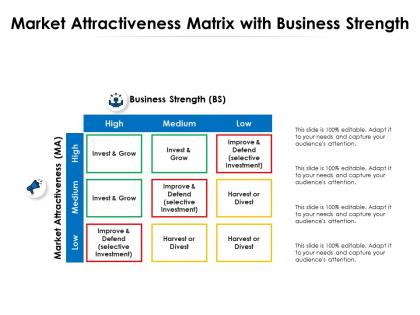
Market attractiveness matrix with business strength




Try Before you Buy Download Free Sample Product
 Impress Your
 Audience
 100%
100% Editable
 Save Hours
 of Time


Our Market Attractiveness Matrix With Business Strength are topically designed to provide an attractive backdrop to any subject. Use them to look like a presentation pro.
People who downloaded this PowerPoint presentation also viewed the following :
Market attractiveness matrix with business strength with all 2 slides:
Use our Market Attractiveness Matrix With Business Strength to effectively help you save your valuable time. They are readymade to fit into any presentation structure.
FAQs for Market attractiveness matrix
So market attractiveness is mostly about size, growth potential, and how much money you can actually make. Look at current market size, growth projections, and profit margins first. Then check out the competition - nobody wants to jump into a bloodbath market, trust me. Customer buying power matters too, plus any regulatory stuff that could mess with you later. Oh, and different industries care about different things. Tech bros obsess over growth while boring companies like utilities just want regulatory stability. Pick 3-4 factors that actually matter for your space, then score each market against those. Don't overthink it.
So business strength is basically how hard you should fight for each market. High strength? Go all in - pour money into products, chase that market share, whatever it takes. Low strength means you're probably better off just milking what you've got or getting out entirely. The matrix maps this against how attractive the market actually is, which honestly makes a lot of sense when you think about it. Don't just focus on where you are now though. Can you realistically build up your strength over the next few years? That's what really matters for your strategy.
So for market attractiveness, I'd start with the obvious stuff - market size and growth rates. Profit margins are huge too. Then dig into how competitive it is and what kind of barriers exist for new players. Customer buying power matters a lot right now since everyone's being more careful with money. Oh, and don't sleep on regulatory stuff or tech trends that might shake things up. Honestly, I'd just make a simple scoring system for all these factors based on what actually matters for your situation. Makes it way easier to compare different markets without getting lost in the weeds.
So basically you plot everything on those nine boxes, right? Top-left corner (high market appeal + you're actually good at it) gets your money first. Those diagonal middle boxes are tricky - they need more digging before you decide. Bottom-right quadrant? Cut 'em loose unless there's some weird strategic angle I'm missing. Honestly, the whole point is making you face reality about what opportunities actually exist versus how strong you really are at stuff. Plot your current projects first, then let that guide where your budget goes. It's pretty straightforward once you see everything laid out visually.
Look, the matrix basically shows you where your portfolio has gaps - it maps each business unit by market attractiveness versus how strong you are competitively. Empty spots or thin areas? Those are your blind spots. Maybe you're missing out on hot markets, or too many of your businesses are stuck in weak positions (which honestly happens more than people admit). Short sentences work here. Use this gap analysis to figure out where to invest next, what to acquire, or which capabilities you need to build. It's pretty much a visual audit that helps you prioritize your next strategic moves.
You need competitive analysis for both parts of this thing. First, figure out how crazy competitive your target market actually is - like, are there pricing wars happening? How hard is it for new companies to even get in? That tells you if the market's worth it. Then honestly compare yourself to the big players. Your resources, capabilities, market position - all of it. I mean, you might think you're crushing it, but are you really? It's kinda like house hunting. You gotta check if the neighborhood's decent AND whether you can actually swing the mortgage, you know?
Honestly, think of the matrix as your trend radar - just update it every quarter since everything moves crazy fast now. Look for markets jumping from low to medium attractiveness while you're still strong there. Those shifts are your early warning system. Focus your resources on those "invest/grow" spots where momentum's building. The trick is figuring out what's actually driving those attractiveness changes - like, what external stuff is happening? Then you can position yourself to catch those waves before everyone else notices. Markets shifting upward while competitors are sleeping? That's your sweet spot right there.
Don't treat it like some perfect roadmap – it's just a moment-in-time snapshot. Markets are way messier than those clean little boxes suggest. Outdated data will screw you over, and honestly, everyone plays favorites when scoring (myself included). Rushing through the analysis is probably the worst thing you can do. You end up with surface-level insights instead of actually understanding what makes markets attractive or where you truly stand competitively. Fast-moving industries? Yeah, you'll need to revisit this thing constantly or it becomes useless pretty quickly.
Yeah so economic stuff totally messes with your market scores. GDP growth, inflation, interest rates - all that boring macro stuff actually matters a ton. Currency swings can flip everything upside down if you're looking international. I swear, one recession and suddenly your "hot" market is dead in the water. Consumer spending tanks when the economy's rough. Business investment dries up too. Keep updating your data regularly because this stuff changes fast. Oh and inflation's been weird lately - definitely factor that in when you're scoring markets.
Look, you've got some decent moves here. Build stuff that's actually hard for competitors to copy - maybe you're crazy efficient, have die-hard customers, or you own some weird niche. Strategic partnerships can help split costs too. The pizza analogy is spot-on btw - sometimes you're just stuck in a market that doesn't care much about what you're selling. Innovation might open new doors, and honestly, cutting costs without killing quality is always smart. Pick your fights carefully though. Don't spread yourself thin trying everything at once. Start by figuring out what you're genuinely great at, then double down on those strengths.
You gotta tailor the criteria for each region because what makes a market attractive is totally different everywhere. GDP growth might be huge in Southeast Asia, but regulatory stuff could matter way more in Latin America - honestly depends on your industry too. Same goes for business strength metrics. Brand recognition might be everything in one place while distribution deals are king somewhere else. I'd run separate matrices for your major regions instead of trying to cram everything into one framework. That universal approach just gives you garbage data that won't help with actual decisions.
Oh yeah, tons of big companies have done this! GE used it back in the 70s to figure out which business units were worth keeping - pretty smart move honestly. P&G did something similar more recently with their brands, ditching the weaker ones and doubling down on winners in good markets. Shell's been using it for their energy divisions too, which makes sense since that industry's all over the place. You should totally map out your own products or business lines on it. Shows you real quick where to put your money and what might need the axe.
Check it quarterly if you can, or at least once a year. Fast-moving industries? Definitely quarterly. Your competitors aren't sitting still, and neither should your matrix. Companies that only update during big strategic planning sessions are honestly shooting themselves in the foot. Six months is forever in business - new products launch, you pivot into different markets, suddenly your strengths look totally different. I literally put recurring reminders in my calendar now because it's too easy to forget. Oh and obviously, garbage data means garbage insights, so keep that current too.
So basically, you gotta look at how your customers actually behave before deciding if a market's worth it. Price-sensitive shoppers who jump between brands constantly? That's a nightmare to deal with. But loyal customers with decent spending power and predictable habits? Gold mine. Check their buying patterns - are they all over the place or pretty consistent? Also think about how fast their preferences change and whether you can even keep up with that. I learned this the hard way with my last project honestly. Bottom line: study their loyalty, spending trends, and shopping habits first. Don't just guess.
Honestly, you want industries where there's tons of data floating around - consumer goods, automotive, pharma, retail. Those sectors have clear winners and losers, plus solid metrics to measure everything. Tech's kinda weird because it changes so fast, but if you can nail down good data it's amazing to work with. Manufacturing and telecom are gold mines too since their competitive stuff is usually documented pretty well. Oh, and energy sector works great. Bottom line: pick something where you can actually measure both how attractive the market is AND how strong different companies are. That's where the magic happens.
No Reviews