

 0 Comment
 Customer Reviews

The business plan's open on the screen. Has been for two days.
Not because the idea is unclear—anyone serious about Bitcoin mining knows the moving parts. ASIC hardware, electricity costs, pool fees, halving cycles, hash rate competition. The knowledge is there. The problem is turning it into something a bank, investor, or partner will actually read without glazing over.
That gap—between understanding a mining operation and presenting one credibly—is where most plans fall apart. It's not a knowledge problem. It's a structure problem.
And the structure problem is specific. Crypto mining business models don't fit neatly into standard business plan formats. Revenue projections depend on Bitcoin price assumptions that might be wrong in six months. Cost breakdowns include line items most accountants have never seen—immersion cooling, ASIC depreciation, mining pool fees. A generic template from a business school website won't cut it.
So the dread isn't about the mining itself. It's about the deck. About sitting down to explain why your Bitcoin mining farm business plan makes financial sense when the numbers shift every time someone refreshes CoinGecko. About making Bitcoin mining profitability analysis look rigorous when half the variables are moving targets.
There's also the audience problem. Investors who understand crypto don't need the basics explained. Investors who don't understand crypto need everything explained—but carefully, without talking down to them. Getting that tone right in a cold presentation, without a template that guides the structure, is genuinely hard.
That's why these templates exist. Not because Bitcoin mining is simple, but because the communication around it is complicated in ways that catch smart people off guard. SlideTeam's pre-designed frameworks handle the structure—cost breakdowns, process flows, revenue models, country-by-country cost comparisons—so you can focus on your actual numbers.
SlideTeam built these content-ready slides knowing that most people building a crypto mining facility plan aren't starting from zero on the facts. They're starting from zero on the format. Here's what's available.
Template 1: Bitcoin Mining Business Plan with Cost PPT Designs
A credible Bitcoin mining business plan lives or dies on how clearly costs are presented. This PPT template is built for founders and analysts who need to walk investors through a full mining cost breakdown without losing them in jargon. It covers capital expenditure, operational costs, and revenue assumptions in a structured flow. Explore more insights alongside this deck in our guide to Bitcoin mining business plan samples. The template is 100% editable and customizable.
[product_image id=1777557]
Template 2: Cryptocurrency Mining Business Plan Overview PPT Designs
Getting a cryptocurrency mining business model across to a non-technical audience is harder than it looks. This PPT preset is designed for that exact scenario — board meetings, investor pitches, and partner briefings where clarity matters more than complexity. It gives practitioners a clean overview structure covering market context, operational model, and financial logic. So yeah, for anyone building a crypto mining profit margins presentation from scratch, this deck saves real time. The template is 100% editable and customizable.
[product_image id=1562274]
Template 3: Bitcoin Mining Process Purpose and Profit Potential PPT Sample
Most audiences want to know three things: what Bitcoin mining is, why it works, and whether it makes money. This PPT template is built to answer all three without padding. It walks through mining purpose, the underlying process, and profit potential in a sequence that suits both informed and general audiences. For context, it's a strong fit for early-stage founders making their first cryptocurrency investment business plan pitch. The template is 100% editable and customizable.
[product_image id=1582889]
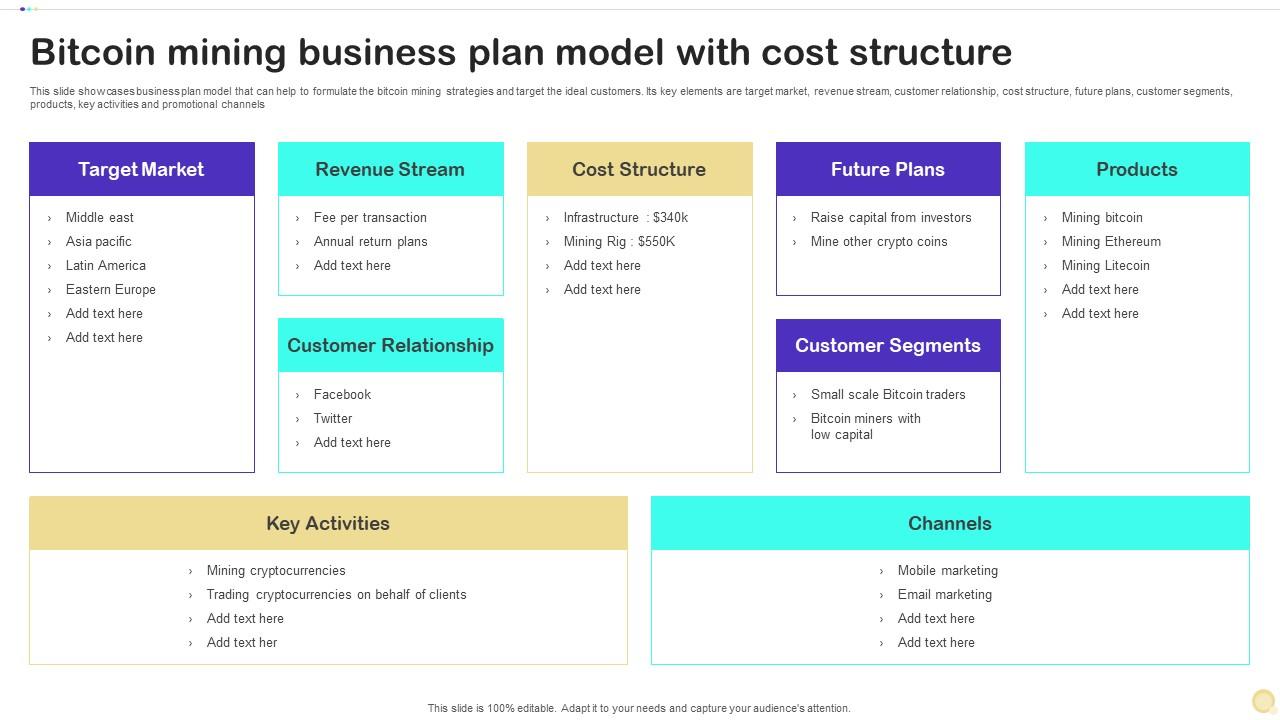
Template 4: Bitcoin Mining Business Plan Model with Cost Structure PPT Slide
A complete business model demands more than just financials. This slide captures nine core elements—target market, revenue streams, cost structure, customer segments, key activities, and promotional channels. It drives clear, structured thinking across every business model dimension. Comprehensive coverage ensures nothing gets overlooked when presenting Bitcoin mining strategies to stakeholders. Customisable layouts let you tailor each section to your specific operational context. Transform your Bitcoin mining business plan presentations today.
Download this PowerPoint Template
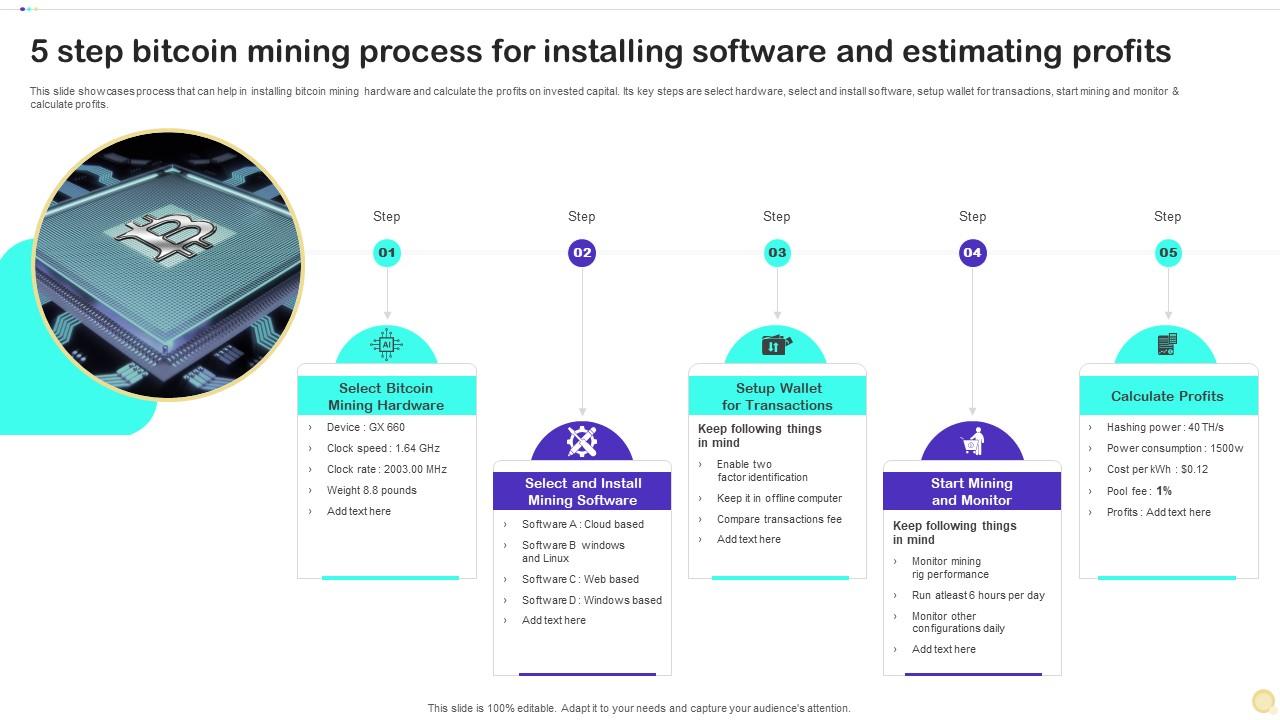
Template 5: 5-Step Bitcoin Mining Process for Installing Software and Estimating Profits
Operational clarity is what separates a credible mining plan from a vague one. This slide is built for practitioners who need to walk an audience through the full crypto mining equipment setup process — hardware selection, software installation, wallet configuration, active mining, and profit monitoring. Five discrete steps make the sequence easy to follow for investors unfamiliar with ASIC miner business setup realities. The template is 100% editable and customizable.
Download this PowerPoint Template
Template 6: Bitcoin Mining Cost Analysis by Country PPT
Bitcoin mining energy costs vary sharply by country, and that variance is the whole story for site selection decisions. This PPT slide presents average mining cost data across multiple countries — Kuwait, Kazakhstan, Ethiopia, Qatar, and others — alongside profit figures. It's the kind of slide a CFO or operations lead reaches for when justifying a mining facility location to a board. For any Bitcoin mining cost breakdown presentation, this data-driven layout does the analytical heavy lifting. The template is 100% editable and customizable.
[product_image id=1139081]
Template 7: Bitcoin Mining Process Using Mastering Blockchain PPT
Every transaction on a blockchain follows a defined sequence. This slide maps that sequence across seven stages—transaction validation, block creation, proof of work, block verification, rewards, block addition, and continuation. It delivers instant audience comprehension, removing ambiguity from complex technical concepts. Structured stage-by-stage flow creates a compelling narrative for blockchain-focused presentations. This template suits technical briefings, investor education sessions, and internal team onboarding for mining operations. Transform your blockchain mining presentations today. Download and unlock effortless clarity across every stage of the mining process.
[product_image id=1138211]
Ace Your Bitcoin Mining Business Plan with SlideTeam
SlideTeam's PowerPoint templates are the best in the industry for presenting a Bitcoin mining business plan with confidence and clarity. These content-ready slides cover everything from crypto mining financial projections to blockchain process flows, saving hours of formatting work. Use these ready-made frameworks to structure cost breakdowns, revenue models, and operational plans that investors actually trust. Deploy these customizable PPT presets to present your mining vision and drive the funding decisions you need.
FAQs on Bitcoin Mining Business Plan
What are the critical hardware components required to start a bitcoin mining operation, and how do they impact overall profitability?
The three hardware components that matter most are the ASIC miner, power supply unit, and cooling system. ASIC miners determine hash rate output — higher hash rate means more blocks solved. Power supply efficiency directly sets your electricity cost per coin mined. Cooling keeps hardware running at full capacity without downtime. Together, these three components set your cost base and uptime, which are the two biggest drivers of profitability.
How do you calculate the break-even point for a bitcoin mining business given current difficulty levels and energy costs?
Break-even is reached when cumulative revenue equals total costs — hardware, electricity, and pool fees. Calculate daily revenue using current Bitcoin price, your hash rate, and the network difficulty. Divide total setup costs by daily net profit to get the payback period in days. Recalculate every time difficulty adjusts, which happens roughly every two weeks. Most operations today target break-even within 12–24 months, depending on electricity rates.
What role does hash rate play in determining the competitiveness of a mining operation?
Hash rate measures how many calculations your hardware performs per second. Higher hash rate means a proportionally larger share of block rewards. Network difficulty adjusts every two weeks to match total network hash rate. If your hash rate stays flat while competitors add capacity, your share of rewards falls. Staying competitive means either upgrading hardware regularly or joining a mining pool to combine hash power.
How should a bitcoin mining business plan account for the volatility of bitcoin prices over a 3-5 year projection period?
Use scenario modeling — build three cases: conservative, base, and optimistic Bitcoin price assumptions. Anchor each scenario to historical price ranges and halving cycle timelines. Avoid single-point forecasts; investors expect and respect range-based projections. Build in a floor price below which operations pause, and show that your cost structure survives it. That discipline makes a 3–5 year plan credible, not just hopeful.
What are the most cost-effective cooling solutions for large-scale mining farms, and how do they affect operational expenses?
Air cooling is cheapest upfront but raises electricity costs significantly at scale. Immersion cooling — submerging hardware in dielectric fluid — cuts cooling energy use by 30–40% and extends hardware life. Hydro cooling sits between the two in cost and effectiveness. For large farms, immersion cooling typically delivers the best long-term operational cost profile, though setup capital is higher. Choose based on scale, climate, and electricity pricing at your site.
How does the Bitcoin halving event impact revenue forecasting in a long-term mining business plan?
Halving cuts the block reward by 50%, which directly halves mining revenue per block — unless Bitcoin's price rises to compensate. Build halving dates explicitly into your revenue model; the next event is predictable. Show investors two revenue lines: pre-halving and post-halving. Factor in that difficulty may drop after a halving as less efficient miners exit, which partially offsets the reward cut. Never project revenue across a halving without accounting for this.
What regulatory and legal considerations must be addressed when launching a bitcoin mining business in different jurisdictions?
Three areas demand attention before launch: business registration and licensing, electricity and zoning permits, and cryptocurrency tax treatment. Regulations vary sharply — some countries ban mining outright, others offer tax incentives. Energy use reporting is increasingly mandatory in the EU and parts of the USA. Engage a local legal advisor and a crypto-specialist accountant before committing capital. Regulatory non-compliance can trigger equipment seizure, so this is not optional groundwork.
How do mining pools differ from solo mining in terms of revenue consistency and risk management for new entrants?
Solo mining gives you the full block reward when you solve a block, but the wait between rewards is long and unpredictable. Mining pools combine hash power from many participants and split rewards proportionally, producing small but consistent daily payouts. For new entrants with limited hardware, pools are the practical choice — the revenue consistency makes cash flow planning possible. Solo mining only makes economic sense at very high hash rate levels.