


Price and quality matrix




Try Before you Buy Download Free Sample Product
 Impress Your
 Audience
 100%
100% Editable
 Save Hours
 of Time


Our Price And Quality Matrix are explicit and effective. They combine clarity and concise expression.
People who downloaded this PowerPoint presentation also viewed the following :
Content of this Powerpoint Presentation
Description:
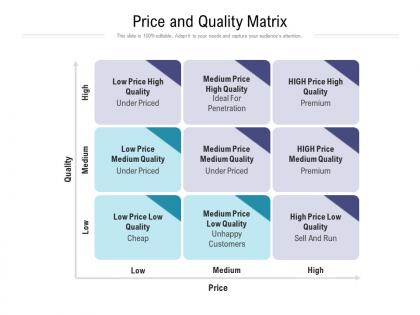
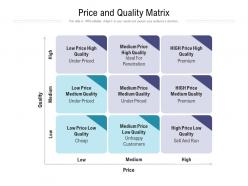
This image displays a "Price and Quality Matrix," which is a strategic tool used to assess the positioning of products or services in the market based on their price and perceived quality. There are nine quadrants in the matrix, each representing a different scenario:
1. Low Price Low Quality (Cheap):
This quadrant suggests products that are both inexpensive and of lower quality.
2. Low Price Medium Quality (Under Priced):
Here, the products are affordable but offer moderate quality, indicating they may be underpriced.
3. Low Price High Quality (Under Priced):
These products have high quality despite their low price, suggesting they are significantly underpriced.
4. Medium Price Low Quality (Unhappy Customers):
Products in this category might not satisfy consumers as they have low quality for a mid-range price.
5. Medium Price Medium Quality (Under Priced):
This quadrant represents products that have fair quality and price, potentially still underpriced.
6. Medium Price High Quality (Ideal For Penetration):
These products are of high quality with a reasonable price, perfect for market penetration strategies.
7. High Price Low Quality (Sell And Run):
This suggests a strategy or situation where the products are of low quality but are being sold at a high price, possibly implying a short-term opportunistic approach.
8. High Price Medium Quality (Premium):
Here, products are of medium quality but are priced highly, often marketed as premium offerings.
9. High Price High Quality (Premium):
This quadrant represents premium products that are both of high quality and high price, signifying a luxury or high-end market positioning.
Use Cases:
Industries where these slides can be applied along with the use cases are:
1. Consumer Electronics:
Use: Product positioning and pricing strategy.
Presenter: Marketing Manager.
Audience: Product development team.
2. Automotive:
Use: Competitive analysis and pricing strategy.
Presenter: Business Strategist.
Audience: Executive leadership team.
3. Apparel and Fashion:
Use: Merchandising and branding decisions.
Presenter: Brand Manager.
Audience: Marketing and sales teams.
4. Food and Beverage:
Use: Menu pricing and quality assessment.
Presenter: Restaurant Owner or Consultant.
Audience: Chefs and management teams.
5. Software and Technology Services:
Use: Software product positioning and pricing tiers.
Presenter: Product Manager.
Audience: Sales and marketing professionals.
6. Real Estate:
Use: Property valuation and market positioning.
Presenter: Real Estate Analyst.
Audience: Investors and real estate agents.
7. Cosmetics and Beauty Products:
Use: Product line positioning and pricing strategy.
Presenter: Product Line Manager.
Audience: Marketing and R&D teams.
Price and quality matrix with all 2 slides:
Give your audience a fulfilling experience. They will find our Price And Quality Matrix elevating.
FAQs for Price
So the Price-Quality Matrix is basically plotting price against how good people think your product is. You get four boxes - the sweet spot is low price + high quality, but good luck making money there long-term. Premium stuff sits in high price + high quality territory. Here's the weird part though: bumping up your price can actually make customers think your product is better quality. Makes no sense but it happens all the time. Map out where you and your competitors sit, then look for empty spaces or ways to shift your position. Pretty useful for figuring out your next move.
So basically, grab a grid and plot price vs quality for you and your competitors. You'll see the whole landscape instantly - where everyone sits, if there's open space to grab. High quality/low price is the value sweet spot. Premium brands live in high quality/high price territory. Honestly avoid that bottom right corner at all costs - high price/low quality is where companies go to die a slow death. Once you map it out, you can figure out if you need to drop prices, boost quality, or just reposition how people see you. Pretty eye-opening exercise actually.
Honestly, perception is everything with the Price-Quality Matrix. You could have the best product ever, but if customers don't *see* that quality? You're screwed. Their perception beats your actual specs every time. But here's what's cool - you can actually shape how people see your stuff. Branding, packaging, reviews, all that matters. If you're going for "expensive but worth it" and people aren't buying the quality angle, don't just slash prices. Work on showing them why it's actually better first. Sometimes the product's fine, the messaging just sucks.
So basically you map out all your competitors on this price vs quality grid - see where everyone's sitting. Look for the empty spots. Maybe nobody's doing high quality at a reasonable price? That's your opening right there. Just don't get caught in that weird middle zone where customers can't figure out what you're supposed to be - I've seen so many brands mess that up. Pick your corner and commit hard. Once you know where you fit, everything else follows - your packaging, ads, whatever. The matrix thing actually works pretty well for spotting opportunities most people miss.
Look at Tesla - they started with expensive luxury EVs, then dropped down to the Model 3. Southwest did the flip, going cheap but reliable to mess with the big airlines. Honestly, Hyundai's the perfect case study though. They spent like 20 years crawling up from economy cars to where they are now. Apple pulled the same move with iPhones - came in expensive but actually worth it. You'll want to map out where everyone else sits first. Then find the empty spot where you can actually deliver something people want.
So basically, people are always weighing price against quality when they shop. Brands fight over different spots on this spectrum - some go luxury route, others focus on being the best deal. What's wild is that customers aren't really buying your actual product. They're buying where they think you rank compared to everyone else. Like, is this worth it for what I'm paying? Most shoppers hunt for that sweet spot where the value just clicks with their budget. Pretty smart when you think about it - companies can't just randomly price things without considering how customers will perceive the quality trade-off.
Yeah, just switch up what "quality" means for your thing. Like B2B software cares about uptime and security, restaurants focus on taste and how fast they serve you. Price ranges need to match too - luxury stuff obviously needs different brackets than regular products. The trick is figuring out what your customers actually care about first. Maybe survey them about their top 3 quality drivers? Also, different buyer types want different things - budget families vs premium buyers are worlds apart. You might need separate matrices for each group honestly. Start with the customer research though, that's where the gold is.
Honestly, the worst mistake is trusting your own data over what customers actually think. Your internal metrics might say you're crushing it, but customers could see you totally differently. Also watch out for weird competition - sometimes it's not your obvious rivals stealing customers, it's some random budget brand from left field. Markets change fast too, so don't get comfortable thinking your spot is locked in. Get real feedback through surveys or just talk to people. I learned this the hard way once. Map out where customers actually place you, not where your spreadsheets say you belong.
When things get rough economically, customers get super picky about price - honestly, it's wild how fast people's priorities shift. You'll need to move toward that "good value" sweet spot in your positioning. Either keep your quality the same but accept smaller margins, or drop quality a bit while slashing prices more aggressively. Just don't land in the "poor value" zone - that's basically brand suicide during a recession. Check where your competitors are pivoting too since everyone's scrambling. Oh, and definitely survey your existing customers about what matters to them now. Their answers might surprise you.
So you plot competitors on price vs quality axes, right? Then hunt for empty spots - that's where your opportunities live. Missing a cheap-but-decent option? Boom, disruption angle. Premium segment totally empty? Even better. I honestly think this beats random brainstorming any day. It stops you from building boring copycat products too since you're actively looking for gaps nobody's filled. Just map it out before you start developing anything - saves tons of wasted effort later. Way better than guessing what the market needs.
Price-quality stuff gets weird across cultures, honestly. Like in collectivist societies, expensive automatically means higher status and fitting in with your group - so people gravitate toward that high-price/high-quality corner. But Western markets? We're way more skeptical about paying premiums and want actual functional benefits. Some cultures think expensive products are just wasteful showing off, which completely breaks the whole matrix concept. Quality expectations are all over the place too - "good enough" in one market might be trash in another. I learned this the hard way when my company assumed our pricing logic would work everywhere. Always test locally first before rolling anything out internationally.
Track your price premium against competitors and how customers react to price changes. Customer satisfaction and NPS scores will show you the quality side. Market share is probably the biggest indicator though - it tells you if people actually buy into your positioning or just talk about it. Also watch your customer acquisition costs and lifetime value since you want the right type of customers, not just any customers. Oh, and return rates are super telling for quality perception. I'd check these quarterly so you can catch issues before they snowball.
Honestly, this thing is pretty handy - you just plot where you and your competitors sit on quality vs price. Makes it super clear if you're in that awkward middle zone where your prices are high but quality is meh. Way better than drowning in Excel sheets, trust me. You can spot gaps where nobody's playing, or see if you need to go premium or budget. I've seen companies realize they're totally missing the value sweet spot. Just helps you figure out your next move - whether that's dropping prices, improving quality, or finding some middle ground that actually makes sense.
So here's the thing - brand loyalty is like having a safety net in business. Your customers won't jump ship as easily when prices go up or if you have an off quarter. Look at Apple fans, they'll pay crazy money for basically the same phone with tiny upgrades. It's honestly kind of impressive how they pull that off. Strong loyalty also means less price sensitivity overall, so you can charge more without offering dramatically better quality than competitors. My advice? Work on that emotional connection first. Once people actually *like* your brand, you've got way more room to maneuver.
So here's what I do - grab a Price-Quality Matrix and plot where all your competitors sit. You'll start seeing gaps pretty quickly. The sweet spot? High quality but reasonable price. Big companies hate competing there because it messes with their fancy premium stuff. Super low price with decent quality works too, though you better figure out your costs first (learned that the hard way). Don't even think about the premium corner unless you've got serious cash for branding. Just pick whatever quadrant you can actually pull off and stick with it.
No Reviews