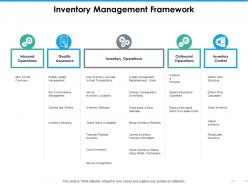
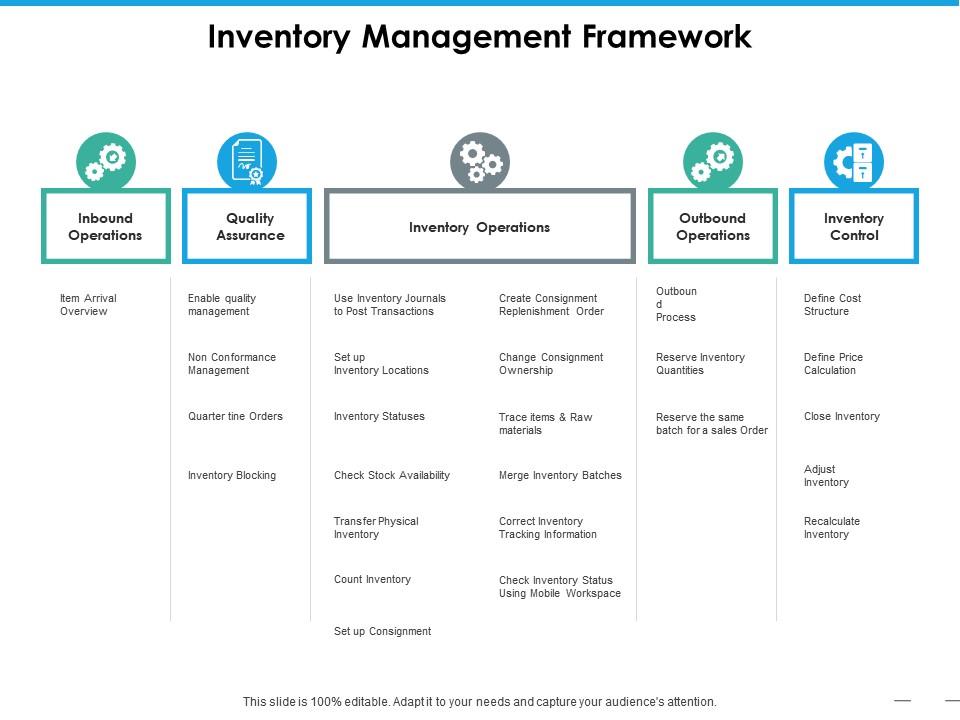
Inventory management framework ppt styles graphics template
Try Before you Buy Download Free Sample Product
Audience
Editable
of Time
Be aware of current fads. Get fully with it due to our Inventory Management Framework Ppt Styles Graphics Template.
People who downloaded this PowerPoint presentation also viewed the following :
Inventory management framework ppt styles graphics template with all 5 slides:
Include all the details about every element with our Inventory Management Framework Ppt Styles Graphics Template. Elaborate on all the ingredients.
FAQs for Inventory management framework ppt
An effective inventory management framework includes demand forecasting, inventory classification systems, reorder point calculations, supplier relationship management, and real-time tracking technologies. These components work together by optimizing stock levels, reducing carrying costs, and minimizing stockouts, with many retail and manufacturing organizations finding that strategic integration ultimately delivers improved cash flow and enhanced customer satisfaction.
Inventory turnover ratios inform better decisions by revealing product velocity, identifying slow-moving stock, optimizing reorder points, and highlighting seasonal patterns that guide procurement timing. These metrics enable retailers and manufacturers to reduce carrying costs, minimize stockouts, and improve cash flow, with many companies finding that strategic turnover analysis ultimately delivers enhanced operational efficiency and competitive advantage.
Technology serves as the backbone of modern inventory management frameworks through AI-powered demand forecasting, IoT sensors for real-time tracking, automated reordering systems, and cloud-based analytics platforms. These technologies streamline operations by reducing human error, optimizing stock levels, and enhancing supply chain visibility, with retailers and manufacturers finding significantly improved efficiency and reduced carrying costs.
Businesses balance just-in-time inventory with demand forecasting by implementing advanced analytics, maintaining strategic safety stock levels, and establishing flexible supplier relationships. Through AI-powered forecasting tools, companies like automotive manufacturers and retailers optimize inventory turnover while minimizing stockouts, ultimately reducing carrying costs by 15-25% while maintaining service levels.
Effective strategies include demand forecasting through historical data analysis, implementing just-in-time ordering systems, establishing safety stock levels, utilizing ABC inventory classification, and deploying automated reorder points. These approaches streamline inventory management by reducing carrying costs, minimizing stockouts, and optimizing cash flow, with many retailers and manufacturers finding that strategic combination of predictive analytics and real-time monitoring delivers significant operational efficiency.
Businesses can incorporate sustainability into inventory management through eco-friendly sourcing, waste reduction strategies, circular economy principles, energy-efficient warehousing, and supplier sustainability audits. These practices streamline operations while minimizing environmental impact, with many retail and manufacturing companies finding that sustainable inventory approaches reduce costs, enhance brand reputation, and deliver competitive advantage in increasingly environmentally-conscious markets.
Organizations should track key metrics including inventory turnover ratio, carrying costs, stockout frequency, order fulfillment rates, and demand forecast accuracy to evaluate framework performance. These metrics streamline operations by identifying inefficiencies, optimizing stock levels, and reducing waste, with many retail and manufacturing companies finding that comprehensive tracking ultimately delivers cost reductions and enhanced customer satisfaction.
Varying supply chain models significantly impact inventory management through different demand patterns, lead times, and distribution requirements. Lean models require just-in-time strategies with minimal buffer stock, while agile models demand flexible inventory positioning and rapid response capabilities, with many retailers and manufacturers finding that hybrid approaches deliver optimal cost efficiency and customer service levels.
E-commerce growth presents both challenges and opportunities for traditional inventory management frameworks, requiring faster fulfillment, multi-channel integration, real-time visibility, and demand forecasting adaptations. Through advanced technologies like AI and automation, retailers streamline warehouse operations, enhance customer experiences, and minimize stockouts, with many organizations finding that strategic framework evolution ultimately delivers competitive advantage in an increasingly digital marketplace.
Businesses can enhance inventory forecasting accuracy through predictive analytics, machine learning algorithms, demand pattern analysis, seasonal trend modeling, and real-time data integration. These technologies streamline forecasting by analyzing historical sales data, market conditions, and customer behavior patterns, with many retail and manufacturing companies finding significantly reduced stockouts, minimized excess inventory, and ultimately improved cash flow management.
ABC analysis best practices include ranking items by annual dollar volume, applying the 80-15-5 rule for A-B-C categories, conducting regular reviews, and integrating demand patterns with lead times. This strategic categorization enables manufacturing and retail organizations to allocate resources efficiently, prioritize high-value inventory management, and optimize procurement strategies, ultimately delivering improved cash flow and reduced carrying costs.
Organizations optimize warehouse layout through strategic zoning, ABC classification systems, automated storage solutions, optimized picking paths, and cross-docking areas. These approaches streamline operations by reducing travel time, minimizing handling errors, and maximizing space utilization, with many retail and manufacturing companies finding that well-designed layouts deliver 30% faster order fulfillment and significantly lower operational costs.
Small businesses face challenges including limited budgets for advanced software, lack of specialized staff to manage complex systems, inadequate storage infrastructure, and difficulty forecasting demand accurately. While these obstacles can seem overwhelming, many retailers, restaurants, and service providers find that starting with scalable, cloud-based solutions enables gradual implementation, ultimately delivering better cash flow and operational efficiency.
Strong supplier relationships significantly enhance inventory management through improved demand forecasting, flexible delivery schedules, collaborative planning, and reduced lead times. These partnerships enable organizations to minimize safety stock requirements, respond quickly to market changes, and maintain optimal inventory levels, with many manufacturers and retailers finding that strategic supplier collaboration delivers cost reductions and enhanced supply chain resilience.
Poor inventory management leads to stockouts, excess carrying costs, reduced cash flow, increased storage expenses, and obsolete inventory write-offs. These issues directly impact customer satisfaction through delayed deliveries and lost sales, while simultaneously eroding profitability through inefficient resource allocation, with many retailers finding that inventory optimization delivers competitive advantage.
No Reviews