

Opportunities and threats matrix presentation diagrams




Try Before you Buy Download Free Sample Product
 Impress Your
 Audience
 100%
100% Editable
 Save Hours
 of Time


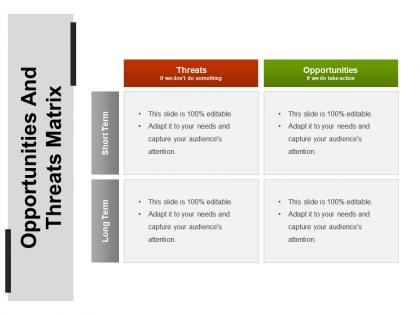
Analyze your business's strengths and weaknesses with these opportunities and threats matrix presentation diagrams slides. This presentation layout of opportunities and threats allows create the list of opportunities in the business market such opportunities, consider emerging technologies, availability of new materials, new customer categories, and positive changes in your competitive environment. You can also use this SWOT analysis template to showcase your organization’s capacity which it can use effectively to achieve its objectives. With the help of this internal and external analysis PowerPoint template, you can identify changes which can be made to improve your business while running brainstorming session to visualize what is it that you do well? Or what advantages do you have over your competitors? Use this strength analysis PPT template to identify new opportunities for your business and developing a strategic plan for goal and mission accomplishment. Download this slide and for more visit our website. Admonish the insolent with our Opportunities And Threats Matrix Presentation Diagrams. Counsel them to improve behavior.
People who downloaded this PowerPoint presentation also viewed the following :
Opportunities and threats matrix presentation diagrams with all 5 slides:
Get the audience fully engaged with our Opportunities And Threats Matrix Presentation Diagrams. They establish a direct connection.


FAQs for Opportunities and threats
An Opportunities and Threats Matrix is a strategic planning tool that systematically evaluates external factors affecting an organization by categorizing market opportunities and potential threats in a structured framework. It enables businesses to identify growth prospects, assess competitive risks, and develop proactive strategies, with many organizations finding that this matrix streamlines resource allocation and enhances decision-making in increasingly complex market environments.
Organizations identify and categorize opportunities and threats through comprehensive market research, competitor analysis, SWOT assessments, stakeholder feedback, and trend monitoring across industry, regulatory, and technological landscapes. These systematic approaches enable companies to distinguish between immediate versus long-term factors, external market shifts versus internal capabilities, ultimately delivering strategic clarity and competitive positioning in increasingly dynamic business environments.
Key benefits include enhanced strategic planning, improved risk assessment, competitive advantage identification, resource optimization, and informed decision-making capabilities. This analytical framework enables organizations to systematically evaluate external factors, with companies in sectors like retail and healthcare finding that structured opportunity-threat analysis streamlines strategic responses, ultimately delivering better market positioning and operational efficiency.
The Opportunities and Threats Matrix focuses exclusively on external environmental factors, while SWOT analysis includes internal strengths and weaknesses alongside external opportunities and threats. This targeted approach enables organizations to conduct deeper competitive intelligence, market trend analysis, and risk assessment across sectors like retail, healthcare, and manufacturing, ultimately delivering more focused strategic responses to external market dynamics.
Market research provides the critical external data needed to accurately identify and assess opportunities and threats within the matrix. Through comprehensive market analysis, competitive intelligence, consumer surveys, and industry trend studies, organizations gather concrete insights about emerging markets, regulatory changes, technological disruptions, and competitive movements, ultimately delivering strategic clarity that transforms assumptions into data-driven decisions for competitive advantage.
Common opportunities businesses identify include market expansion into new segments, technological adoption for operational efficiency, strategic partnerships with complementary organizations, regulatory changes creating competitive advantages, and emerging consumer trends. These opportunities enable companies to diversify revenue streams, reduce costs, and strengthen market positioning, with many organizations finding that systematic opportunity identification through matrices accelerates strategic decision-making and sustainable growth.
Common threats identified through opportunities and threats matrices include cybersecurity breaches, supply chain disruptions, regulatory changes, competitive pressures, and economic volatility. Industries like financial services frequently cite cyber risks and compliance challenges, while manufacturing focuses on supply chain vulnerabilities and raw material costs, ultimately enabling organizations to prioritize risk mitigation strategies.
Small businesses can leverage an Opportunities and Threats Matrix by systematically identifying market gaps, emerging trends, competitive vulnerabilities, and external risks to make strategic decisions with limited resources. This framework enables smaller organizations to pivot quickly, target underserved niches, and anticipate industry shifts more effectively than larger competitors, ultimately delivering agility and focused resource allocation for sustainable growth.
Tools that enhance Opportunities and Threats Matrix creation include strategic planning software like LivePlan, SWOT analysis platforms such as Creately, business intelligence tools like Tableau, collaborative platforms including Miro, and comprehensive suites like Microsoft Visio. These technologies streamline data visualization, enable real-time collaboration, and automate trend analysis, with many organizations finding that integrated dashboards ultimately deliver faster strategic insights and more informed decision-making processes.
Teams can collaborate effectively by establishing clear roles, conducting structured brainstorming sessions, and leveraging diverse perspectives from different departments to ensure comprehensive matrix population. Through cross-functional workshops and systematic data gathering, organizations streamline the analysis process while maintaining objectivity, with many teams finding that collaborative approaches deliver more accurate threat assessments and innovative opportunity identification, ultimately enhancing strategic decision-making capabilities.
The opportunities and threats matrix can be updated through regular market research, competitive intelligence gathering, customer feedback analysis, industry trend monitoring, and stakeholder consultations. Organizations typically revise their matrices quarterly or semi-annually, with many finding that continuous environmental scanning and cross-functional team reviews enable rapid adaptation to shifting market dynamics, ultimately maintaining strategic relevance and competitive positioning.
Organizations should avoid oversimplifying complex market dynamics, relying on outdated data, and creating matrices without diverse stakeholder input, as these limit strategic accuracy. Additionally, failing to regularly update assessments, focusing only on obvious factors while missing emerging trends, and not connecting identified opportunities and threats to actionable strategic initiatives can significantly reduce the matrix's effectiveness, ultimately leaving companies unprepared for competitive challenges.
The Opportunities and Threats Matrix informs decision-making by systematically evaluating external factors against organizational capabilities, enabling leaders to prioritize initiatives based on potential impact and feasibility. Through strategic mapping, companies across sectors like healthcare, technology, and retail can allocate resources more effectively, minimize risk exposure, and capitalize on market advantages, ultimately delivering enhanced competitive positioning.
**INPUT**: What methods can be employed to assess the impact of identified opportunities and threats? **OUTPUT**: Impact assessment methods include probability scoring, financial modeling, scenario analysis, SWOT integration, and stakeholder evaluation frameworks. These approaches enable organizations to quantify potential outcomes, prioritize strategic responses, and allocate resources effectively, with many companies finding that systematic assessment delivers clearer decision-making and enhanced competitive positioning.
Organizations measure strategy success from Opportunities and Threats Matrix implementation through key performance indicators like market share growth, revenue increases, cost reduction percentages, and competitive positioning metrics. These measurements enable businesses to track whether identified opportunities delivered expected returns and threats were effectively mitigated, with many companies finding that regular quarterly assessments ultimately provide strategic advantage and operational clarity.
-
The Designed Graphic are very professional and classic.
-
Illustrative design with editable content. Exceptional value for money. Highly pleased with the product.