


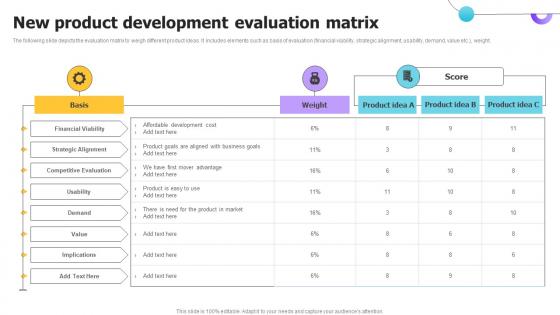
New Product Development Evaluation Matrix




Try Before you Buy Download Free Sample Product
 Impress Your
 Audience
 100%
100% Editable
 Save Hours
 of Time


The following slide depicts the evaluation matrix to weigh different product ideas. It includes elements such as basis of evaluation financial viability, strategic alignment, usability, demand, value etc., weight.
People who downloaded this PowerPoint presentation also viewed the following :
New Product Development Evaluation Matrix with all 6 slides:
Use our New Product Development Evaluation Matrix to effectively help you save your valuable time. They are readymade to fit into any presentation structure.





FAQs for New Product
Okay so for your eval matrix, I'd hit four main things: content stuff (like is it accurate, organized, relevant), how they actually present (voice, body language, eye contact), visual aids, and whether they keep the audience interested. Timing's huge too - seriously, going over time is the worst. Use a 1-5 or 1-10 scale for each part. Oh and definitely leave space for written comments because just numbers are kinda useless. You can always tweak it later based on what actually matters for your situation, but that's a solid starting point.
So basically, evaluation matrices keep you from just winging it when judging presentations. You score specific stuff - content, delivery, visuals, how well they connect with the audience. Way better than going off vibes alone. Plus it stops you from getting swayed by someone who's super charming but doesn't actually know their material (we've all seen that person). The presenters get real feedback too, not just "good job!" I'd go with 4-5 main categories and maybe a 1-5 scale. Honestly makes the whole process less awkward for everyone involved.
Most evaluation matrices focus on the usual suspects: market opportunity, team strength, financials, competitive edge, and scalability. Product viability and customer validation are huge too - like, will people actually pay for this or nah? Some orgs go overboard with fancy criteria but simple works better. Score each pitch on 5-7 factors using 1-5 or 1-10 scale. Start with those core five, then throw in maybe two more that fit your industry. Oh and stick to the same scoring system for everyone - makes comparing pitches way easier later.
Yeah, totally depends on who you're presenting to. Executives? Focus on ROI and how it fits their strategy. Tech people want the nitty-gritty methodology stuff. Younger crowds might dig interactive elements more, but honestly don't overthink the age thing too much. Cultural background and industry experience matter too - like, a finance audience vs healthcare will care about completely different things. Mixed groups are tricky. Weight your criteria toward whoever's making the final call. The setting changes everything too. Just figure out what your specific audience actually values instead of using some cookie-cutter rubric that doesn't fit anyone.
Honestly, feedback is what stops your evaluation matrix from becoming totally useless. Regular check-ins with your team and stakeholders will show you which criteria actually matter and which ones you completely whiffed on. I've seen people weight stuff way too heavily or miss obvious factors that only become clear when you're using it. Don't wait for people to volunteer criticism - they won't. Ask directly: "what's working here?" Set up quarterly reviews to capture everything systematically. Otherwise you'll just keep using the same flawed criteria forever, which... yeah, not great.
Honestly just use whatever your team already knows - Google Forms or Microsoft Forms work great since they'll auto-calculate everything for you. Excel templates are solid too if you set up the formulas right. Real-time stuff like Mentimeter is actually pretty fun to watch during presentations, though maybe overkill depending on your situation. Some presentation software has scoring built right in now which is convenient. The main thing is picking something people will actually use consistently instead of fighting you on it. Don't overthink it with some fancy platform they've never seen before.
Ugh, the worst thing you can do is make your criteria super vague like "quality" or "good value." What does that even mean? Be way more specific about what you're actually measuring. Also don't go crazy with like 15 different criteria - honestly, that just makes everything harder to compare. Focus on maybe 3-5 things that really matter for your decision. Oh and definitely test it out first with a couple options you're considering. If everything ends up with similar scores, your criteria probably aren't helping you much and need some adjusting.
Honestly, it depends what you're trying to do with your presentation. If you're being persuasive, focus on how strong their arguments are and whether they actually moved you emotionally. Informative ones? I'd look at accuracy and how well they organized everything. Instructional presentations are probably the hardest to nail down - you've got to see if people actually learned something, which is tricky to measure. Start with your main goal first. Then pick maybe 3-4 things that really matter for that specific type. Don't overthink it.
You should track stuff like how often they ask questions, make eye contact around the room, and switch up their voice tone. Count gestures and movement too - anything that stops people from zoning out honestly. When they do try to engage, see how the audience actually responds. Rate each thing 1-5 for how well it worked and jot down specific moments when energy went up or crashed. Way better than just saying "eh, they were pretty engaging" afterward. Having real numbers means you can pinpoint what to work on next time instead of guessing.
So basically, an evaluation matrix gives you real numbers to track how you're doing over time. Like maybe your eye contact is getting better but you still suck at transitions - at least you know exactly what to work on. Way better than just walking away thinking "eh, that felt okay I guess." You get actual scores on stuff like how clear you were or if people seemed engaged. Then you can compare across different presentations and see if all that practicing is actually helping. Honestly, just pick 3-4 things to track consistently and you'll start noticing patterns pretty fast.
Honestly, peer-reviewed evaluation matrices are game-changers for grading presentations. They give you solid, tested criteria instead of just winging it with feedback. Students know exactly what you're looking for upfront. Your grading stays consistent too - you won't miss stuff like delivery skills or how well they organized their content. The peer-reviewed part matters because other teachers have already proven these rubrics actually work (versus some random one you found online). Find ones in educational journals for your subject area, then tweak them to fit what you're teaching. Way better than making something up from scratch.
Oh man, this stuff gets tricky fast. What looks like "strong leadership" here might come across as totally rude somewhere else - which is wild when you think about it. You've gotta factor in local business styles, like whether they value individual wins or team success. Some places want direct feedback, others think that's harsh. I'd definitely loop in local people when you're setting up criteria for different regions. Maybe even weight the same traits differently based on culture? Communication styles vary so much it's not even funny.
Visual aids help a ton with evaluation matrices - they make everything way clearer. Color coding and simple icons show people exactly what each performance level looks like instead of leaving them guessing. Honestly, the difference is huge when everyone's looking at the same visual cues. You'll see way fewer arguments about scoring because there's less room for interpretation. My team always does better with a color scale or little performance symbols rather than just text descriptions (which can be pretty vague tbh). Try adding some visual elements next time and you'll probably notice your scores get more consistent across the board.
Honestly, evaluation matrices are perfect for this. List your company's top 3-5 priorities first - like if innovation matters most, weight that heavily in your scoring. Think of it as a fancy rubric that actually measures what your org cares about instead of just "did they speak well?" Short sentences work. Longer ones keep people engaged when they flow naturally like this one does. The matrix stops everyone from getting distracted by pretty slides when they should focus on business outcomes. I've seen too many flashy presentations that looked amazing but said absolutely nothing useful. Build your criteria around what actually moves the needle for your company, then score against those benchmarks. Way more effective than generic presentation metrics.
Here's what I'd focus on for measuring your evaluation matrix. Inter-rater reliability is huge - you want different evaluators scoring the same stuff with at least 80% agreement. Then check criterion validity (does your matrix actually predict real outcomes?). I've honestly seen so many that look perfect but totally miss the mark on actual performance correlation. Track completion rates too and how long evaluations take - nobody uses clunky tools. Get feedback from stakeholders about satisfaction levels. Oh, and definitely start with that inter-rater reliability piece first. If your evaluators can't even agree on basic scores, you're basically back to square one.
-
This PowerPoint layout is very helpful from a business point of view, and it's visually stunning too! I'm so happy with this product because it has helped me understand and deliver great presentations.
-
It’s really cool, and you can find pretty much everything you could need for your work or school.