


New product development cost evaluation powerpoint presentation slides





Try Before you Buy Download Free Sample Product
 Impress Your
 Audience
 100%
100% Editable
 Save Hours
 of Time


Showcase the guidelines to interpret the cost of the newly launched product by using our informative New Product Development Cost Evaluation PowerPoint Presentation Slides. With the help of this content ready product cost estimation PPT theme, you can explain how to improve the cost-effectiveness of a particular item or a product. Use product cost analysis presentation template and talk about cost control methods and its benefits. You can illustrate the steps that measure the marginal cost of a particular item with the aid of product development cost implementation. Take the assistance of this professionally designed total cost assessment methodology PowerPoint layout and demonstrate the cost analysis methods. Employ NPD costing plan PPT visual and focus on the minimization of the operational cost of the product. Talk about the advantages of costing methods with the assistance of a product cost management PowerPoint deck. Hence, download our ready-to-use product cost analysis presentation slides and show the production & operational analysis of your product.
People who downloaded this PowerPoint presentation also viewed the following :
Content of this Powerpoint Presentation
Slide 1: This slide introduces the New Product Development Cost Evaluation. Add your Company Name to begin.
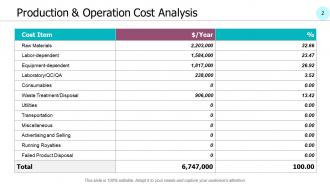
Slide 2: This slide shows the Production & Operation Cost Analysis.
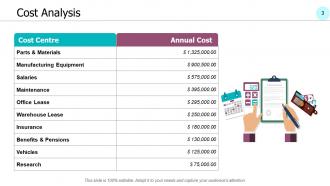
Slide 3: This slide shows Cost Analysis and components of Cost Centre.
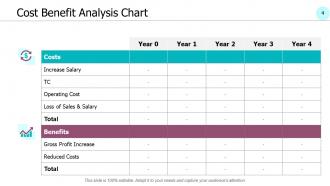
Slide 4: This slide shows the Cost Benefit Analysis Chart.
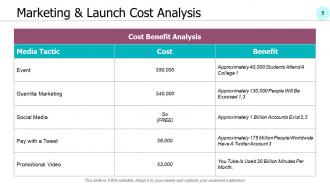
Slide 5: This slide explains the Marketing & Launch Cost Analysis.
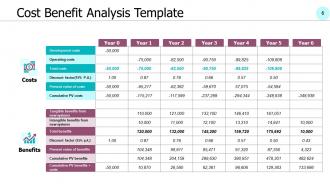
Slide 6: This slide unveils the Cost Benefit Analysis Template.
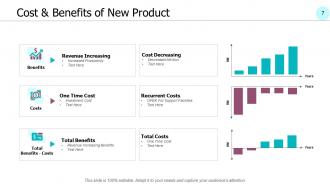
Slide 7: This slide showcases the Cost & Benefits of New Product such as- Revenue Increasing, Cost Decreasing, One Time Cost, Recurrent Costs, Total Benefits, Total Costs.
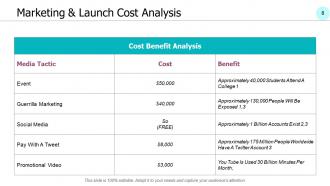
Slide 8: This slide showcases the Marketing & Launch Cost Analysis.
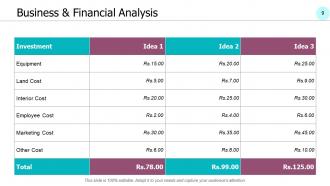
Slide 9: This slide showcases the Business & Financial Analysis.
Slide 10: This template contains the New Product Development Cost Evaluation Icons Slide.
Slide 11: This is a coffee break slide that represents that Presentation will Continue In 15 Minutes.
Slide 12: This slide is titled as Additional Slides for moving forward.
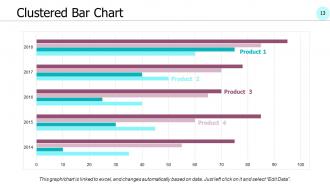
Slide 13: This slide contains an editable Clustered column graph showing the market share of products for a specific period of time.
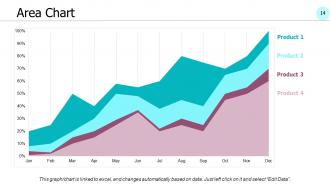
Slide 14: This slide contains an Area Chart showing the market share of products for a specific period of time.
Slide 15: This slide contains editable Venn diagrams linked to Excel.
Slide 16: This slide comprises a Quote by Barack Hussein Obama II.
Slide 17: This slide displays Our Mission.
Slide 18: This slide diaplays a Puzzle design.
Slide 19: This slide reveals the names and designation of Our Team members.
Slide 20: This slide shows Post It notes.
Slide 21: This is a Thank You slide consisting of Address, Contact numbers and email Address.
New product development cost evaluation powerpoint presentation slides with all 21 slides:
Use our New Product Development Cost Evaluation Powerpoint Presentation Slides to effectively help you save your valuable time. They are readymade to fit into any presentation structure.










FAQs for New product development cost evaluation
Key factors influencing new product development costs include research and development expenses, talent acquisition, regulatory compliance requirements, manufacturing setup, and market testing investments. These elements significantly impact budgets across industries, with technology companies, pharmaceuticals, and automotive manufacturers finding that strategic resource allocation and early-stage planning ultimately streamline expenses while accelerating time-to-market outcomes.
Businesses can accurately forecast new product development costs through detailed phase-by-phase budgeting, historical data analysis, cross-functional team input, and contingency planning for unexpected expenses. By leveraging project management software and involving finance, engineering, and marketing teams early, organizations streamline cost estimation processes, minimize budget overruns, and ultimately deliver more predictable financial outcomes throughout development cycles.
Market research significantly influences development cost evaluation by identifying target audience preferences, competitive pricing landscapes, market size potential, and feature prioritization requirements. Through comprehensive market analysis, companies can streamline resource allocation, minimize costly design revisions, and optimize product specifications, with many organizations finding that early research investment reduces overall development expenses while enhancing market success probability.
Project management tools streamline cost evaluation by automating budget tracking, providing real-time expense monitoring, and enabling cross-functional collaboration through centralized dashboards. These platforms enhance accuracy by integrating financial data, resource allocation metrics, and timeline dependencies, with many organizations finding that automated reporting and predictive analytics ultimately deliver faster decision-making and improved cost control.
Essential components include research and development expenses, material and manufacturing costs, labor allocation, marketing and launch expenditures, and regulatory compliance fees. These elements work together to provide accurate financial forecasting, enabling organizations to make informed investment decisions, optimize resource allocation, and establish competitive pricing strategies, with many companies finding that comprehensive analysis significantly reduces unexpected costs and accelerates market entry timelines.
Prototyping impacts new product development costs by reducing expensive late-stage changes, minimizing production errors, and accelerating time-to-market through early validation. While initial prototyping requires upfront investment, manufacturers across industries find that iterative testing ultimately delivers significant cost savings, enhanced product quality, and faster market entry, providing competitive advantage in increasingly dynamic markets.
Key ROI metrics for new product development include net present value, internal rate of return, payback period, customer acquisition cost, and lifetime value ratios. These financial indicators work together by measuring immediate profitability, long-term revenue potential, and market penetration efficiency, with many organizations finding that combining quantitative metrics with customer satisfaction scores ultimately delivers comprehensive investment visibility and strategic decision-making capabilities.
Companies can mitigate financial risks by implementing stage-gate processes, conducting thorough market research, creating detailed financial projections, diversifying product portfolios, and establishing contingency funds. Through phased development approaches, organizations in sectors like consumer electronics and pharmaceuticals can minimize resource exposure, validate concepts early, and pivot quickly when needed, ultimately delivering cost-effective innovation while maintaining competitive advantage.
Cross-functional collaboration in cost evaluation ensures comprehensive analysis by integrating perspectives from engineering, marketing, finance, operations, and supply chain teams throughout development phases. This strategic approach enables organizations to identify hidden costs early, optimize resource allocation, and make informed trade-off decisions, ultimately delivering more accurate budgets and competitive market positioning.
Material and supplier selection significantly impacts development costs through pricing variations, quality requirements, minimum order quantities, and supply chain logistics. Strategic partnerships with reliable suppliers can reduce costs by 15-30% while ensuring consistent quality, with companies in automotive and electronics finding that early supplier collaboration streamlines production processes and minimizes costly design revisions.
Organizations can implement risk assessment frameworks, agile development methodologies, cross-functional collaboration protocols, robust supplier partnerships, and continuous market validation processes to minimize unexpected expenses. These strategies enable companies to identify potential cost overruns early, adapt quickly to changing requirements, and maintain budget control, with many finding that proactive planning and iterative testing ultimately deliver more predictable outcomes and competitive advantage.
Benchmarking against industry standards improves cost evaluation by providing realistic baselines, identifying cost inefficiencies, and revealing best practices from successful competitors. Companies can optimize resource allocation, streamline development processes, and avoid costly overruns by comparing their expenditures with industry averages, ultimately delivering more competitive products while maintaining profitability and strategic advantage.
Technology and innovation significantly transform new product development expenses by enabling faster prototyping, reducing physical testing costs, and streamlining design iterations through digital tools and simulations. While initial technology investments can be substantial, companies across manufacturing, pharmaceuticals, and consumer goods find that automation, AI-driven analytics, and virtual testing ultimately deliver substantial cost reductions and accelerated time-to-market advantages.
Companies balance cost and quality in product development through strategic resource allocation, phased testing approaches, and value engineering methodologies that prioritize essential features while optimizing manufacturing processes. This balanced approach enables organizations to deliver competitive products within budget constraints, with many finding that early investment in quality planning ultimately reduces long-term costs and accelerates market entry.
Common pitfalls include underestimating development time, overlooking regulatory compliance costs, inadequate market research budgeting, ignoring manufacturing scaling expenses, and failing to account for iterative design changes. These oversights often result from rushed timelines and incomplete scope definition, with many organizations finding that systematic cost frameworks and cross-functional collaboration significantly enhance estimation accuracy and project success rates.
-
The content is very helpful from business point of view.